Feeds:
Posts
Comments

(Note: It is best to read ‘Irregular Passions’: The Countess of Pembroke   before this post)

Between bouts of drinking and debauchery at Titchfield, Thomas Nashe, Robert Greene and George Peele (co-ordinated by William Shakespeare) managed to produce The true Tragedy of Richard Duke of York and the death of good King Henry VI with the Whole Contention between the Two Houses, Lancaster and York .

 This was to end up as Henry VI Parts Two and Three. (Part One was written later.)

The plays are a warning of what would happen to England again if Queen Elizabeth did not nominate a successor: bloody Civil War.

They were commissioned by the Countess of Pembroke and the Countess of Southampton, both anxious to safeguard their dynastic line. (By 1590 it was thought that Queen Elizabeth, who had always suffered from ‘secret’ ill-health, would soon be dead).

In the play Queen Margaret (with her ‘tiger’s heart wrapped in a woman’s hide’  who has ‘stolen the breech from Lancaster’) orders her husband, King Henry VI, to leave the field of battle because she can conduct the war more successfully without him.

This was  a history lesson. The Countess of Pembroke saw herself as a schoolmistress and Wilton House a ‘school’…
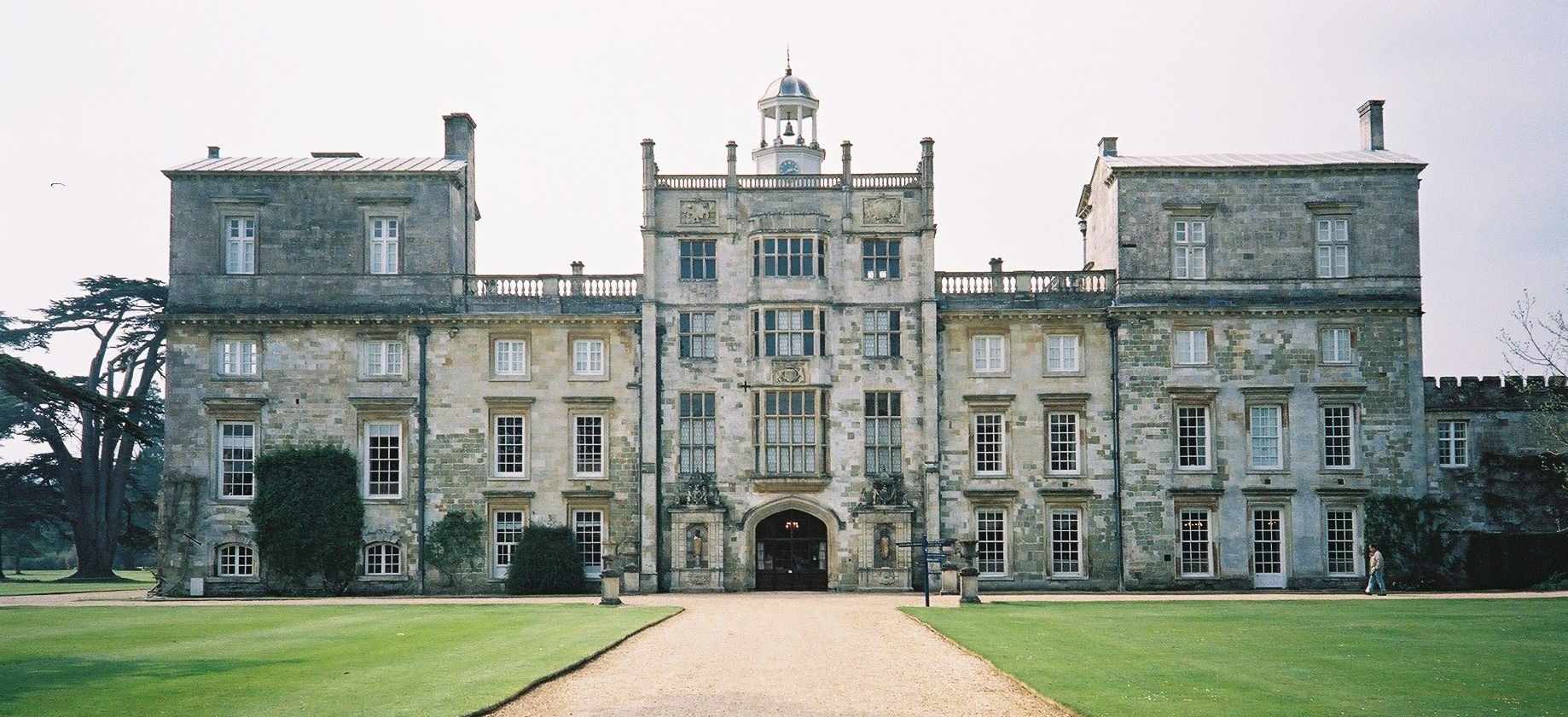
Wilton House

It is also is a coded attack on Queen Elizabeth. She had tried to seize command of the Armada campaign from her generals, but skimping on gunpowder and ammunition, had nearly ruined it. In the play Richard, the Duke of York says:

A woman’s general, what should you fear?

Queen Margaret, in the play, dips her handkerchief in the blood of the son of Richard the Duke of York, presents it to the Duke, then places a paper crown on his head. York exclaims:

How ill-beseeming is it in thy sex

To triumph like an Amazonian trull

Upon his woes whom fortune captivates.’   

Margaret’s sadism is a coded critique of Queen Elizabeth’s sadism.

Elizabeth was rumoured to enjoy an erotic relationship with her chief inquisitor, Richard Topcliffe, who, between kissing her breasts and fondling her stomach, claimed to have given her detailed descriptions of how he tortured his victims.

In return Elizabeth gave him a pair of silk drawers.

The Duke of York also attacks Queen Margaret’s legitimacy by saying:

I would assay, proud Queen to make thee blush;

To tell thee of whence thou art, from whom derived,

’Twere shame enough to shame thee…’

This is also an attack upon Elizabeth. Many of her subjects, especially the Roman Catholics, thought Elizabeth was a bastard because her father, Henry VIII was never properly divorced from Catherine of Aragon….

Catherine of Aragon

The Jesuits, however made it worse. They put it about that Anne Boleyn was King Henry VIII’s illegitimate daughter!

This incestuous union had initiated the rule of Satan in England. All of Henry’s children would die young, or, if they survived, have no children themselves.

Shakespeare was to touch on this idea again in Pericles in which a king’s incestuous relationship with his daughter brings ruin on his country.

●

Dame Eleanor, who in The True Tragedy of Richard Duke of York tries to upstage Queen Margaret, is a satire on Lettice Knollys, the Queen’s pushy, red-headed ‘cousin’, mother of the second Earl of Essex and second wife to Robert Dudley, the Earl of Leicester.

In the play, Queen Margaret drops her fan, Dame Eleanor goes to pick it up and the Queen strikes her – an exact re-enactment of what Elizabeth had done to Lettice.

When Queen Elizabeth found out that Lettice had married her lover, the Earl of Leicester, she banished her, in perpetuity, from the court. Lettice took her revenge by parading round London with her entire entourage, posing as the Queen. She even plotted to set up a rival court with her husband, Leicester, across the Channel in the Lowlands.

The ruthless Warwick in the play, ‘The rampant bear chained to the ragged staff’ (who even refers to himself as ‘the bear’) is Leicester himself, then safely dead. ‘The Bear and Ragged Staff’, as every member of the audience would have known, had been part of his coat of arms.

To this day The Bear and Staff  is the name of a pub in Leicester Square in London.

●

Greene soon tired of playing second fiddle to Shakespeare the ‘grammarian’ (grammar school boy) and left Titchfield for London. After a ‘banquet’ of Rhenish wine and pickled herrings with Nashe and Beeston, Greene fell sick and died, a few months later, in utter penury.

 This gave Nashe the opportunity of attacking Shakespeare under Greene’s name. He called Shakespeare an ‘upstart crow beautified with our feathers’ i.e. a plagiarist. Mis-quoting from The True Tragedy of Richard Duke of York he also described Shakespeare as having ‘a tiger’s heart, wrapped in a player’s hide’.

For this attack to hit home – which it did – the original line (‘O tiger’s heart wrapped in a woman’s hide’) cannot have been written by Shakespeare.

From then on, Nashe continued to hint at his own hand in Shakespeare’s plays by dropping phrases from them into his own work.

The Shakespeare Code will catalogue many of these phrases.

Peele left Titchfield as well, though poverty forced him to return two years later to work on Titus Andronicus – a plot idea that Shakespeare was to bring back from Rome in 1593. (See: Shakespeare in Italy)

Nashe, however, stayed in Titchfield and was to collaborate with Shakespeare (as he had done with Christopher Marlowe and was to do with Ben Jonson) off and on till his death in 1601.

Nashe wanted to replace Shakespeare in the affection (and pay) of the Southampton family. He took every opportunity to attack Shakespeare (in code, of course) for his class, creepiness, treachery and wild, ruthless ambition.

●

The Shakespeare Code believes The True Tragedy and other early Shakespeare plays were first performed in the halls and grounds of Titchfield andWilton because:

1. With their courts, processions and armies, they would benefit from huge casts. Servants and workers on the estates could be co-opted as extras. (Indeed, in real life, they had been drafted as real soldiers for the Armada campaign).

2. They all have wonderful parts for women. Aristocratic women were directly on hand, bored with country life and eager to perform.

3. Battle scenes need to be enacted. Both estates had stables full of horses and armouries full of weapons.  Place House at Titchfield was also fortified, so wall-scaling, and the exploding of maroons, was perfectly in order. (As Kevin Fraser demonstrated brilliantly when The Titchfield Festival Theatre performed at the Abbey).

But, most important:

4. Both estates teemed with frustrated young, male aristocrats, eager to win their spurs in battle. Queen Elizabeth, hating warfare, had forbidden them to fight in Europe: so they fought, in play, in Hampshire and Wiltshire instead. They had acted, as undergraduates, at their colleges at Oxford and Cambridge: now they acted at home.

The performances of plays about ‘good King Henry VI’ would have been particularly poignant at Titchfield. The King had married Margaret at Titchfield Abbey and spent his honeymoon there.  He had endowed the town with a Corpus Christi Fair and a grammar school, where, The Shakespeare Code believes, Shakespeare worked as ‘a schoolmaster in the country’. (See:The Strange Case of Mr. Apis Lapis. )

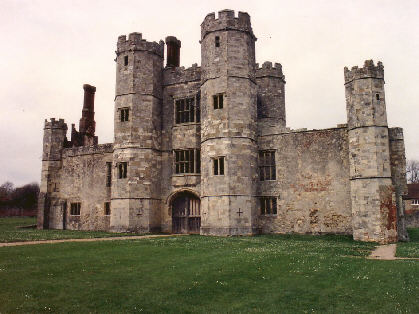
Titchfield Abbey

After the initial performances of the plays, the professional players involved would adapt the plays to try to make them ‘commercial’ (many touring companies ‘broke’ i.e. went bust) put talented boys in the women’s parts and hit the road as ‘The Earl of Pembroke’s Men’…



Just scanning the site, and the material about Shakespeare and Italy, it may be relevant to the line you want to run that Shakespeare must have read Italian to a fairly high level. We can say this with some certainty because the prime source for ‘Othello’, Cinthio, had not been translated into English when Shakespeare wrote the play.

The Shakespeare Code would like to thank Prof. Womersley, who is also a Fellow of the British Academy, for his interest.

Used copies of Love’s Labour’s Found – the book on which The Shakespeare Code is partly based – are being offered on the Internet at exorbitant prices ($70 dollars, in one case, PLUS p. and p.).

Love’s Labour’s Found is out of print, but please note:

1. The book is available at all copyright libraries.

2. All the relevant ideas in the book will appear, in time, in The Shakespeare Code.

3. Actual extracts from the book will also be posted.

4. Many of the ideas in The Shakespeare Code have evolved since the book was published in 2002.

So, please keep reading The Shakespeare Code – AND SAVE YOUR MONEY!

1,000 views!

Today The Shakespesare Code is happy to announce it has recorded ONE THOUSAND VIEWS!

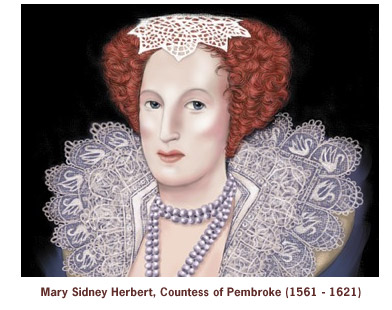
Mary Sidney, the Countess of Pembroke lived at Wilton in Wiltshire, thirty miles away from the Countess of Southampton at Titchfield.

Like all beautiful talented women, she had been banned from Queen Elizabeth’s court. So she set up her own rival version, in friendly competition with the Countess of Southampton.

With musicians, poets and actors (often shared with Titchfield) on the payroll, she staged tournaments and entertainments to honour the memory of her dead soldier-brother, Sir Philip Sidney.

And to annoy the Queen.

Elizabeth had opposed Sidney’s imperialistic, expansionist foreign policy and despised his cult of chivalry. In an act of bravado, he had thrown off his leg armour at the Battle of Zutphen (1586) because the much older Marshall of the Camp was only lightly armed. Sidney was immediately shot in the thigh.

According to John Aubrey, he later died on the campaign while making love to his wife.

Elizabeth had kept Sidney under virtual house arrest at Wilton where he ‘followed the arts’ because he had nothing else to do. He was in love with the sister of the Earl of Essex, the beautiful Penelope Rich, a married woman who was, in private performance, to play many of Shakespeare’s heroines. By her life, and her all-consuming love for Lord Mountjoy, she was also to inspire Shakespeare to create the part of Cleopatra in his great, ‘romantic tragedy’ Antony and Cleopatra. 

Sidney wrote the sonnet sequence Astrophil and Stella about her: Stella is the ‘star’ and he is Astrophil the  ‘lover of the star’.  Sidney plays plays on her married name ‘rich’: in Canto 37 he writes:

‘Though most rich in these and every part

Hast no misfortune but that Rich she is.’

Shakespeare does the same thing in Love’s Labour’s Lost when he has the Princess, originally played by Penelope,  say in the last scene of the play:

Sweet hearts, we shall be rich ere we depart… 

Shakespeare plays on the word ‘rich’ five times more before the play ends.

With the help of his sister, Sidney wrote his Arcadia, in which a handsome young knight dresses up as a woman to gain access to a guarded princess. The knight’s male friend falls madly in love with him, followed by the Princess’s own father!

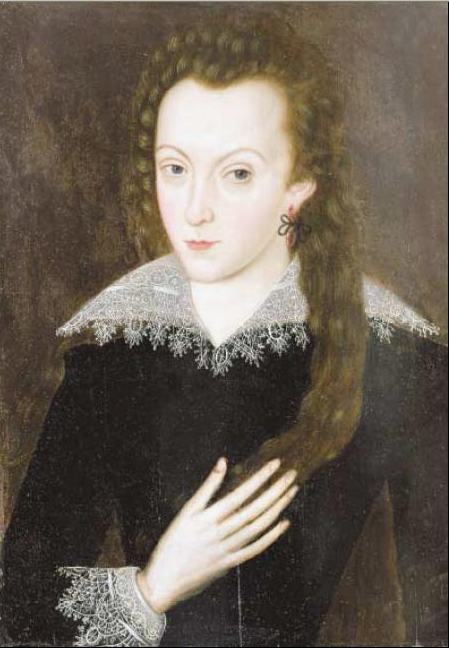
Scenes from the poem were acted out by Sidney and the Countess at Wilton and the young, impressionable, Henry Wriothseley, third Earl of Southampton, was clearly present. He cultivated his long hair so that he could look as beautiful as Sir Philip in drag. Shakespeare at one point even addresses the third Earl as ‘the master-mistress’ of his ‘passion’. 

The Third Earl of Southampton in drag?


The Countess of Pembroke had challenged Elizabeth by emerging from mourning for her brother at the Armada celebrations with a power parade of forty gentlemen on horseback, two coaches full of women, a litter for her children,  four ladies on horseback and a retinue of fifty liveried servants.

A couple of years later the Countess, who numbered The Ape (Robert Cecil) and The Fox (Walter Raleigh) and even, according to  Aubrey, her brother Philip, amongst her lovers, went into full, hypocritical attack.

She translated Robert Garnier’s play Antonius which showed how Cleopatra’s (i.e. Elizabeth’s)  ‘irregular passions in forsaking Empire to follow sensuality’  had brought ruin and civil war to the State.

This was a case of the pot calling the kettle: according to Aubrey the Countess watched, through a ‘vidette’ in the wall of her house, stallions mounting mares in the mating season.  The episode in Venus and Adonis when a ‘breeding jennet, lusty, young and proud’  is mounted by Adonis’s steed with his ‘melting buttock’ was written to catch her eye.

She commissioned Fulke Greville, her brother’s old friend and lover, to follow up her attack on Elizabeth with an Antony and Cleopatra. Greville  tore up his manuscript, terrified it would be ‘construed or strained to a personating of vices in the present governors and government.’ 

When, in 1590, Elizabeth withdrew Holinshed’s history Chronicles, on the grounds that they were ‘fondly set out’ (she wanted no-one to judge her reign by comparing it to others) the Countess of Pembroke commissioned Samuel Daniel (a poet in her employ) to write a verse version of ‘The Civil Wars’,  now known as ‘The Wars of the Roses’.  She turned to her neighbour, ‘the man Shakespeare’ as she was later to call him, to provide a theatrical version of the same events.

She wanted to warn people of the chaos that would ensue if Elizabeth did not name a successor. She formed a company of actors to disseminate these ideas, employing her estranged husband’s name and money. (The Earl of Pembroke’s Men)

This was a huge undertaking. Grammar-schoolboy Shakespeare needed help.  He paid University Men, Robert Greene, Thomas Nashe and George Peele, all desperate for the cash, to come down to Titchfield to help him. And to lodge with Mr. Apis Lapis, and his three maids, at Posbrook Farm. (See The Strange Case of Mr. Apis Lapis. )

The Countess of Pembroke would have approved of Mr. Apis Lapis. Both were addicted, amongst other things, to alchemy.

(It’s best now to read Queen Elizabeth, incest and sadism. )

Before 1593 Shakespeare had not set a single play in Italy. By the time of the First Folio (1623) ten plays – over a quarter of the canon – had been set in Italy or have scenes in Italy. There are around 800 references to Italy and 400 to Rome alone.

Shakespeare’s work deepened dramatically after 1593.  He was no linguist, but we know from the Sonnets he was fascinated by painting. ‘Mine eye hath played the painter’, he writes in Sonnet 24, ‘and hath steeled thy beauty’s form in table of my heart.’

He became aware of psychological complexity from the Old Masters in Europe – and brought it to England to transform the Drama.

Two years ago Prof. Roger Prior, using entirely different criteria, concluded that Shakespeare had visited Italy.

His date?  1593!

(It’s best to read The Introduction and Parts 1. 2. 3. 4.and 5. first) 


It was Ben Jonson who first attacked Shakespeare’s knowledge of geography. In The Winter’s Tale he gives Bohemia a coast-line.

It was fashionable, at one time, to say that Shakespeare knew nothing of Italian geography either: he has Prospero, in The Tempest, sailing from Milan to the Adriatic Sea and Valentine, in Two Gentleman of Verona, sailing to Milan from Verona.

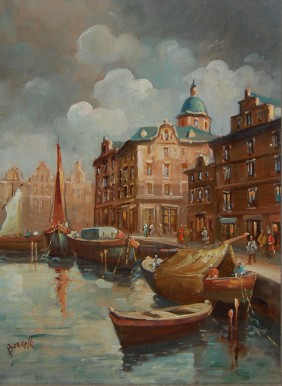
But, as Professor Ernesto Grillo (an Italian lecturing in Literature at Glasgow University) pointed out as early as 1949 in his Shakespeare and Italy, people travelled round Italy by an extensive network of canals.

Here’s a painting of one…..

Shakespeare’s other famous ‘mistake’ was to claim that Tranio’s father (in The Taming of the Shrew) was a ‘sail maker’ from land-locked Bergamo. People had forgotten about the Italian lakes. There is a boat building industry in Bergamo to this day!

Here is one of its latest products….

So Shakespeare’s mistakes were never mistakes at all.

In fact, the third Earl of Southampton was so taken with Italian canals that in 1611 he dug a canal on his own land at Titchfield, only the second canal in England…

Titchfield Canal Lock

It clearly never flourished, so Titchfield today is almost as it was in Shakespeare’s time.

This is South Street….

South Street, Titchfield, Hampshire.
And this is Titchfield in the snow……..
 
(It’s best to read Part 7. now.)

Before she kills herself, Lucrece, in Shakespeare’s poem of the same name, studies a ‘piece/Of skilful painting’ of the Sack of Troy. Julio Romano, whom Shakespeare eulogises in The Winter’s Tale (for seeming to have sculpted such a life-like stature of the King’s wife, Hermione) painted such a mural in the Sala di Troia in Mantua.

The language Shakespeare uses to praise Romano’s work as a sculptor – ‘had he himself eternity and cut breath into his work’ –  is identical to the epitaph for Romano in San Maurizio’s Church in Mantua.

(The Shakespeare Code hopes to report from the site)

It’s best now to read: Shakespeare’s Italian ‘Mistakes’.

(It’s best to read The Introduction and Parts 1. 2. and 3. first.)

Shakespeare dedicated the narrative poems Venus and Adonis and Lucrece to Henry Wriothesley, third Earl of Southampton. The first was published in September, 1593 and the second in 1594.

In Willobie his Avisa  (as we have seen) ‘H.W.’ is described as Italo-Hispalensis – and ‘H.W.’ himself recalls seeing beautiful women ‘in France and Flanders and in Spain’.

Harry Southampton’s maternal grandfather, Lord Montague, (one of the leading Catholics in England) had been King Philip II of Spain’s Master of Horse when, married to Bloody Mary Tudor, Philip had been King of England. The Montague family were thus on intimate terms with the Spanish monarch.

The Shakespeare Code will argue that Southampton, who had been ‘groomed’ by the Vatican since boyhood, went to Madrid to pay secret respects to fellow Catholic and family friend, King Philip of Spain.

EXHIBIT (7). Venus and Adonis.

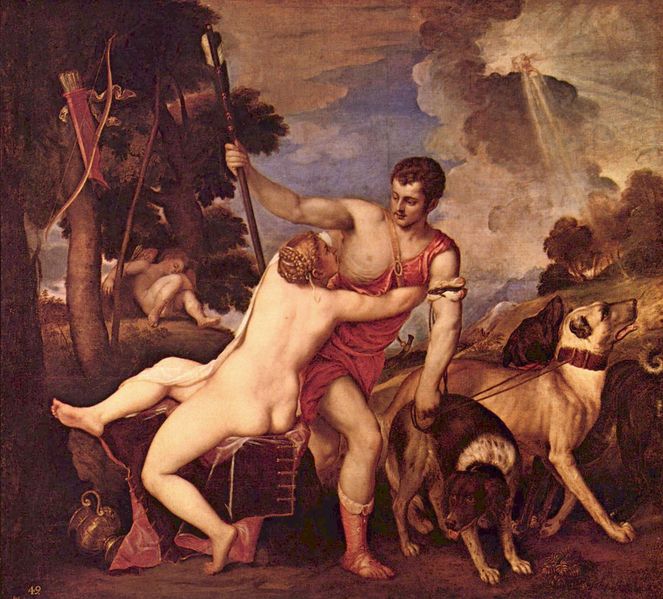
In 1554, when he was King of England, Philip commissioned Titian to paint Venus and Adonis, a work which was badly damaged on the sea voyage to London.

By 1593, the painting was in Madrid, along with another of Philip’s commissions from Titian, The Rape of Lucrece.

The Shakespeare Code will suggest that Shakespeare, accompanying his patron, Southampton, saw the two paintings at Philip’s Court. They inspired Shakespeare to write the two poems.

Richard Field, the publisher, entered Venus and Adonis at the Stationers’ Register on 18 April, 1593. This was often a device to ‘copyright’ an idea and stop any other writer from using it. The actual text of the poem was presented to the Stationers by John Harrison on 25th June, 1594 (though letters from William Renoldes prove that the printed book was in circulation by September, 1593).

But if Shakespeare was in Madrid around March/April of 1593, how could he have his idea entered in the Register?

It was exactly at this time that the flamboyant homosexual Spaniard Antonio Pérez, former secretary to King Philip of Spain and now spy for the Earl of Essex, arrived in England from the Continent.  He lodged at Essex House, where he was encouraged to celebrate the Latin Mass, and was on intimate terms with the Essex and Southampton entourages. Shakespeare lampooned him as the fantastical Spaniard Don Armado in his later (1599) version of Love’s Labour’s Lost. (Both Perez and Armado were nick-named ‘The Oracle’)

As part of Essex’s growing spy ring, Perez would have met with Southampton, Shakespeare and Nashe on the continent. The Shakespeare Code argues that Shakespeare gave Perez the blocking order on Venus and Adonis to give to Richard Field when he arrived in London. Southampton, as patron, had clearly given the go-ahead to the project. So there was money to be made for writer and publisher.

●

 Titian’s painting of the Venus and Adonis story (which is still in Madrid) shows Venus throwing her arms round a hesitant Adonis as the sun comes up…

 This is exactly the way Shakespeare’s poem opens:

‘Even as the sun with purple-coloured face

Had ta’en his last leave of the weeping morn,

Rose-cheek’d Adonis hied him to the chase;

Hunting he lov’d, but love he laughed to scorn.

Sick-thoughted Venus makes amain unto him,

And like a bold-fac’d suitor gins to woo him’.

Venus has her back to us (as though we ourselves, the audience, are implicated in her feelings for Adonis) and the poem is largely from Venus’s standpoint. A contemporary, William Renoldes, took Venus to be a portrait of Queen Elizabeth and certainly, as she rugby-tackles Adonis to he ground, Elizabeth’s shameless pursuit of Essex would have come to mind.

 But Shakespeare’s great gift is empathy: Elizabeth’s passion for Essex becomes mixed with Shakespeare’s for Southampton.

●

Shakespeare drops coded hints that his poem has been inspired by a painting. Venus insults the passionless Adonis as a ‘lifeless picture’ and as ‘painted grapes’. Shakespeare also writes:

‘Look when a painter would surpass the life

In limning out a well-proportioned steed,

His art with nature’s workmanship at strife,

As if the dead the living should exceed.’

EXHIBIT (8): Lucrece.

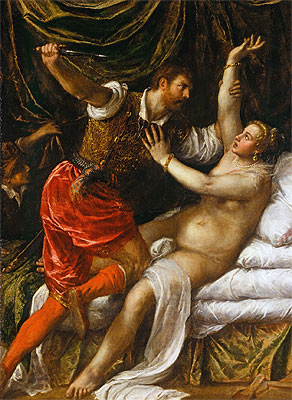
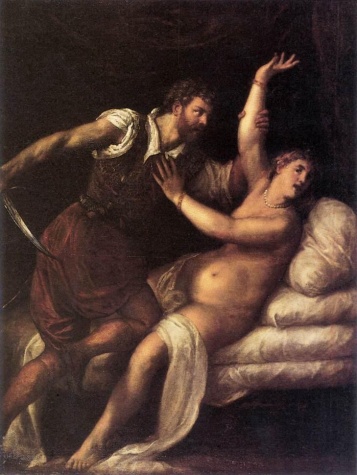
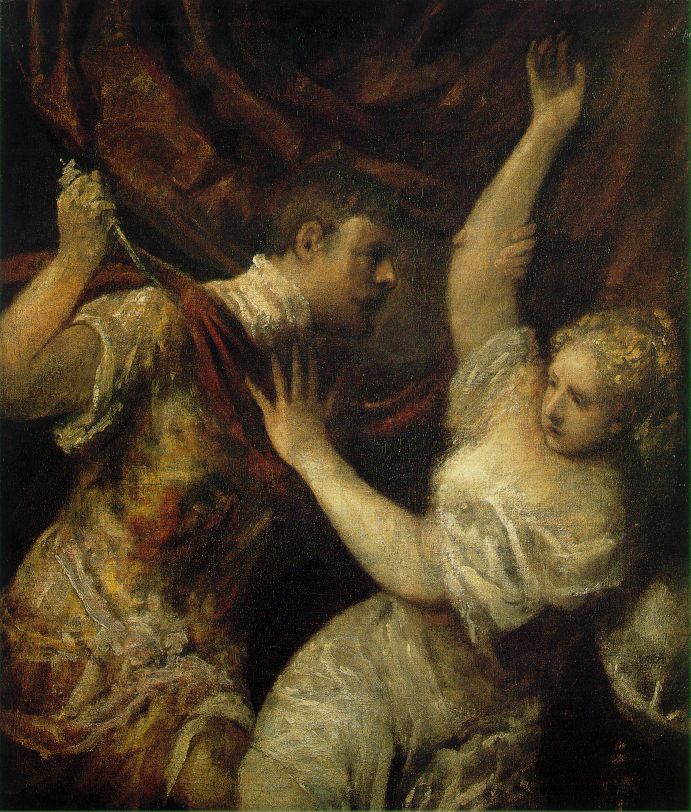
Shakespeare’s poem Lucrece has been criticised for being ‘static’; but this is Shakespeare’s intention. He wants to evoke, in words, Titian’s painting Tarquin and Lucretia, which depicts the famous rape.

Titian painted three versions around 1570; but the one now housed in the Fitzwilliam Museum in Cambridge (provenance unknown) corresponds to the poem exactly.

Shakespeare writes:

‘Without the bed her [Lucrece’s] other fair hand was

On the green coverlet whose perfect white

Show’d like an April daisy on the grass….’

In the Fitzwilliam version, Lucretia has an identical green coverlet on the bed.

Shakespeare also refers to Tarquin’s  scarlet lust.

In the Fitzwilliam version, Tarquin is wearing scarlet hose.

Tarquin in the poem, as in the Fitzwilliam painting, holds his knife ‘like a falcon tow’ring in the skies’ over Lucretia and, as also in the Fitzwilliam version, ‘her pity-pleading eyes are sadly fixed/In the remorseless wrinkles of his face.’

There are two other versionsof Tarquin and Lucretia by Titian.

One is in Bordeaux and shows Tarquin threatening Lucretia with his knife pointing upwards while Lucretia looks away….

The other is in Vienna, and though it shows Tarquin threatening Lucretia with a raised knife, Lucretia is looking at the knife rather than his face…

The Shakespeare Code argues that the Fitzwilliam ‘Tarquin and Lucretia’ is the one which originally hung at King Philip’s Court at Madrid – and which Shakespeare saw and described in verse.

Thomas Nashe also saw the Titian painting. When he describes a rape in The Unfortunate Traveller he says:

Therewith he flew upon her and threatened her with his sword…..and used his knee as an iron ram to beat ope the two lead gates of her chastity…

Just as Tarquin does to Lucrece.

(It’s best to read Part 5. next.)

(It’s best to read The Introduction and Parts 1. and 2. first.)

EXHIBIT (6): Titus Andronicus.

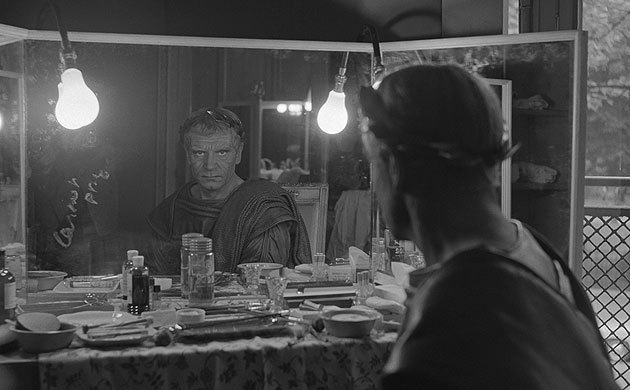
Sir Laurence Olivier as Titus Andronicus

 The main source for Shakespeare’s play Titus Andronicus was a chapbook published only in Rome and only in Italian.

It was not till the eighteenth century (between 1736 and 1764) that The History of Titus Andronicus, the Renowned Roman General was ‘Newly translated’ (into English) ‘from the Italian Copy printed at Rome.’

So how did Shakespeare know the story?

The most likely explanation is that he picked up a copy of the book in Rome while he was there with Southampton and Nashe. (Shakespeare was studying Italian from Florio’s phrasebooks, and Southampton, groomed by the Vatican, spoke Italian like a native)

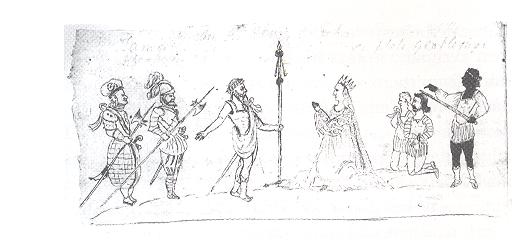
First production of 'Titus Andronicus'. At least one observer thought the costumes were better than the play...

Shakespeare turned the book  into a play which is first mentioned (as new) by the theatre manager Philip Henslowe at the end of January, 1594. The year after Shakespeare’s visit to Europe.

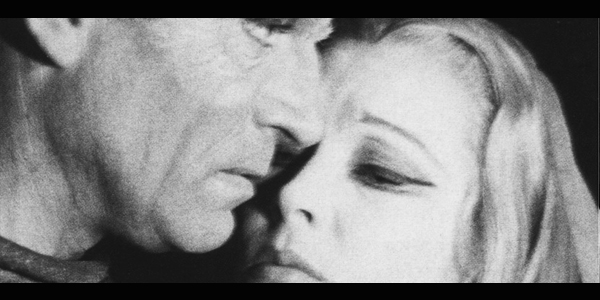
Laurence Olivier as Titus and Vivien Leigh as Lavinia.
(It’s best to read Part 4.  next.)