Feeds:
Posts
Comments

(It’s best to read The Introduction and Parts 1. 2. and 3. first.)

Shakespeare dedicated the narrative poems Venus and Adonis and Lucrece to Henry Wriothesley, third Earl of Southampton. The first was published in September, 1593 and the second in 1594.

In Willobie his Avisa  (as we have seen) ‘H.W.’ is described as Italo-Hispalensis and ‘H.W.’ himself recalls seeing beautiful women ‘in France and Flanders and in Spain’.

Harry Southampton’s maternal grandfather, Lord Montague, (one of the leading Catholics in England) had been King Philip II of Spain’s Master of Horse when, married to Bloody Mary Tudor, Philip had been King of England. The Montague family were thus on intimate terms with the Spanish monarch.

The Shakespeare Code will argue that Southampton, who had been ‘groomed’ by the Vatican since boyhood, went to Madrid to pay secret respects to fellow Catholic and family friend, King Philip of Spain.

EXHIBIT (7). Venus and Adonis.

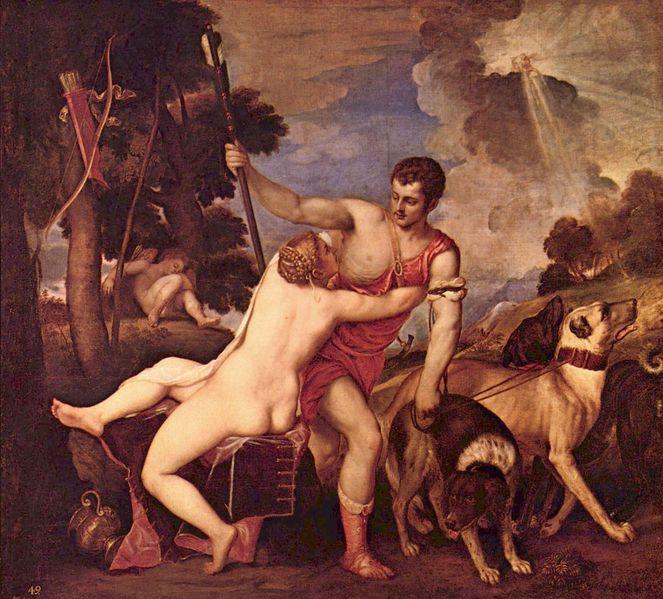
In 1554, when he was King of England, Philip commissioned Titian to paint Venus and Adonis, a work which was badly damaged on the sea voyage to London.

By 1593, the painting was in Madrid, along with another of Philip’s commissions from Titian, The Rape of Lucrece.

The Shakespeare Code will suggest that Shakespeare, accompanying his patron, Southampton, saw the two paintings at Philip’s Court. They inspired Shakespeare to write the two poems.

Richard Field, the publisher, entered Venus and Adonis at the Stationers’ Register on 18 April, 1593. This was often a device to ‘copyright’ an idea and stop any other writer from using it. The actual text of the poem was presented to the Stationers by John Harrison on 25th June, 1594 (though letters from William Renoldes prove that the printed book was in circulation by September, 1593).

But if Shakespeare was in Madrid around March/April of 1593, how could he have his idea entered in the Register?

It was exactly at this time that the flamboyant homosexual Spaniard Antonio Pérez, former secretary to King Philip of Spain and now spy for the Earl of Essex, arrived in England from the Continent.  He lodged at Essex House, where he was encouraged to celebrate the Latin Mass, and was on intimate terms with the Essex and Southampton entourages. Shakespeare lampooned him as the fantastical Spaniard Don Armado in his later (1599) version of Love’s Labour’s Lost. (Both Perez and Armado were nick-named ‘The Oracle’)

As part of Essex’s growing spy ring, Perez would have met with Southampton, Shakespeare and Nashe on the continent. The Shakespeare Code argues that Shakespeare gave Perez the blocking order on Venus and Adonis to give to Richard Field when he arrived in London. Southampton, as patron, had clearly given the go-ahead to the project. So there was money to be made for writer and publisher.

 Titian’s painting of the Venus and Adonis story (which is still in Madrid) shows Venus throwing her arms round a hesitant Adonis as the sun comes up…

 This is exactly the way Shakespeare’s poem opens:

‘Even as the sun with purple-coloured face

Had ta’en his last leave of the weeping morn,

Rose-cheek’d Adonis hied him to the chase;

Hunting he lov’d, but love he laughed to scorn.

Sick-thoughted Venus makes amain unto him,

And like a bold-fac’d suitor gins to woo him’.

Venus has her back to us (as though we ourselves, the audience, are implicated in her feelings for Adonis) and the poem is largely from Venus’s standpoint. A contemporary, William Renoldes, took Venus to be a portrait of Queen Elizabeth and certainly, as she rugby-tackles Adonis to he ground, Elizabeth’s shameless pursuit of Essex would have come to mind.

 But Shakespeare’s great gift is empathy: Elizabeth’s passion for Essex becomes mixed with Shakespeare’s for Southampton.

Shakespeare drops coded hints that his poem has been inspired by a painting. Venus insults the passionless Adonis as a ‘lifeless picture’ and as ‘painted grapes’. Shakespeare also writes:

‘Look when a painter would surpass the life

In limning out a well-proportioned steed,

His art with nature’s workmanship at strife,

As if the dead the living should exceed.’

EXHIBIT (8): Lucrece.

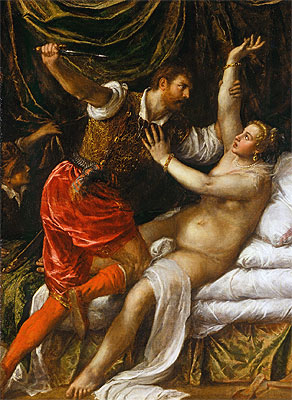
Shakespeare’s poem Lucrece has been criticised for being ‘static’; but this is Shakespeare’s intention. He wants to evoke, in words, Titian’s painting Tarquin and Lucretia, which depicts the famous rape.

Titian painted three versions around 1570; but the one now housed in the Fitzwilliam Museum in Cambridge (provenance unknown) corresponds to the poem exactly.

Shakespeare writes:

‘Without the bed her [Lucrece’s] other fair hand was

On the green coverlet whose perfect white

Show’d like an April daisy on the grass….

In the Fitzwilliam version, Lucretia has an identical green coverlet on the bed.

Shakespeare also refers to Tarquin’s  scarlet lust.

In the Fitzwilliam version, Tarquin is wearing scarlet hose.

Tarquin in the poem, as in the Fitzwilliam painting, holds his knife ‘like a falcon tow’ring in the skies’ over Lucretia and, as also in the Fitzwilliam version, ‘her pity-pleading eyes are sadly fixed/In the remorseless wrinkles of his face.’

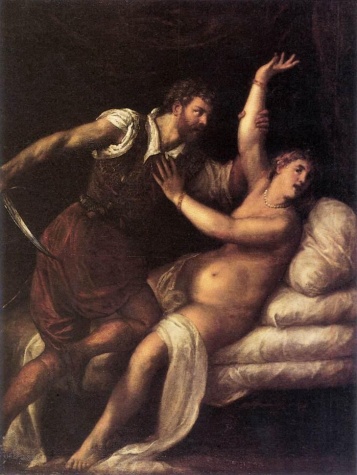
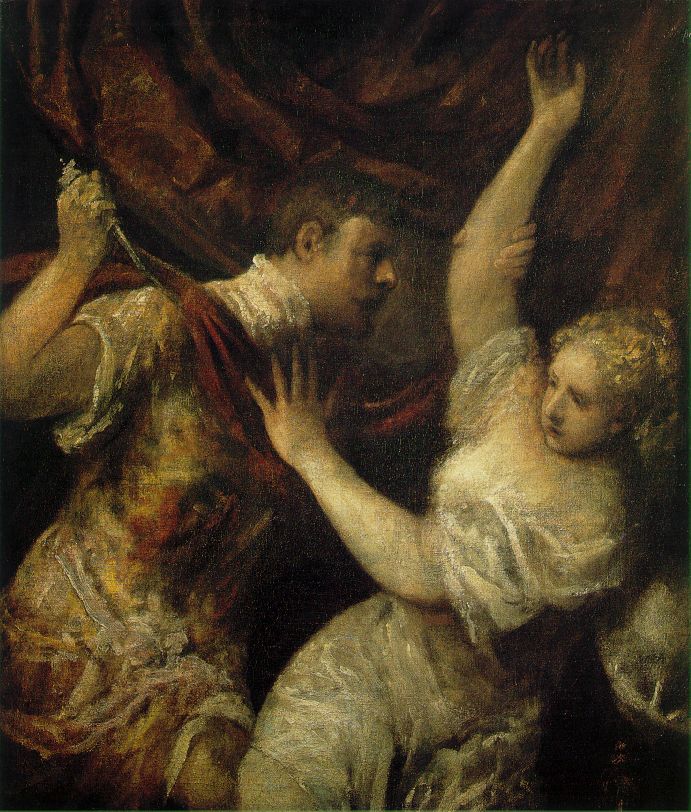
There are two other versionsof Tarquin and Lucretia by Titian.

One is in Bordeaux and shows Tarquin threatening Lucretia with his knife pointing upwards while Lucretia looks away….

The other is in Vienna, and though it shows Tarquin threatening Lucretia with a raised knife, Lucretia is looking at the knife rather than his face…

The Shakespeare Code argues that the Fitzwilliam ‘Tarquin and Lucretia’ is the one which originally hung at King Philip’s Court at Madrid – and which Shakespeare saw and described in verse.

Thomas Nashe also saw the Titian painting. When he describes a rape in The Unfortunate Traveller he says:

Therewith he flew upon her and threatened her with his sword…..and used his knee as an iron ram to beat ope the two lead gates of her chastity…

Just as Tarquin does to Lucrece.

(It’s best to read Part 5. next.)

(It’s best to read The Introduction and Parts 1. and 2. first.)

EXHIBIT (6): Titus Andronicus.

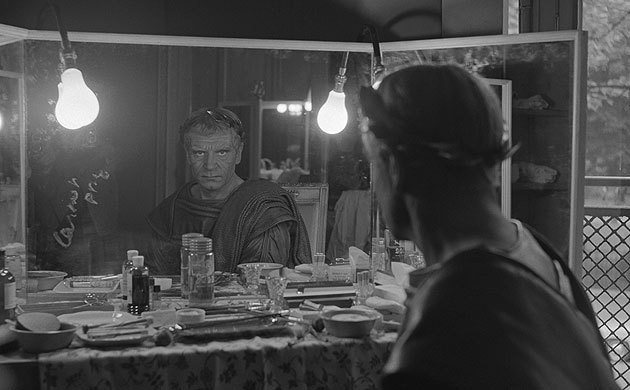
Sir Laurence Olivier as Titus Andronicus

 The main source for Shakespeare’s play Titus Andronicus was a chapbook published only in Rome and only in Italian.

It was not till the eighteenth century (between 1736 and 1764) that The History of Titus Andronicus, the Renowned Roman General was ‘Newly translated’ (into English) ‘from the Italian Copy printed at Rome.’

So how did Shakespeare know the story?

The most likely explanation is that he picked up a copy of the book in Rome while he was there with Southampton and Nashe. (Shakespeare was studying Italian from Florio’s phrasebooks, and Southampton, groomed by the Vatican, spoke Italian like a native)

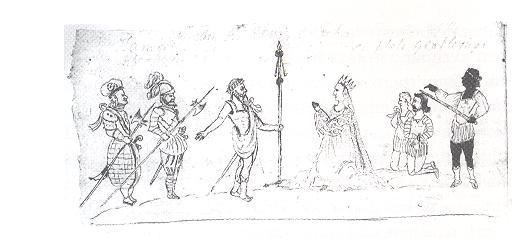
First production of 'Titus Andronicus'. At least one observer thought the costumes were better than the play...

Shakespeare turned the book  into a play which is first mentioned (as new) by the theatre manager Philip Henslowe at the end of January, 1594. The year after Shakespeare’s visit to Europe.

Laurence Olivier as Titus and Vivien Leigh as Lavinia.
(It’s best to read Part 4.  next.)
 

(It’s best to read The Introduction and Part 1. first.)

EXHIBIT (3)

Harry Southampton’s Letter.
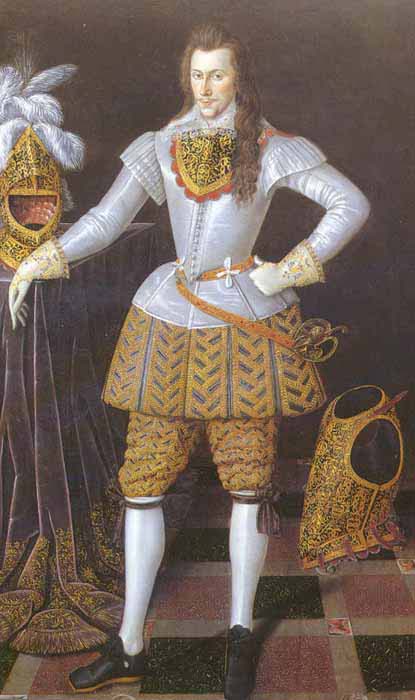
The Earl of Southampton preparing to joust.

A letter exists written by Henry Wriothesley, third Earl of Southampton, to Robert Devereux, second Earl of Essex from Dieppe.

It is dated 2March.

The full text reads:

Though I have nothing to write about worth your reading, yet can I not let pass this messenger without a letter, be it only to continue the profession of service which I have heretofore verbally made unto your Lordship, which howsoever in itself it is of small value, my hope is, seeing it wholly proceed from a true respect born to your own worth, and from one who hath no better present to make you than the offer of himself to be disposed of by your commandment, your Lordship will be pleased in good part to accept it, and ever afford me your good opinion and favour, of which I shall be exceedingly proud, endeavouring with myself always with the best means to deserve it. As I shall have opportunity to send into England I will be bold to trouble your Lordship with my letter, in the mean time wishing your fortune may even prove answerable to the greatness of your own mind, I take my leave &c…

Southampton did not record the year.

Historians have given two possible dates, 1591 and 1598.

The first date (1591) has now been dismissed because the eighteen year old aristocratic Southampton would never have been allowed by the Privy Council to travel to France at a time of war.

However, the second date (1598) is equally unlikely. Southampton writes about his ‘profession of service’ to Essex having been ‘verbally made unto your Lordship’ and consequently ‘of small value’.

By 1598 Southampton had fought gallantly for Essex on the Islands Campaign and so his loyalty had been already proved by action rather than words.

The Earl of Essex was keen to form a spy network round the world so he could be first with the news, and so first with the power, at Elizabeth’s Court where he had many enemies.

When Harry Southampton writes –

As I shall have opportunity to send into England I will be bold to trouble your lordship with my letter.

– this is a coded way of saying that he will send back regular spy reports to Essex.

On 25February, 1593, Essex was made a member of the Privy Council with the power to grant passports.

So the date of 2March, 1593, fits the contents of the Third Earl of Southampton’s Letter perfectly.

EXHIBIT (4) Thomas Nashe’s The Unfortunate Traveller.

On 27th June, 1593, on his return to England, Nashe entered The Unfortunate Traveller on the Stationer’s Register.

The prototype of the picaresque novel, it chronicles Jack Wilton’s adventures in Europe with his master the Earl of Surrey – code for Nashe and Southampton.

Nashe dedicates the book to Henry Wriothesley, third Earl of Southampton (a dedication he was later forced to withdraw) as ‘a lover and cherisher’ ‘as well of the lovers of poets [Amelia Bassano/Lanier] as of poets themselves’ [Shakespeare].

The Earl changes places with Jack ‘to take more liberty of behaviour’ in Italy, the land of ‘whoring’ and ‘sodomitry’. This is exactly the same plot device Shakespeare was to use in his re-write of The Taming of a Shrew: Lucentio, studying at the University of Padua, changes place with his adoring servant Tranio.

Given Harry Southampton’s taste for lower class men, this is what really happened. Southampton pretended to be his own servant so he could have more fun.

Many of Nashe’s details suggest direct observation. Jack/Nashe describes how his long hair, lightcoloured clothes and dagger with unblunted tip were all forbidden in Rome.

He writes:

The name of the place I remember not, but it is as one goes to St. Paul’s Church not far from the Jews’ piazza.

Nashe, describing a beautiful garden in Rome, refers to the music of the spheres which we cannot hear because of ‘the grossness of our senses’…an idea to re-surface in The Merchant of Venice.

EXHIBIT (5)

Shakespeare and the Obelisk at Rome.

Brass eternal slave to mortal rage…

In Sonnet 123 Shakespeare writes:

‘No! Time, thou shalt not boast that I do change;

Thy pyramids built up with newer might,

To me are nothing novel, nothing strange;

They are but dressings of a former sight’

On 15th March 1604, King James processed through the City of London. Shakespeare – as a Groom of the Chamber – was given 4 and a half yards of scarlet material to march in livery.

Lining the route were tall constructions of wood and plaster – the tallest of which was ninety foot high. Ben Jonson describes a huge rainbow in the Strand supported by ‘two magnificent pyramids of 70 foot in height, on which were drawn his Majesty’s several pedigrees of Eng and Scot.’

What Jonson calls a pyramid we would now call an obelisk. 

Triumphal arch with pyramids constructed above the Cheapside Conduit in the City of London.

In 1586 Pope Sixtus V re-sited an Egyptian obelisk in front of St. Peter’s in Rome.

It was the ‘former sight’ of this Obelisk that Shakespeare describes in Sonnet 123.

Eighty-three foot tall, this Obelisk had a profound importance for Catholics. It had been plundered from Egypt by Caligula and erected in the Circus, where, in the reign of Nero, St. Peter was said to have been crucified upside down.

According to Catholic doctrine, this Obelisk was the last thing the Saint saw before he died.

This brush with sanctity was thought to have given the Obelisk miraculous powers: it was one of only two left standing in Rome.

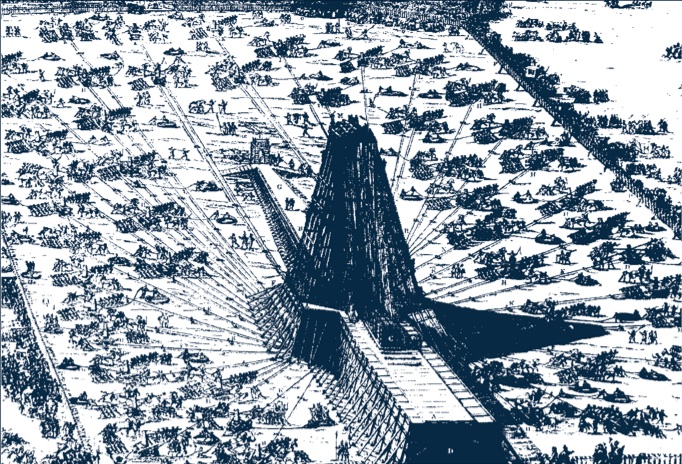
The Pope wanted to move the Obelisk – now a holy relic – to a position in front of the Basilica of St. Peter. The commission for moving the monument – which Michelangelo passed over as too terrifying – was hotly contested by the most brilliant of Rome’s engineers. The job, surprisingly, went to the youngest bidder, Domenico Fontana, who devised a scheme that would take six months and involve hundreds of men and horses…
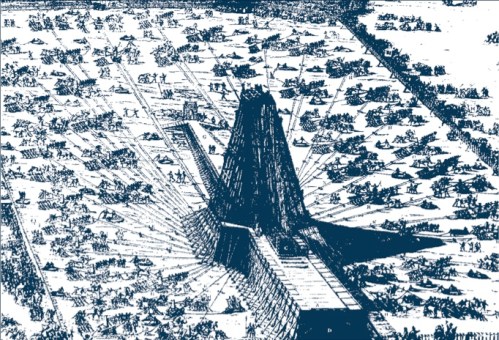
First, the Obelisk had to be taken downthen the bronze orb, rumoured to contain the ashes of Julius Caesar, removed from its summit.

This famous event was celebrated by Shakespeare in Sonnet 64. It begins by evoking in code the topography of Rome (Shakespeare could not openly admit he had been there):

‘When I have seen by time’s fell hand defaced

The rich, proud cost of outworn buried age’

It continues:

‘When sometime lofty towers I see down razed,

And brass eternal slave to mortal rage.’

The ‘lofty tower’ was the Obelisk and the ‘brass eternal’ the gilt orb on its summit.

‘Mortal rage’ is a Roman Catholic reference to the Protestant ‘Sack of Romewhich occurred in 1527. The Lanquenets – Mercenary Soldiers of Charles V – killed 147 of the Swiss Guard (who were defending Pope Clement VII) on the steps of St. Peter’s. 

‘Blasphemous’ shots were fired at the orb on top of the Obelisk (sacred to Catholics) and a lead bullet was imbedded in the metal.

Shakespeare would have seen this famous orb on his trip to Rome: it is on show, as a Catholic relic, to this day.

Sonnet 125 picks up the theme of James’s Coronation Obelisks. Shakespeare warns Southampton no more to trust in temporal power than to believe that the plaster board Obelisks lay ‘great bases for eternity’ the way the ‘sanctified’ original did. The ‘great base for eternity’ also suggests St. Peter, the ‘rock’ upon which Christ built his ‘eternal’ Catholic Church.

In the Sonnet previous to this (124) Shakespeare has declared his love ‘all alone stands hugely politic/That it nor grows with heat, nor drowns with showers’

Shakespeare loved to intertwine the religious and the erotic. ‘Hugely politic’ suggests the phallic as well as the sacred nature of the Obelisk.

Elsewhere in the Sonnets, Shakespeare talks of his homosexuality as ‘dear religious love’ and offers his passion as an ‘oblation’ to Southampton.

 In As You Like It Rosalind says of Orlando, who, like Harry Southampton, had ‘chestnut’ coloured hair:

His kissing is full of sanctity as the touch of holy bread.

Shakespeare, like many of his contemporaries, seemed to thrive on danger. He would have adored standing in front of the Pagan-Christian Obelisk with Harry Southampton, his forbidden love, in a forbidden city, following  a forbidden faith.

To endorse his love he even has the audacity, in the final couplet of the Sonnet, to summon up for ‘witness’ ‘the fools of time’ Catholic Martyrs like St. Peter himself, who ‘die for goodness, who have lived for crime’.

That is, martyrs whose only crime was to be alive and to be Catholic.

Like homosexual men, condemned to death in Elizabeth’s time, just for being what they were.

Caligula's Obelisk in 1875

 (It’s best to read Part 3.  next.)
(It’s best to read The Introduction first.)

The Shakespeare Code will present NINE new pieces of evidence to prove that William Shakespeare, Henry Wriothesley, third Earl of Southampton and Thomas Nashe visited Italy in 1593.

EXHIBIT (1)

Willobie his Avisa

In this anonymous satire, ‘W.S.’ ‘an old player’ (code for William Shakespeare) tries, unsuccessfully, to seduce Avisa – a chaste, idealised, woman.

‘W.S.’ then encourages his ‘familiar friend’ ‘H.W.’ (Henry Wriothesley, third Earl of Southampton) to woo her, so that he will fail as well.

‘H.W.’ is described in Willobie his Avisa as ‘Italo-Hispalensis’ (Italian/Spanish) and Italian phrases from John Florio are scattered throughout the work. 

In Canticle XLIX ‘H.W.’ says to Avisa:

A thousand features I have seen,

For traveller’s change and choice shall see,

In France, in Flanders and in Spain,

Yet none, nor none could conquer me:

Till now I saw this face of thine,

That makes my wittes are none of thine.

Willobie his Avisa was published in 1594.  For the satire to hit, Southampton must have visited Flanders, France, Spain and Italy before this date, i.e. 1593.

EXHIBIT (2)

The Parnassus Plays

These were satires, rather like the modern Cambridge Footlights Revues performed at St. John’s College in December 1601, but written, in part, by Thomas Nashe before his death earlier in the year.

 Ingenioso – Nashe’s flattering version of himself – introduces a character called Gullio:

Now gentlemen you may laugh if you will, for here comes a gull  

The four silver falcons on Henry Wriothesely, the thir d Earl of  Southampton’s crest – one of which Shakespeare used on his – were often described as sea-gulls….

Wriothesley/Southampton crest, 1611

Gullio, with his ‘becoming’ hair, his leg ‘better’ than Sir Philip Sidney and his ‘amiable face’ is a satire on Southampton.

Like Southampton, Gullio had just come back from Ireland, was boastfully proud of his military conquests, had a great quarrel with a ‘puling Liteltonian’ (code for Southampton’s enemy Lord Grey) and worshipped ‘sweet Mr. Shakespeare’ whose Venus and Adonis he lays under his pillow and whose picture he will have in his ‘study at the Court’.

Gullio refers to:

This rapier I bought when I sojourned in the University of Padua

And boasts:

My Latin was pure Latin, and such as they speak at Rheims and Padua.

So it was clearly known to the coterie audience that Gullio/Southampton had, by 1601, travelled and studied in Italy.

Rheims, a Catholic seminary, is also a dig at Southampton’s adherence to ‘the Old Faith’.

This portrait of Gullio is also very similar to Aguecheek in Twelfth Night (which, The Shakespeare Code will argue, is also a coded satire on Southampton).

Maria, in Twelfth Night, desribes Aguecheek as ‘a fool and a great quarreller’. And Aguecheek has the same vanity about his long hair as Gullio:

Sir Toby: Then thou hadst had an excellent head of hair

Sir Andrew: Why would that have mended my hair?

Sir Toby:  Past question, for thou seest it will not curl by nature.

Sir Andrew:  But it becomes me well enough, does’t not?

Sir Toby:  Excellent, it hangs like flax on a distaff; and I hope to see a housewife take thee between her legs, and spin it off.’

In The Parnassus Plays, Gullio says:

I stood stroking up my hair, which became me very admirably….

And Sir Toby Belch describes Aguecheek as:

An ass-head and a coxcomb and a knave, a thin-faced knave, a gull


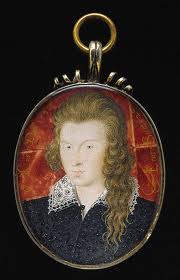
Below is Nicholas Hilliard’s minature of the third Earl of Southampton:

Or is it Sir Andrew Aguecheek!

(It’s best to read Part 2. next.)

1. Theory

The Shakespeare Code will argue that between March and June of 1593, Shakespeare, Southampton and Nashe travelled to Italy to escape from the Plague in London, spy for the Earl of Essex – and enjoy themselves.

2. The Background

1592 was the beginning of Shakespeare’s love-triangle with the dark-skinned beauty Amelia Bassano and Henry Wriothesely (Harry, third Earl of Southampton).  Along with Thomas Nashe, they were all ‘detained in the country’ – Titchfield – through ‘fear of infection’ from the virulent plague in London.

 They put on plays and entertainments, like Love’s Labour’s Lost and Edmund Ironside: but in the boredom of the pandemic summer their greatest amusement was themselves.

Shakespeare reveals in the Sonnets how he fell in love with Amelia, Harry became jealous, Amelia seduced Harry, Harry slept with Amelia to upset Shakespeare and Shakespeare came to realise that he was more in love with Harry than he was with Amelia. In confused despair, Shakespeare left Titchfield in July 1592 to join a tour of Lord Strange’s Men.Nashe – resentful of Shakespeare’s wealth, fame and friendship with Southampton – set out to destroy his rival.

‘For all my labours turned to loss’ Nashe writes in Pierce Pennilesse, hinting at his hand in the composition of Love’s Labour’s Lost. Later he adds ‘If my destiny be such to lose my labour everywhere’ for those who missed the point first time round.

He proceeds with an oblique attack on Shakespeare as one of the ‘drudges’ with ‘no extraordinary gifts of body or mind’ who ‘filch themselves into some nobleman’s service’ and  ‘labour it with cap and knee and ply it with privy whisperings’.

 His chance to launch a full-frontal attack came in September. Robert Greene died, destitute, in London. Nashe could steal his name.

Pretending to find A Groatsworth of Wit among the dead man’s papers, Nashe penned ‘Greene’s’ famous attack on Shakespeare:

There is an upstart crow, beautified with our feathers, that with his ‘Tiger’s heart wrapped in a Player’s hide’ supposes he is as well able to bombast out a blank verse as the best of you: and being an absolute ‘Johnannes factotum’, is in his own conceit the only Shake-scene in a country.

‘Greene’ reveals how it was Shakespeare, a nouveau-riche, dandified, ruthless, talentless mediocrity, who bribed him with the promise of ‘pleasure’ and ‘money’ to write plays for him and ‘lodged him at the town’s end in a house of retail’ – Mr. Apis-Lapis’s notorious Posbrook Farm, with its three ‘serving-maids’ outside Titchfield. (See The Strange Case of Mr. Apis Lapis)

‘Greene’ also suggests Amelia (codename ‘Lamilia’) seduced Harry (codename ‘Luciano’) for his money, that Shakespeare (codename ‘Roberto’) acted as pander for his ‘brother’ and demanded a cut of Amelia’s fee.

Nashe now became the Titchfield pander himself. He wrote blatant pornography to excite Harry who responded by impregnating Amelia. She was married to the ‘minstrel’ Alphonse Lanier ‘for colour’ on 10th October.

Her son was called Henry.

Shakespeare, meanwhile, had been sent a copy of A Groatsworth of Wit.

On the 8th December the publisher, fat Henry Chettle, printed a retraction. He claimed he had ‘seen’ [Shakespeare’s] ‘demeanour’ and it was ‘no less civil than he excellent in the qualities he professes’. More to the point he adds that:

 divers of worship have reported ‘uprightness of dealing which argues his honesty, and his facetious grace in writing, which approves his art.

The Southamptons had pulled rank.

 Though absent on tour, Shakespeare had kept up a sonnet correspondence with Harry in which he finally acknowledged his love for the young man – a love which Harry’s mother, Mary, second Countess of Southampton, finally encouraged. (See Shakespeare, Love and Religion Part One).

Nashe swore on his immortal soul that he was not the author of A Groatsworth of Wit. Shakespeare, unconvinced, took a long-term revenge.

Nashe’s observation in Pierce Pennilesse that a particular fault in man can destroy all his good qualities re-appears in the 1604 Hamlet.

Unacknowledged. By then Nashe was dead.

1593

Lord Strange’s Men, though they had nearly ‘broken’ [gone bankrupt] on tour, managed to play the Christmas season at the Court. Early in 1593 they were performing at the Rose.

In February 1593 Nashe, forgiven by the Southamptons, says in Terrors of the Night he was ‘in the country some three-score mile off from London’ in a ‘low, marish terrain’ – with mists ‘as thick as mould butter’. (Titchfield, on the River Meon, is a few miles from the Solent – at sea-level and subject to sea-fogs). Using a pun that Shakespeare was to lift for Much Ado about Nothing Nashe observes in Strange News:

 For the order of my life, it is as civil as a Seville orange; I lurk in no corners, but converse in a house of credit, as well governed as a college, where there be more rare qualified men and selected good scholars than in any nobleman’s house that I know in England.

John Florio, satirised as Holofernes the pedant in Love’s Labour’s Lost, was compiling his Italian-English dictionary World of Words at Titchfield. Posted there as Burghley’s Protestant spy, Florio was Harry’s Italian tutor. Harry spoke perfect Italian so it was natural for him to want to try it out in Italy. As a Catholic, groomed from childhood by the Vatican itself, it was also natural for him to want to make a secret pilgrimage to Rome.

Shakespeare was learning Italian. He quotes from Florio’s Italian-English phrasebook, First Fruits, in Love’s Labour’s Lost (‘Venetia, chi no ti vede, non ti pretia’) and more famously in The Merchant of Venice ‘Tutto quelche luce, non é ora’ – ‘All that glisters is not gold’.

On the 1st February all the theatres in London were closed by the Plague. They were to stay ‘dark’ till Christmas.

On the 25th February Essex was made a member of the Privy Council.  He now had the authority to issue passports.

Southampton was desperate to serve Essex.

Shakespeare was out of work.

Nashe would go anywhere for a meal.

It was at this moment that the three men sailed, as gentlemen-spies, to Europe…

(It’s best to read Part 1. now.)

Simon Callow, the great actor, writer, biographer, raconteur and Gladiator for Truth, writes:

I have read your blog. I entirely accept the Titchfield connection with Shakespeare and equally buy your association of Beeston with Falstaff. I much enjoyed Love’s Labour’s Found. Warmest and best.

Warmest and best to you, Simon.  And thanks.

Mr. Callow’s name has been inscribed in The Shakespeare Code’s ROLL OF HONOUR.

Maggie Ollerenshaw, celebrated actress, author and wit, renowned for her portrayal of ‘Wavy Mavis’ in Open All Hours, writes to Shakespeare Code Agent, Karen Little, about the Shakespeare blog:

Fascinating! And I’ve only got as far as reading Stewart’s biography.

The biography, (click at the top of the Home Page) will gradually evolve….

Miss Ollerenshaw’s name has been inscribed in The Shakespeare Code’s ROLL OF HONOUR.

Greg Doran, Chief Associate Director of the Royal Shakespeare Company  and described by the Sunday Times as ‘one of the great Shakespeareans of his generation’, writes of Love’s Labour’s Found:

The book is exquisite. Thank you.

Mr. Doran’s name has been inscribed in The Shakespeare Code’s ROLL OF HONOUR.

Jane Howell, doyenne director of Shakespeare for stage and television (her production of the Henry VI trilogy for the B.B.C. is legendary) writes about Love’s Labour’s Found, the basis for The Shakespeare Code:

It’s got such verve, excitement and gusto in it. It just races along and pulls you with it. It’s light, exciting, fascinating and interesting. You somehow get soaked up into the life of those times. It’s a wonderful piece of work. I hope it gets people stirred up and arguing. It’s brilliant!

The Shakespeare Code will quote extensively from  Love’s Labour’s Found, updating it as the new theories evolve.

Miss Howell’s name has been inscribed in The Shakespeare Code’s ROLL OF HONOUR


Nicholas Hytner, radical, scintillating, Director of the Royal National Theatre, writes:

Your theory is fascinating and seductive. It rings of truth. I never understand those who say they are uninterested in Shakespeare’s life; the creation of life for the writer of the playsseems an emotional necessity to me. Yours moves me and convinces me. I hope you have a huge success.

Sir Nicholas’s name has been inscribed in The Shakespeare Code’s ROLL OF HONOUR