Feeds:
Posts
Comments

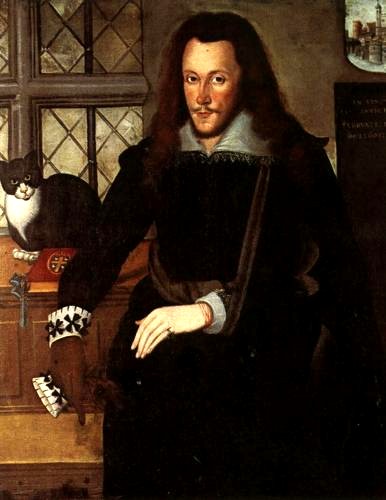
In Boughton House (the Northamptonshire home of the Duke of Buccleuch) there hangs a painting of Henry Wriothesley, the third Earl of Southampton, Shakespeare’s patron and lover.

He is shown as a prisoner in the Tower of London – accompanied by a black and white cat.

The Earl of Southampton’s presence in the Tower is easily explained.

On 8 February, 1601, along with his intimate friend, Sir Robert Devereux, the second Earl of Essex (and two hundred of their hot-headed followers) Southampton had rebelled against Queen Elizabeth.

The men wanted Elizabeth to name King James VI of Scotland as her successor. They feared that, if she did not, civil war would break out when she died.

The Queen, for her part, feared that, if she did name James as her successor, she would be assassinated.  She had, after all, executed King James’s mother, Mary Queen of Scots.

Another aim of the rebellion was to kill Sir Walter Raleigh and Sir Robert Cecil who had plotted against Essex while he was away from the Court, fighting in Ireland.

But the attempt (after divine service on a Sunday morning) to raise the citizens of London had fallen flat.  Everyone had prospered too well under Elizabeth.

Essex was beheaded and Southampton imprisoned in the Tower. Southampton had also been sentenced to death, but his mother and his wife had pleaded for mercy. Queen Elizabeth agreed to transmute the death sentence to life imprisonment.

She despised the long-haired, quarrelsome Southampton, but realised he was no real threat to her. Also, the beheading of Essex had proved very unpopular with her subjects. The London mob had tried to lynch Essex’s executioner who had taken three blows to sever his head.

The Cat in the Tower is more difficult to explain.

A legend has grown up, first reported in 1793 by Thomas Pennant in Some Account of London:

After he [the third Earl of Southampton] had been confined there [the Tower] a small time, he was surprised by a visit from his favourite cat, which had found its way to the Tower; and, as tradition says, reached its master by descending the chimney of his apartment. I have seen at Bulstrode, the summer residence of the late Duchess of Portland, an original portrait of this Earl, in the place of his confinement, in a black dress and cloak, with the faithful animal sitting by him.

Pennant, at least, has the good grace to add:

Perhaps this picture might have been the foundation of the tale.

Even the great Southampton scholar, C.C. Stopes (mother of Marie)  joins in the cat speculation by suggesting that Southampton’s wife brought the cat with her on a ‘prison visit’  to her husband  ‘to help to comfort, and to help calm the excitement of meeting again after such a long and anxious separation.’

In our time, Southampton’s ‘favourite cat’  has even acquired a name:

‘TRIXIE’

 To celebrate its 2,000th view, The Shakespeare Code has sworn to eliminate Trixie the Cat with EXTREME PREJUDICE.

The third Earl of Southampton, stripped (officially, at least) of his title and signing himself plain ‘H. Wriothesley’, was incarcerated on 8 February, 1601. He was ill from the start of his imprisonment and on 22 March the Privy Council allowed a doctor in to treat his ‘quartern ague’ which produced ‘swelling in his legs and other parts’.  

In August the following year (1602) the Lieutenant of the Tower transferred the ‘weak and very sickly’  Southampton to a more salubrious lodging, but warned the Privy Council that:

Without some exercise, and more air than is convenient for me to allow without knowledge from your honours of her Majesty’s pleasure, I do much doubt of his recovery.

Southampton’s mother, Mary, was allowed in to see him later that month, then, in October, his wife, Elizabeth.

In February of the following year (1603) the Jesuit Father Rivers noted that: ‘

The Earl of Southampton in the Tower is newly recovered of a dangerous disease…but in no hope of liberty.

Then, on 24 March, 1603, Queen Elizabeth died.

James became King of England as well as King of Scotland and everything turned round. The traitors of Elizabeth’s reign became the heroes of James’s.

When Southampton heard that Elizabeth had died, he threw his hat, for sheer joy, over the walls of the Tower. He expected King James would release him and pardon him.

He also hoped James would make him his lover.

However, many other handsome young aristocrats (including the Countess of Pembroke’s two sons) were vying for this  powerful position.

How could Southampton, imprisoned in the Tower, catch the King’s eye before his rivals?

He could commission a portrait and rush it to King James in Scotland!

The painting is heavily coded:

  1. The book on the window ledge (gilt-edged and most likely a Bible) has the Southampton family crest of four silver falcons embossed on the cover. This shows the painting was executed after Southampton’s title was restored by the House of Peers on 26  March,  1603.
  2. Southampton is dressed in black with a ring prominently displayed on his left finger. He is  in mourning (in a ‘suit of woe’) for his friend, the second Earl of Essex who, in James’s eyes at least, was a ‘martyr’.  The ring is a memorial tribute to Essex.
  3. A pane of glass in the window is smashed. This symbolises the violent, untimely death of the youthful Essex.
  4. Southampton’s arm is in a sling. This shows that Southampton is still recovering from his illness and so needs freedom and fresh air. It also allows Southampton (a) to show off the beauty of his long, elegant fingers and (b) offer his ‘submissive’ left hand to James as a lover.
  5. Red threads (holding tiny red gemstones) are wrapped round Southampton’s wrist. This indicates (a) that Southampton was recovering from a form of rheumatism (red thread round the wrist was an old folk-remedy) and (b) that Southampton was offering his love to James (red gems were all named ‘rubies’ at the time and symbolised passion).
  6. Southampton’s hair cascades, unadorned, round his shoulders. This shows (a) the unaffected truth and straightforwardness of his nature, (b) his hatless deference to the new King into whose presence the portrait would be taken and (c) his readiness to symbolically ‘wed’  James. Brides at this period wore their hair, plainly brushed, down to their shoulders for the wedding ceremony.

 [See the painting (also now at Boughton House) of the Earl of Southampton’s bride, Elizabeth Vernon, combing her shoulder-length hair in preparation for the wedding service which will make her a Countess]

7.  There is a painting (within the painting) of the Tower of London with four white swans swimming in its moat.  These swans represent the faithful lovers who will greet Southampton when he is released from the Tower.

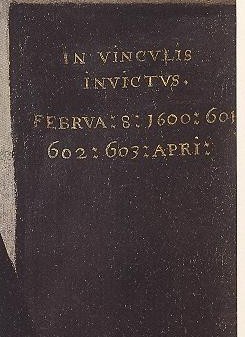
8.  Beneath the painting of the Tower is the exact date of Southampton’s incarceration, ‘FEBRUA: 8 1600:’ (The New Year  at this time, started on 31 March). This date is followed by:  ‘601: 602: 603: APRI:’

There is no exact date after ‘APRI’ as there is after ‘FEBRUA’.  If the painting had been executed after the Earl of Southampton’s release, the exact date would have been included.

This painting, the Shakespeare Code believes, is an invitation to King James to fill in the exact date in April by ordering Southampton’s release from the Tower.

The painting was a rushed job, executed over six days and nights (26  March to 1 April) then sent, by horseback courier, to James at Holyrood House in Edinburgh.

King James, smitten with the painting of the Earl, responded on 5 April with a letter to the ‘Peers, Nobility and Council’  of England:

Although we are now resolved, as well in regard of the great and honest affection borne unto us by the Earl of Southampton as in respect of his good parts enabling him for the service of us, and the state, to extend our grace and favour towards him….we have thought meet to give you notice of our pleasure….which is only this : Because the place is unwholesome and dolorous to him to whose body and mind we would give present comfort, intending unto him much further grace and favour, we have written to the Lieutenant of the Tower to deliver him out of prison presently to go to any such place as he shall choose in or near our city of London, there to carry himself in such quiet and honest form as we know he will think meet in his own discretion, until the body of our state, now assembled, shall come unto us, at which time we are pleased he shall also come to our presence, for that as it is on us that his only hope dependeth, so we will reserve those works of further favours until the time he be-holdeth our own eyes, whereof as we know the comfort will be great unto him so it will be contentment to us to have opportunity to declare our estimation of him…

The painting had clearly worked at every possible level.

But what is ‘Trixie’ doing in the Tower?  And why is she staring out of the painting?

For the answer to this question, we must turn to….

The Swan of Avon….

William Shakespeare….

(it’s best to read Part Two now.)


The Shakespeare Code announced that on 28th April, 2011, the eve of the Royal Wedding) it received its –

TWO THOUSANDTH VIEW!!!

 The Codethanked all those eminent men and women who sent endorsements and encouragements to the site. In recognition, The Shakespeare Code recorded their names or titles on its coveted:

ROLL OF HONOUR

 They are, in chronological order:

Michael Hentges

Martin Green

Alan Samson

Lord Bragg of Wigton

Sir Nicholas Hytner

Jane Howell

Greg Doran

Maggie Ollerenshaw

Simon Callow

Prof. David Womersely (Thomas Wharton Professor of English at Oxford University)

Karen Gledhill

Prof. Jonathan Bate (Professor of Shakespeare and Renaissance Studies at Warwick University)

Dr. James Kelly (Senior Tutor at Queen’s College, Cambridge)

China Miéville

Martin Jarvis

The Shakespeare Code also thanked the hundreds of intellectually curious and open-minded  people from all over the world who have clicked onto the site, The Brothers and Sisters of The Code…


Professor Jonathan Bate writes of The Strange Case of Mr. Apis Lapis ( The Shakespeare Code, 17th February, 2011):

 It’s a terrific article and very persuasive that Beeston [of Posbrook Farm, Titchfield] is Apis Lapis… All very interesting….’

The Shakespeare Code would like to thank Prof. Bate for his interest and support. He is a Commander of the British Empire, a Fellow of the British Academy and the Royal Society of Literature, Professor of Shakespeare and Renaissance Studies at the University of Warwick and a Governor and Board Member of the Royal Shakespeare Company.

To read ‘The Strange Case of Mr. Apis Lapis’, click here.

To read Prof. Bate’s endorsement of The Code’s ‘Titchfield Theory’, click here.

(It’s best to read Parts One, Two, Three, Four and Five and ‘A Synopsis’ first)

Queen Elizabeth hated warfare. She thought it was a waste of money and a waste of life. She had no interest in attacking other countries and would only allow armies to be mobilised if England itself was attacked.

The Earls of Essex and Southampton hated peace. They thought it made men ‘hate one another’ because they ‘less need one another’. ‘It begot plenty, plenty pride, pride distain and disdain strife’. War, they believed, was ‘an agent of civilization’ and ‘the school of tolerance’.

So when Richard III, in his opening soliloquy, criticises the effeminacy of peacetime (when ‘grim-visaged war’ is reduced to capering ‘nimbly in a lady’s chamber’), many Elizabethans would have agreed with him. And not just the men.

War is ‘grim-visaged’ and so is King Richard himself. That’s why he feels at home on the field of battle. (He has already proved himself  a valiant warrior at Tewksbury before the play starts).

But peace, he thinks, makes him look like a monster. So he behaves like one. 

Shakespeare’s genius is to show, at the Battle of Bosworth Field, all Richard’s positive qualities flooding back: his courage, comradeship, defiance and wit. He cheers the hearts of his soldiers, is utterly professional in his preparations and in battle ‘enacts more wonders than a man’.

Indeed, if Richmond (later Henry VII, Queen Elizabeth’s grandfather) had not filled the battle field with look-alike ‘Richmonds’ (five of whom King Richard slays) the Battle could well have gone the other way.

Note: Shakespeare himself invents these sneaky ‘look-alikes’. Would he have done that if the intention of the play was to justify the Tudor claim to the throne?

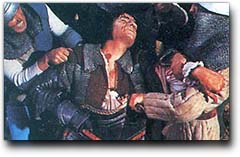
The Death of Richard III - Olivier as the King

War even brings out a poetic sensibility in the hunch-backed King. On the eve of battle he urges the Duke of Norfolk to make sure he is safely guarded in his tent, then adds:

Stir with the lark tomorrow, gentle Norfolk

To which the Duke, with loyalty and affection, responds:

I warrant you, my lord…

(It’s best to read Parts One, Two, Three, Four and Five first)

‘Richard III’ Decoded  is a series of five short articles which argue that William Shakespeare’s The True Tragedy of Richard III was not a piece of pro-Tudor propaganda.

It was, in fact, a coded attack on Queen Elizabeth herself.

It was a satire on the life of Sir Robert Dudley, the Earl of Leicester, Queen Elizabeth’s lover and friend, who had died just a couple of years earlier (1588).

In 1584, the Jesuits had published Leicester’s Commonwealth, a savage attack on Leicester which Shakespeare draws on to create his portrait of the hunch-backed king.

The King Richard of Shakespeare’s play

1. Murders a husband to get his wife.

2. Murders his wife to get another wife.

3. Uses black magic (or seems to!) to get his way with women.

4. Assumes, in the midst of his atrocities, an air of religious piety.

The historical King Richard was never accused of these crimes: but the Earl of Leicester was.

The Shakespeare Code argues that the original, lavish production of Richard III was staged in the grounds of Place House in Titchfield.

It was here that Leicester, acting as agent-provocateur, had destroyed the Catholic cause in England. He had encouraged the Duke of Norfolk to marry Mary Queen of Scots and the Earl of Southampton’s family to rebel against Queen Elizabeth.

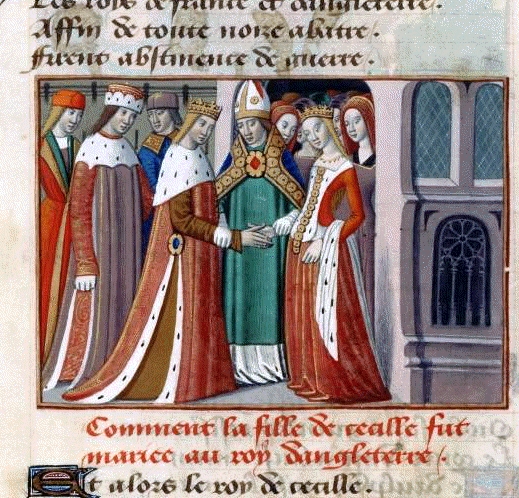
It was also at Place House (when it was an Abbey) that King Henry VI had married Margaret of Anjou.

Henry VI marries Margaret of Anjou in Titchfield

That is why Henry VI – as a corpse and a ghost – plays such a prominent part in Richard III. He was a local hero at Titchfield and had granted, in 1447,  the village a school and a fair. It was against the background of this fair that the play – with its horses, armour, tents and armies – was originally performed.

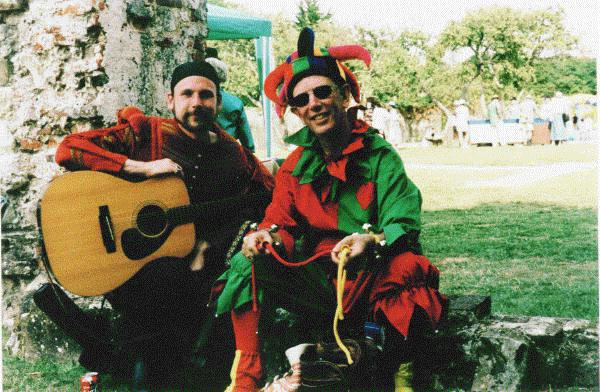
The fair at Titchfield is held to this day:

Titchfield Fair

The Shakespeare Code also argues that the pro-Tudor version of the Richard III story, performed by the Queen’s Men, was a government reply to Shakespeare’s subversive one.

It was the beginning of the hostility that was to grow between Queen Elizabeth and one of the most brilliant of her subjects, the Catholic homosexual, William Shakespeare.

(It’s best to read ‘Richard III’ and War next.)

(It’s best to read Parts One, Two, Three and Four first.)

William Shakespeare’s version of the Richard III story is so much better than that of the Queen’s Men that scholars have assumed the evolutionary principle is at work.

The Queen’s Men version came first, they claim, then Shakespeare improved on it.

But this flies in the face of the facts. We have seen that Thomas Nashe quotes a line from Shakespeare’s The True Tragedy of Richard III and describes the plot of the play in his pamphlet, Pierce Pennilesse. This was printed in 1592.

The Queen’s Men’s version of The True Tragedy of Richard III ‘as it was played by the Queen’s Majesty’s Players’ was printed in 1594.

It might be that the play was performed years before it was publisheed, BUT –

The Shakespeare Code argues that the Queen’s Men version of the play was a ‘State’ reply to Shakespeare’s satire on the life of the Earl of Leicester.

The Queen’s Men version has a character called ‘Truth’ appearing in a Prologue whose job is to present a ‘Tragedy in England’ that will ‘revive the hearts of drooping minds’. It then proceeds to remove as many parallels between the lives of Richard III and the Earl of Leicester as it possibly can.

The King Richard in the Queen’s Men version:

  1. Does not kill Prince Edward in order to gain his wife. (Queen Anne does not even appear in the play).
  2. Does not kill his wife, Queen Anne, to marry Elizabeth.
  3. Does not use ‘black magic’ to gain power over women.
  4. And does not assume an air of bogus piety.

The Queen’s Men want its audience to think of King Richard as a tyrant from the past. They do not want ‘drooping minds’ to draw parallels from the present.

We see exactly the same process of ‘Establishment gagging’ at work in the Falstaff plays. Shakespeare originally named the fat knight ‘Sir John Oldcastle’, an historical figure who was the ancestor of the Brooke family. Shakespeare’s motive was to tease the Brookes, who were the arch-enemies of the Earls of Essex and Southampton, Shakespeare’s paymasters.

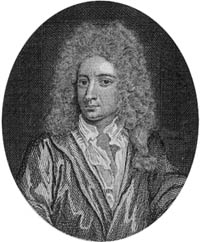
It was Queen Elizabeth herself, Nicholas Rowe claimed in 1709, who forced Shakespeare to change the name.

Nicholas Rowe

The Brooke family also arranged for the Rose Theatre to present a new play called Sir John Oldcastle (written by four playwrights). This is a white-wash job on the historical Oldcastle – a ‘heretic’ who rebelled against King Henry V.  In this version Oldcastle emerges as a philanthropist and patriot.

The Queen’s Men were faced with a problem in staging their version of Richard III. Shakespeare had the huge resources of two aristocratic families to draw on for his staging.  The Queen’s Men had 14 actors. So how do you ‘do’ the eleven ghosts who appear before the Battle of Bosworth Field? Answer: you cut them out!

The Queen’s Men may have had the approbation of the Queen and Privy Council, but the public had seen good drama from the Shakespeare team and wanted more of it. The Queen’s Men waned as Shakespeare waxed. By 1596 they were no more.

The Shakespeare Code has noted how, against their political intentions, the Queen’s Men turn King Richard into a hero at the end of the play. Shakespeare’s ending, where, typically, he sides with the underdog, has been so powerful, the Queen’s Men cannot get it out of their minds. Nor can they get out of their minds Richard’s glorious cry:

A horse! A horse! My kingdom for a horse!

In the hands of the Queen’s Men, it becomes:

A horse! A horse! A fresh horse!

Thank God for Shakespeare!

And the people who supported him….

And the people who performed him….

Sir Laurence Olivier as King Richard III

(It’s best to read A Synopsis next.)
 

(It’s best to read Parts One, Two and Three first.)

At the end of William Shakespeare’s Richard III the ghosts of the eleven people the King has murdered appear to him in a dream. They tell him to ‘despair and die’  nine times.

Thomas Nashe, in his 1592 pamphlet, Pierce Pennilesse: his Supplication to the Divell, writes:

Why is’t damnation to despair and die

When life is my true happiness disease?

The Shakespeare Code argues that Nashe collaborated with Shakespeare at Titchfield (see: The Strange Case of Mr. Apis Lapis).  He put phrases from the plays into his own writing to hint at his hand in Shakespeare’s work. In the opening paragraph of Pierce Pennilesse he writes: ‘for all my labours turned to loss’

Love’s Labour’s Lost, The Code argues, was another Titchfield entertainment on which Nashe worked with Shakespeare.

Later on in the pamphlet, Nashe defends the theatre as a good alternative to ‘gaming, following of harlots’ or ‘drinking’ and describes how, in plays:

all cosenages, all cunning drifts over-gilded with outward holiness, all stratagems of war, all the cankerworms that breed on the rust of peace, are most lively anatomised: they show the ill-success of treason, the fall of hasty climbers, the wretched end of usurpers, the misery of civil dissension, and how just God is evermore in punishing of murder…they [plays] are sour pills of reprehension, wrapped up in sweet words…

This is a blow by blow account of Shakespeare’s The True Tragedy of Richard III.

It describes how King Richard disguises his villainy by pretending to be religious –‘over-gilding’ his ‘cunning drifts’ with ‘outward holiness’.

Just like the lately deceased Earl of Leicester.

And unlike the historical King Richard III who never pretended to be holy.

Nashe continues this coded attack on Leicester with his tale of  ‘The Usurper Bear’:

The Bear, on a time, being chief Burgomaster of all the beasts under the Lion, gan think with himself how he might surfeit in pleasure, or best husband his authority to enlarge his delight and contentment. With that he began to pry and to smell through every corner of the forest for prey, to have a thousand imaginations with himself what dainty morsel he was master of, and yet had not tasted: whole herds of sheep he had devoured and was not satisfied; fat oxen, heifers, swine, calves and young kids, were his ordinary viands: he longed for horse-flesh and went presently to a meadow…

Every Elizabethan reader would know that  ‘the Bear’ was Leicester and ‘the Lion’  was Queen Elizabeth.

To protect himself, Nashe claimed he had no particular individuals in mind.  The Queen was still alive, even if Leicester wasn’t, and she had once chopped off a writer’s hand for libel. However, Nashe writes:

Now a man may not talk of a dog, but it is surmised he aims at the man who giveth the dog in his crest…

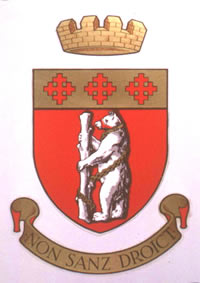
Leicester famously had a bear in his crest. So, far from denying that ‘The Bear’ is a portrait of Leicester, Nashe is, in reality, pushing his point home.

Earl of Leicester's Coat of Arms

In Nashe’s story ( which is a variant on Shakespeare’s ‘Richard III’ story)  the Bear, seeking total supremacy, wants to eat a ‘fat Camel…a huge beast and well shod’ who displays ‘gentleness’ and ‘prowess’ has been fed in ‘plentiful pasture’.

‘The Camel’ was Thomas Howard, 4th Earl of Norfolk, the richest man in England….

Far from showing the required ‘homage’ to the Bear, the Camel gives him a kick on the forehead with his hind legs.

[Norfolk and Leicester exchanged blows after a tennis match in 1565]

 So the Bear enlists the help of the Ape, who abhorred the Camel ‘by nature because he [the Camel] overlooked him so Lordly, and was by so many degrees greater than he was’

‘The Ape’ is the diminutive, round-shouldered Sir Robert Cecil, whose grandfather had been a tavern-keeper….

The Ape advises the Bear to dig a pit to trap ‘the goodly’ Camel and the Bear ends up ‘gorged’ with the Camel’s ‘blood’.

[‘The pit’ is the trap Leicester set up for Norfolk. He encouraged him to marry Mary Queen of Scots, hoping it would lead, as it did, to Norfolk’s beheading.]

Next the hungry Bear spies a herd of deer ‘a-ranging’ in a grove and singles out ‘one of the fairest in the company’ with whom to ‘close up his stomach instead of cheese’.

The ‘herd of deer’ are the Queen’s Ladies-in-Waiting, of which the ‘fairest’ was, famously, the Queen’s cousin, Lettice Knollys….


However, the Bear cannot fool or flatter the jolly Forrester and and youthful Lord of the Lawnds [glades] in charge of the deer – unlike the Lion [Elizabeth] ‘whose eyes he could blind as he list’).

‘The jolly Forrester’ is the dashing, courageous Sir Walter Devereux, first Earl of Essex and Lord Lieutenant of County Stafford, who wooed and won Lettice’s hand in marriage….

The Bear decides ‘to poison the stream’ where the Forrester is ‘wonted to drink’. So, ‘all faint and malcontent (as prophesying his near approaching mishap by his languishing)’ the Forrester ‘with a lazy wallowing pace, strayed aside from the rest of his fellowship, and betook him all carelessly to the corrupted fountain that was prepared for his funeral’.

[Leicester had Essex sent to Ireland as Earl Marshall so he could pursue his affair with his wife, Lettice. He then poisoned him at Dublin Castle. Essex was ill for a month before he died in 1576].

The Bear finally settles for a diet of honey [the tax on imported sweet wines] and gets the Fox to help him. 

The Fox’ is the cunning and ambitious Sir Walter Raleigh….

The Ape and the Ape’s father, the old Chameleon, also assist. 

[The old Chameleon’ is the adroit wind-bag and long-time survivor, Lord Burghley

The three men try to destroy the English wine-producing business so that everyone will have to import it and pay tax. But the many eyed Lynceus learns of the plot and destroys it

”Lynceus’, the eagle-eyed Argonaut, is subtle spymaster, Sir Francis Walsingham


The Bear finally dies of pure anger, being out run-by a ‘fat hind’, [The aging Lettice again, who was pursuing an affair with a man half her age..]

Shakespeare gets close to making his own ‘bear jokes’ in Richard III itself.  The young Duke of York says to Richard:

‘You mean to bear me, not to bear with me

Uncle, my brother mocks both you and me:

Because that I am little like an ape,

He thinks that you should bear me on your shoulders’

But Shakespeare is too much of an artist to write a work that is pure propaganda. He shows Richard to be a brave and gallant commander of his men at the Battle of Bosworth, much more ‘himself’ in war than he ever was in peace. Far from flying the field like the historical Richard, Shakespeare’s Richard stands his ground. 

He even goes down with truly Don Giovanni-like defiance:

‘March on! Join bravely. Let us to it pell-mell

If not to Heaven then hand in hand to Hell’.

Strangely, the Queen’s Men’s version of the play (which is strongly pro-Elizabeth) gives the King this same courageness at the end….

(It’s best to read Part Five next.)

 (It’s best to read Parts One and Two first.)

Leicester’s Commonwealth attacks the tyranny of Robert Dudley, the Earl of Leicester. It compares him to Julius Caesar and the Tarquin who raped Lucretia.  

It also attacks the naivety of Queen Elizabeth. It compares her to Philip of Macedon who was killed by his lover, Attalus.  

The book also draws parallels between Elizabeth and the former Kings of England who gave too much power to their favourites and their wives – Edward II (to Piers Gaveston) Richard II (to Robert De Vere) and Henry VI (to Queen Margaret).

But, of most importance, it also compares the Earl of Leicester to another King of England, the hunch-backed Richard III.

The Shakespeare Code argues that William Shakespeare, like everyone else in England, had read this Roman Catholic attack on Leicester (The handwriting expert, Charles Hamilton, believes Shakespeare wrote out some pages of the book in manuscript).  Shakespeare drew on material from Leicester’s Commonwealth when he wrote Richard III. 

As well as being a history lesson, the play is a savage satire on the recently deceased Earl of Leicester.

The Queen’s Men’s version of the story praises Henry VII for overcoming the tyranny of Richard III and instigating the reign of Queen Elizabeth.

Shakespeare’s version suggests, that because of her blind love for Leicester, Queen Elizabeth had unleashed her own tyranny on the land – a tyranny that must never be repeated.

Again, the Countesses of Pembroke and Southampton would have been behind the anti-Elizabeth commission. The Countess of Southampton (a committed Roman Catholic who sheltered priests in her London home) hated the memory of Leicester. It was at her own country seat, Place House in Titchfield, that Leicester had encouraged the Duke of Norfolk to marry Mary, Queen of Scots and the Catholic Northern Lords to rebel against the Queen.

The Shakespeare Code argues that the play was first performed as a pageant production in the grounds of Place House. The two opposing tents required by the action could easily be pitched in ‘the Park’  there and  (with stables and armour to hand)  battles staged to spectacular effect.

 The play’s massive cast (over 60 characters, not including ‘Guards, Halbediers, Gentlemen, Lords, Citizens, Attendants and Soldiers’) would be made up of professional actors, aristocratic lords and ladies and members of the Pembroke and Southampton entourages – many of  whom would have trained as real soldiers in preparation for the Armada ‘invasion’. 

The play’s major ‘doubling’ problem – how do you bring on eleven ghosts (including a woman and two children) in the scene just before the battle? – would, with these forces, be a problem no longer. And the play’s length – over three hours of playing – wouldn’t be a problem either.  Feasting, jousting and dancing would have broken up the performance – which might, like Elizabeth’s outdoor progress entertainments, have been given over several days. 

The town of Titchfield itself explains why the ghost of King Henry VI (not seen in the play) appears at the end and why, at the beginning, Queen Anne is following King Henry’s body and not, as in the Sir Laurence Olivier film version, her husband Prince Edward.  

‘Good’ King Henry (see painting below) was a local hero who had married at Titchfield Abbey and endowed the town with a school and a fair. He was much more important to a local Titchfield audience than his son, Prince Edward.

Indeed, The True Tragedy of Richard III might have been performed in the context of King Henry’s fair itself – as, The Shakespeare Code argues – Love’s Labour’s Lost was at Whitsun in 1592.

The similarities between Richard III and the Earl of Leicester as presented in Leicester’s Commonwealth are so numerous it will be best to table them.

1. Both men want to be King of England.

2. Both men suffer from mind-poisoning physical disabilities. Richard has a withered arm and Leicester ‘a broken belly on both sides of his bowels whereby misery and putrefaction is threatened to him daily’.

3. Both men kill anyone who gets in the way. Richard kills Henry VI, Prince Edward, Hastings, Buckingham, the Princes in the Tower, Anne, Clarence, Rivers, Grey and Vaughan. Leicester kills the first Earl of Essex, Cardinal Chatilian, Amy Robsart, the Earl of Sheffield, Sir Nicholas Throckmorton, the Earl of Sussex, Lady Lennox and Salvator. Leicester also tried to kill Simier, the Dauphin’s equerry.

4. Both men kill the husbands of wives they want to marry. Richard kills Lady Anne’s husband, Edward Prince of Wales and Leicester poisons Lettice Knollys’s husband, Sir Walter Devereux, first Earl of Essex.

Laurence Olivieer as Richard and Vivien Leigh as Lady Anne

5. Both men kill their own wives to marry other women. Richard kills Anne to marry Elizabeth and Leicester kills Amy Robsart to be free to marry Queen Elizabeth.

6. Both men are involved in the murder of royal children. Richard kills the Princes in the Tower and the young Leicester offers his services to Princess Mary Tudor sixteen days before his father murders the boy King Edward.

7.  Both men use black magic.  Queen Anne describes Richard as a ‘fiend’ conjured up by ‘a black magician’ and Leicester keeps conjurers like John Dee in his entourage.

8. Both men are likened to animals, Richard to ‘an elvish-marked, abortive, rooting hog’ and Leicester to ‘a bear with a paunch’. (The compositor of the first printing of the play even made a ‘Freudian’ slip. He set up ‘The Bear had raste his helm’ when he should have set up ‘The Boar had raste his helm’. This mistake went unnoticed for five more editions!

9. Both men overthrow the authority of the English Archbishops and, most importantly…

10. Both men assume, in the midst of their atrocities, an air of religious piety.

King Richard says:

But then I sigh, and with a piece of scripture,

Tell them that God bids us do good for evil:

And thus I clothe my native villainy

With odd ends stol’n forth of Holy Writ.’

Leicester, who was never heard to utter a private prayer in his life, appointed himself Captain General of the Puritan movement in England.

 This last point, The Shakespeare Code believes, proves that Shakespeare’s Richard III was an attack on Leicester. The historical King Richard III never pretended to be a holy man. That was Leicester’s ploy alone – which Shakespeare, in his play, lampoons.

(It’s best to read Part Four now.)

(It is best to read Part One first.)

Robert Dudley, the Earl of Leicester , was the love of Queen Elizabeth’s life. He had protected (and financed) her during the reign of her step-sister, Bloody Mary Tudor, when few thought she would survive, let alone become Queen of England. 

Leicester (lying, as usual) claimed to be exactly the same age as Elizabeth, so contemporaries explained their intimacy in terms of planetary alignments. Elizabeth and Robert had even been imprisoned in the Tower at the same time.

Robert Dudley

Elizabeth, abused as a child and a teenager, only trusted those who had been kind to her before she ascended the throne, so Leicester was in a unique position. He contrtolled all access to the Queen and so made a fortune from those seeking her attention.

Realising, also, that he was above the law, he poisoned any man who got in his way (including, it was said, Sir Walter Devereux, the first Earl of Essex) and slept with any woman who took his fancy. He was rumoured to pay £300 a night (£150, 000) for the favours of Elizabeth’s beautiful ladies-in-waiting. 

At one point he had a chamber next to the Queen, so many people assumed he was her lover. Some even thought he had fathered an illegitimate child with her. But what was certain was that during the Queen’s bouts of illness, which were frequent, he would sit all night by her bedside.

And he would often dance with her….

The Roman Catholics hated Leicester for encouraging the Duke of Norfolk to marry Mary Queen of Scots, a plot designed to destroy them both. The Papists also claimed that Leicester had acted as an agent –provocateur  at  Place House in Titchfield, where the disastrous Rebellion of the Catholic Northern Earls was planned. (Mary Queen of Scots was to be sprung from prison at Tutbury and taken to Arundel Castle, twenty miles from Titchfield).

As a consequence of the failed  rebellion, the second Earl of Southampton was imprisoned in the Tower where Henry Wriothesley, the third Earl, William Shakespeare’s patron and lover, was conceived.

Shakespeare’s own family also suffered under Leicester (whose fabulously decadent Kenilworth Castle was only a dozen miles away from Stratford-upon-Avon). Leicester’s agent, Sir Thomas Lucy, had raided the home of Edward Arden, a devout Catholic on Shakespeare’s mother’s side, who had denounced Leicester as a serial adulterer. Arden was charged with ‘treason’ and hanged, drawn and quartered. The sadistic Lucy had also whipped the young Shakespeare for poaching on his land. (Poaching was a recognised ‘revenge’ tactic on the enemies of Catholicism which the Vatican positively encouraged).

Then, in 1584, the Jesuits dropped a bombshell.

They printed vast quantities of a green-backed book in Flanders and smuggled it into England. It was called Leicester’s Commonwealth and the public leapt on it. Francis Bacon had a manuscript copy and the American handwriting expert, Charles Hamilton, believes that some of the pages are in Shakespeare’s hand.

The book claimed that Leicester had set out to destroy all the claimants to the English throne except Queen Elizabeth, whom he would then proceed to assassinate. Next he would back the Yorkist claim of his brother-in-law, Huntingdon, but only as a step towards seizing completely power for himself.

The great Regency historian Lucy Aikin writes:

The success of this book [Leicester’s Commonwealth] was prodigious; it was read universally and with the utmost avidity. All who envied Leicester’s power and grandeur, all who had smarted under his insolence, or felt the gripe of his rapacity, all who had been scandalised, or wounded in family honour, by his unbridled licentiousness, all who still cherished in their hearts the image of the unfortunate Duke of Norfolk, whom he was believed to have entangled in a deadly snare, all who knew him for the foe and suspected him for the murder of the gallant and lamented Earl of Essex – finally, all, and they were nearly the whole of the nation, who looked upon him as a base and treacherous miscreant, shielded by the affection of his sovereign and wrapped in an impenetrable cloud of hypocrisy and artifice, who aimed in the dark his impenetrable weapons against the bosom of innocence exulted in the exposure of his secret crimes, and eagerly received and propagated for truth even the grossest of the exaggerations and falsehoods with which the narrative was intermixed.’

Aikin goes on to describe how Elizabeth ordered everyone in authority to suppress the books and punish anyone who circulated them. In what became known as ‘The Whitewash Manifesto’ Elizabeth:

testified in her conscience before God, that she knew in assured certainty the books and libels against the Earl to be most malicious, false and scandalous, and such as known but an incarnate devil could dream to be true.

Elizabeth also stated that she regarded the publication of the books as an attempt to discredit her own government…

as though she should have failed in good judgement and discretion in the choice of so principal a councillor about her; or to be without taste or care of all justice or conscience, in suffering such heinous and monstrous crimes, as by the said books and libels be famously imputed, to pass unpunished, or finally, at the least, to want either good will, ability or courage , if she knew these enormities were true, to call any subject of her’s whatsoever to render sharp account of them, according to the force of her laws.  

Elizabeth’s Privy Councillors, naturally enough, supported their monarch by declaring:

to do his lordship but right, of their sincere consciences must needs affirm these strange and abominable crimes to be raised of a wicked and venomous malice against the said Earl, of whose good service, sincerity of religion, and all other faithful dealings with her majesty, they had long and true experience.

Leicester was powerful enough to survive this attack and even a disastrous military campaign in the Lowlands. Elizabeth still trusted him enough to put him in charge of the defence of England in Armada year. But when, after the victory over the Spanish, Elizabeth planned to make Leicester Lieutenant-General of England, enough was enough. He died, mysteriously, on his way to Kennilworth Castle.

The rumours were his wife Lettice had poisoned him so she could take a young lover; but he was so unpopular the entire English (and Welsh) population could have been murder suspects. Even William Camden, the contemporary historian wrote:

Nor was the public joy [at the Armada victory] anything abated by Leicester’s death (though the Queen took it much to heart).

But his death left the field wide open – and safe – for the satirists, of whom Thomas Nashe was one and William Shakespeare another….

Leicester in middle age...

 (It is best to read Part Three next.)

Queen Elizabeth’s grandfather, Henry VII, became King of England by defeating Richard III at the Battle of Bosworth Field. Apart from that, Henry’s claim to the throne was tenuous.

Henry VII, Queen Elizabeth's grandfather.

This made Elizabeth’s own claim tenuous as well.

Princess Elizabeth, Henry VII's grand-daughter.

Many Roman Catholics also thought that Elizabeth’s father, Henry VIII, had not been properly married to Anne Boleyn, so Elizabeth was a bastard.

The Jesuits even claimed that Anne Boleyn was Henry VIII’s own illegitimate daughter. So Elizabeth was also an incestuous bastard.

Elizabeth’s cunning spymaster, Sir Francis Walsingham and her lover, Robert Dudley, Earl of Leicester, formed a company of star actors in 1583 called the Queen’s Men. Liveried in red, and paid more than any other performers, their job was constantly tour England to shore up the position of the Queen.

To justify Henry VII’s defeat of Richard III, they turned Richard into a devil-worshipping monster. In their version of The True Tragedy of Richard III  he’s not only a serial murderer, he’s Hannibal Lector as well:

I hope with this lame hand of mine to rake out that hateful heart of Richmond, [Henry VII] and when I have it, to eat it panting hot with salt, and drink his blood luke warm though I be sure will poison me…

By defeating Richard, the play argues, Henry VII was carrying out the will of God and the whole universe:

‘The sun by day shines hotly for revenge

The moon by night eclipseth for revenge

The stars are turned to comets for revenge

The planets change their courses for revenge

The silly lambs sit bleating for revenge

The  screeking raven sits croaking for revenge

Whole heads of beasts come bellowing for revenge

And all, yea all the world I think

Cries for revenge, and nothing but revenge…’

In a preposterous act of prophesy, a character in the play even foresees the dazzling reign of Henry VII’s grand-daughter, Queen Elizabeth:

‘She is the lamp that keeps fair England light

And through her faith her country lives in peace

And she hath put proud Anti-Christ to flight

And been the means that civil wars did cease.

Then England kneel upon thy hairy knee,

And thank that God that still provides for thee…

For if her Grace’s days be brought to end

Your hope is gone, on whom did peace depend.

Did Shakespeare’s version of Richard III serve the same political

purpose as that of the Queen’s Men?

The Shakespeare Code argues emphatically ‘NO

(It’s best to read Part Two now.)