Feeds:
Posts
Comments

(It is important to have read Part Six before reading this Post – and good to have read The Introduction and Parts One, Two, Three, Four and Five as well.)

As Brothers and Sisters well know, The Shakespeare Code believes that Thomas Nashe collaborated with Shakespeare in the writing of Twelfth Night. Shakespeare wrote the ‘lyrical’ sections, while Nashe wrote the ‘comical ones’.

That is why, The Code believes, that Henry Wriothesley, the third Earl of  Southampton is ‘lampooned’ in the play in the figure of the foolish knight, Sir Andrew Aguecheek.

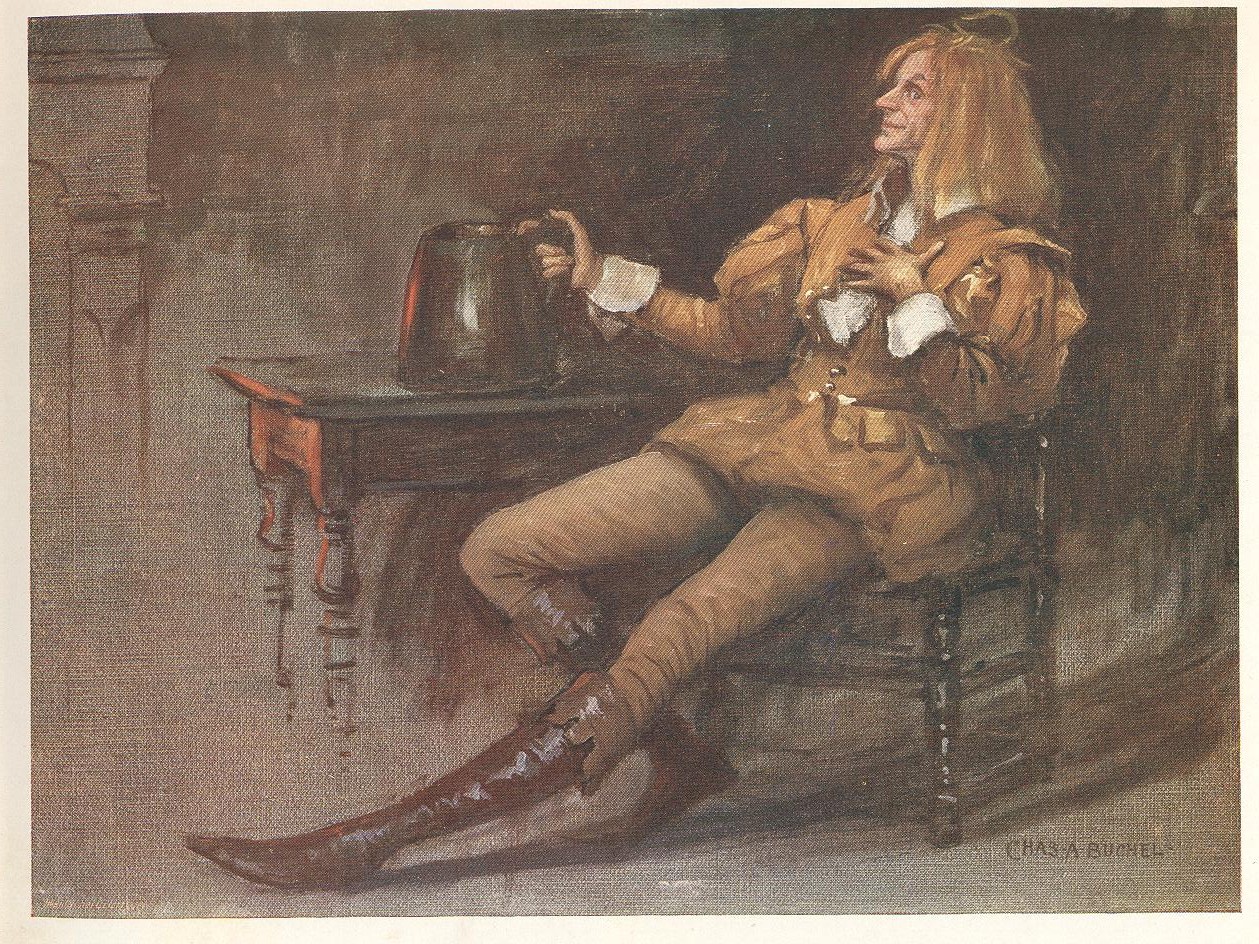
Sir Andrew, designed by Lila di Nobili

Nashe, as The Shakespeare Code has demonstrated, lived and worked for a time at Titchfield.

(See ‘The Strange Case of Mister Apis Lapis.’  )

But he failed to secure, as Shakespeare did, the Earl of Southampton’s long-term patronage. No longer obliged to flatter Southampton to get his money, he is free to satirise a man he despised…

He also does this in The Parnassus Plays where Southampton is mocked in the character of foppish, foolish Gullio.

The Shakespeare Code has suggested a dozen adjectives to describe the characters of Agueceek and Gullio: it will now demonstrate that these same adjectives apply to the Earl of Southampton himself.

1. Foolish.

In 1594, Lady Bridget Manners,the Earl of Rutland’s sister, declined to marry Southampton (or the Earl of Bedford).

 
Lady Bridget Manners in old age


The reason she gave was that…

they be so young and fantastical and would be so carried away…

(i.e. they were raving homosexuals….)

In 1599 Queen Elizabeth described Southampton to Essex (after he had appointed him his General of Horse in Ireland) as:

one whose counsel can be of so little and experience of less use.

 
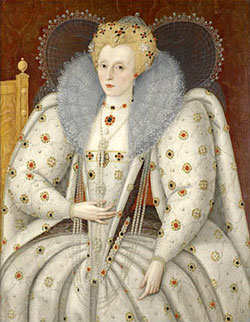
Queen Elizabeth in 1599

She goes on to imply that Essex had only given Southampton the position because he had married Essex’s cousin, Elizabeth Vernon.

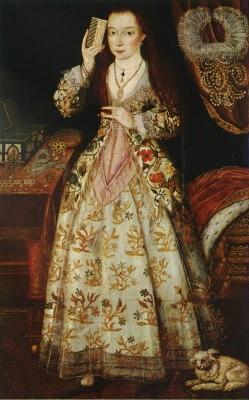
Elizabeth Vernon as the Third Countess of Southampton.

Otherwise Essex….

would have used many of [his] old lively arguments against him [Southampton] for any such ability or commandment.

Southampton was also one of the main supporters of Essex’s very foolish rebellion against the Queen.

2. Rich.

Southampton was so rich that Lord Burghley felt justified in imposing a £5,000 fine on him in 1594 when, although he was Burghley’s ward, he refused to marry his grandaughter, the daughter of the Earl of Oxford.

Lord Burghley, guardian to the Earl of Soputhampton.

A £5,000 fine is the equivalent of two and a half million pounds in today’s money.

3. Prodigal.

There is a story (well-authenticated through Sir William Davenport and Nicholas Rowe) that Southampton gave Shakespeare a gift of £1,000 (half a million pounds) to ‘make a purchase.’

 
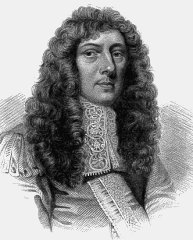
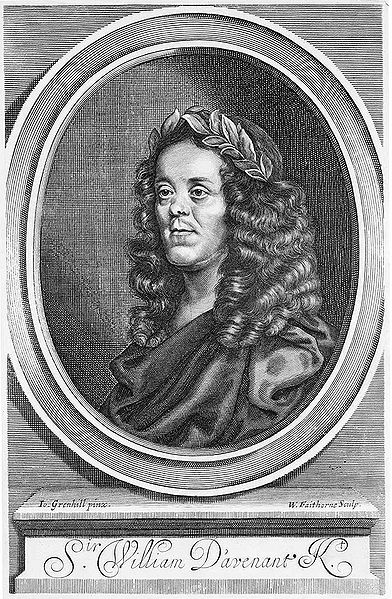
Sir William D’Avenant, Shakespeare’s illegitimate son and a syphilitic (hence nose).

4. ‘Musical’.

 In Sonnet 8,  Shakespeare writes of Southampton:

Music to hear, why hear’st thou music sadly?

On 15 July 1598, Sir Thomas Edmondes, the English agent in Paris, sent on to Sir Robert Sidney:

certain songs which were delivered by my Lord Southampton to convey to your Lordship from Cavelas.

5.  Polyglottal.

John Florio, in his introduction to his 1598 edition of The World of Words (his Italian/English Dictionary) implies that Southampton is so fluent in Italian he doesn’t need a tutor.

John Florio

 Southampton could certainly write in Latin and Greek as well and is decribed in Willobie his Avisa as ‘Italo-Hispalensis’ which suggests he spoke Spanish as well.

His maternal grandfather, Lord Montague, was Master of Horse to King Philip II of Spain when he was King of England in ‘Bloody’  Mary’s reign.

King Philip of England

6. Vain.

In Sonnet 84, Shakespeare writes of Southampton:

You to your beauteous blessings add a curse

Being fond on praise which makes your praises worse…

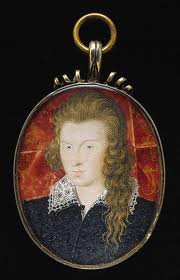
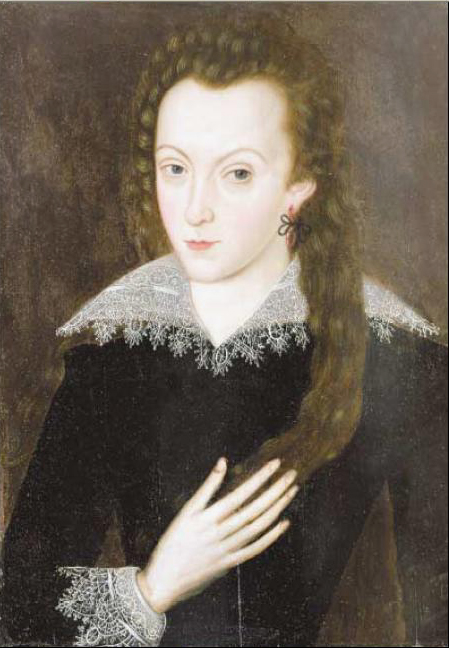
Southampton had  himself painted in a series of portraits to show off…

A. His feminine beauty….

B. His long elegant hair…

C. His long elegant legs…..

D. His long elegant hands……….

Compare these with a photograph of the great Arthur (‘Ello, ‘Ello) Bostrom playing Sir Andrew Aguecheek…

……Long, elegant everything!

Shakespeare, in his Sonnets, encourages this vanity.

In Sonnet 20 he describes Southampton as the ‘master-mistress of [his] passion’ and claims that Dame Nature originally intended Southampton to be a woman – but falling in love with her – turned her into a man instead…

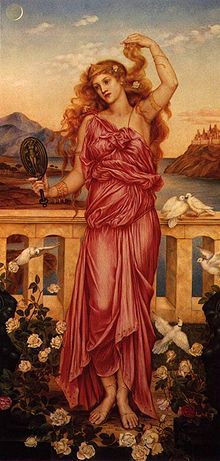
In Sonnet 53 Shakespeare even speculates how beautiful Southampton would look dressed in drag like Helen of Troy!

Helen of Troy

7. Quarrelsome.

Early in  1597 Southampton quarrelled violently with Henry Percy, 9th Earl of Northumberland (‘The Wizard Earl’), Essex’s brother-in-law.

The Wizard Earl

Northumberland was Southampton’s ‘neighbour-from-Hell’ at Petworth, a day’s ride from Titchfield. He and Sir Walter Raleigh were part of a group of Scientists and Occultists attacked by the Jesuits as The School of Atheism and by Shakespeare as The School of Night in Love’s Labour’s Lost.

Southampton sent his rapier to Northumberland, but they never fought a duel.

Early the following year (1598) Southampton got into an argument with Ambrose Willoughby after a playing at cards with him and the Queen. He struck Willoughby near a tennis court and Willoughby snatched a piece of Southampton’s hair. The Queen took Willoughby’s side and banished Southampton, temporarily, from the court.

On 24 January, 1600, Gilbert  Whyte reported  that Thomas Lord Gray had challenged Southampton to a duel – but that Southampton had replied he had the choice of the place and the weapon. He did not want this to be in England as he could expect …

little grace and mercy…

He offered to meet Gray in Ireland or France to fight.

[Note: We now spell Gray’s family name as Grey – but in Elizabethan documents, it is spelt Gray or Graye.]

In May Southampton travelled to Ireland – and Gray to the Low Countries; but their quarrel continued. In July Southampton travelled to Flanders – but by then news of the quarrel had reached the ears of the Privy Council. They stated that it was ‘publicly known’ that there was ‘unkindness and heartburn’  between the two men and wrote to them to forbid the duel.

Southampton ignored the Council, sent his sword to Gray and a duel was fought. Southampton came off the better.

But on 9th January, 1601, Lord Gray, with a party of attendants, made a ‘revenge’ attack on Southampton when he was riding along the Strand with only a boy to hold his horse.

Southampton defended himself till help came, but the boy lost his hand in defending his master. The Queen sent Gray to Fleet Prison.

It is this incident, The Shakespeare Code believes, that Nashe is satirising in The Parnassus Plays when Gullio says:

Since my arrival in England [from Ireland] (which is now six months I take sithens) I have been the death of one of our puling Liteltonians for passing by me in the Moor fields unsaluted, but that there was no historiographer by to have recorded it…

 The ‘puling Liteltonians’ refers to the students of law who still studied the Tenures of Sir Thomas Littleton (1422-1481) at Gray’s Inn Court, the original home of the Grays of Wilton of which Thomas Lord Gray, Southampton’s enemy, was a member.

Gray’s Inn Court, 1881

Even in Twelfth Night, Sir Andrew, terrified of fighting, offers ‘Caesario’  his:

horse, Gray capilet…

This is a dig at Lord Gray, who (as we know from Leslie Hotson’s brilliant researches) was sitting next to Queen Elizabeth at the first night of Twelfth Night.   Both were trying to translate the play into Latin for the sake of a visiting Bavarian Count, Wolfgang Wilhelm.

Wilhelm had already visited the Court on 14th December – where he had dined, lavishly, The Code imagines – in the private chambers of the Lord Chamberlain (George, Lord Hunsdon) the original of Sir Toby Belch. See Part Three.

 8. Cowardly.

Though it was generally agreed that Southampton was a gallant soldier, he was terrified of Queen Elizabeth.  He sneaked back to England from Europe, incognito, to marry Elizabeth Vernon in hopes that the Queen wouldn’t find out…

Also, at his trial for treason it was thought (understandably perhaps)  that…

 he was somewhat too low and submiss, and seemed too loath to die before a proud enemy…

9. Maladroit with women

Southampton’s father, the second Earl of Southampton, who believed his wife, Mary Browne, second Countess of Southampton,  had been unfaithful to him, taught his son Harry to hate women. He brought him up in a predominantly male world in which (according to Mary Browne) he had made his ‘servant his wife’.

Mary Browne, second Countess of Southampton.

Harry consequently had a stormy relationship with his mother – and as a teenager showed so little interest in girls that on his seventeenth birthday the Countess commissioned Shakespeare to write seventeen Sonnets to turn him ‘straight’.

So it was invevitable that when he did fall in love (with Shakespeare’s mixed-race mistress Amelia Bassano) the relationship was also stormy. It is cruelly satirised in Willobie his Avisa where H.W. [Henry Wriothesley] has…

a fantastical fit at the first sight of A’ [Avisa=Amelia].

The Shakespeare Code believes that Harry Southampton stole Amelia away from Shakespeare to make himself the centre of Shakespeare’s attention. The anonymous author of Willobie his Avisa (which The Code believes was Amelia herself) attributes dark motives to Shakespeare .

It claims that because Shakespeare was hurt in love by ‘Avisa’ he wants his young friend Harry to be hurt as well. In the end Avisa despises Harry’s tears and hysterics and ‘blobbered face’ and leaves him dying of love-sickness…

Even his coutship of Elizabeth Vernon, Essex’s cousin and Queen Elizabeth’s Lady-in-Waiting, was an hysterical process.

Elizabeth Vernon

Rowland Whyte, a Court gossip, wrote in 1595:

My Lord of Southampton do with too much familiarity court the fair Mistress Vernon…

Whyte  followed this up three years later with:

I hear my Lord Southampton goes with Mr. Secretary [Cecil] to France and so onward in his travels; which course of his  doth extremely grieve his mistress that passes her time in weeping and lamenting…

Whyte adds (a week later):

I heard of some unkindness should be between 3000 [Code for the Earl of Southampton] and his mistress occasioned by some report of Mr. Ambrose Willoughby.  3000 called him to account for it, but the matter was made known to the Earl of Essex and my Lord Chamberlain, who had them under examination; what the cause is I could not learn for it was but new; but I see 3000 is full of discontentments…His fair mistress doth wash her fairest face with many tears…

On 12th February he added:

My Lord of Southampton is gone [to France] and left behind him a very desolate Gentlewoman that almost wept out her fairest eyes. He was at Essex house with 1000 [C ode for Essex] and there had been much private talk with him for two hours in the court below…

In the event, The Shakespeare Code is pleased to report that Southampton’s marriage to Elizabeth Vernon  proved a happy one.

10. Plagiaristic.

In Twelfth Night Sir Andrew Aguecheek copies down phrases that  ‘Caeasrio’ uses to praise Olivia in a commonplace book. His intention is to pass them off as his own later.

A Commonplace Book

We know for certain that Southampton had a commonplace book because Shakespeare gave him one! In Sonnet 77 he talks of the present of a book whose:

vacant leaves the mind’s imprint will bear…

And advises Southampton that whatever his memory cannot ‘contain’ [ he should…

Commit to these waste blanks, and thou shalt find

Those childrern nursed, delivered from thy brain…

Whether the book was filled, like Gullio’s mind is, with

nothing but pure Shakespeare, and shreds of poetry that he [Gullio] hath gathered at the theatres….

we shall never know. We learn, in Sonnet 122, that Southampton filled up his commonplace book and gave it back to Shakespeare.

Shakespeare promptly lost it.

11.  Deluded.

Southampton genuinely believed he could become the lover of Queen Elizabeth – just as Sir Andrew believes he is in with a chance with the Countess Olivia.

It is true that when he first came to the Court in 1595, the Queen showed some interst in Southampton.  She was growing tired of Essex and so was, according to Fulke Greville…

almost superinduced into favour the Earl of Southampton.

But a full-on, Essex-like affair was never on the cards. In November of the same year the Queen refused to allow Southampton to help her mount her horse. Southampton flounced out of the Court.

The truth is, Elizabeth could have eaten the Earl of Southampton for breakfast…

Also, Southampton was deluded enough to believe that the citizens of London (made prosperous under Elizabeth) would rise up under Essex and overthrow the Queen.

12. Manipulable.

Shakespeare had a profound influence over the Earl of Southampton. With his first seventeen Sonnets he tried to persuade him that heterosexual love might be a pleasant distraction from his determined homosexuality: with Romeo and Juliet – which local legend claims was first performed at Titchfield – he succeeded. The Parnassus Plays suggest that Shakespeare even wrote Southampton’s love poetry for him – rather like Cyrano de Bergerac…

Depardieu as Cyrano in the movie 'sobbie'

But Southampton fell under the sway of a far more powerful (and malign) influence. Henry Cuffe was a humble Grammar School boy who rose to become Regius Professor of Greek for seven years at Oxford University.

Cuffe  joined the Essex/Southampton entourage and was described as ‘a great philosopher’ who could…

suit the wise observations of ancient authors to the transactions of modern times.

Cuffe brainswashed the Earl of Essex into rebellion through his interpretation of Aristotle’s Poetics – and in 1598 Essex sent him to Paris to brainwash the Earl of Southampton as well…

Which, as Brothers andSisters of The Code will by now have realised…..

WAS NO HARD TASK!

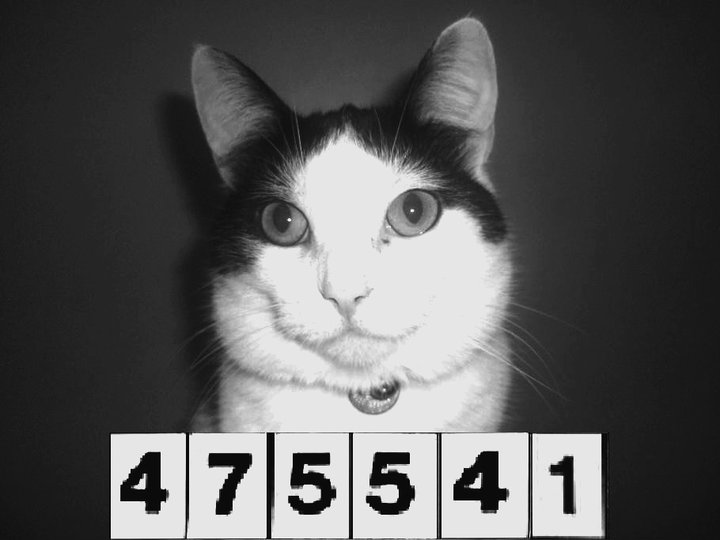
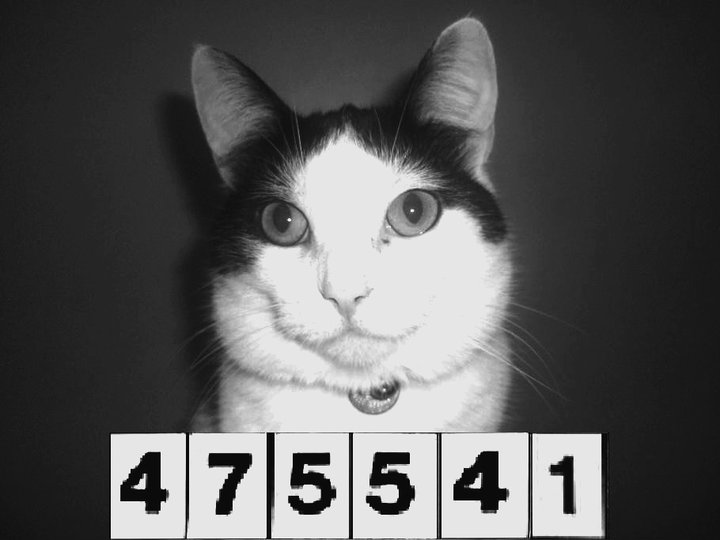
Trixie the Cat says….

The Shakespeare Code will reveal in later Posts how the appalling Henry Cuffe was the model for the appalling Iago…

And one or two other ‘philosopher villains’ as well….

Othello manipulated by Iago.

 So stay tuned to THE SHAKESPEARE CODE…

 Your STATION OF THE STARS!

Bye, now.

‘More flags than the exterior of Harrods…’

Apart from the UNITED KINGDOM of course (where our Head Office is currently located) The Code has been contacted by Brothers and Sisters in….

ONE HUNDRED AND NINETY EIGHT COUNTRIES

CURAÇAO

curacao map

SAINT MARTIN

sint maarten flag

LESOTHO

lesotho flag

MALI

mali flag

FRENCH POLYNESIA

flag french polynesia

CENTRAL AFRICAN REPUBLIC

central african republic

BENIN

benin

UZBEKISTAN

uzbekistan

LIBERIA

liberia

MADAGASCAR

madagascar

COTE D’IVOIRE

cote d'ivoire


SAINT VINCENT AND THE GRENADINES

saint vincent and the grenadines

PALESTINIAN TERRITORY, OCCUPIED

palestinian occcupied

MOZAMBIQUE

mozambique

UNITED REPUBLIC OF TANZANIA

tanzania united rerpublic

LIECHTENSTEIN

liechtenstein

CÔTE D’IVOIRE

cote d'ivoire

BHUTAN

bhutan

FRENCH GUIANA

french guiana

GAMBIA

Gambia

FALKLAND ISLANDS

falkland islands

ANGOLA

angola

GUADELOUPE

guadeloupe

BURUNDI

burundi

SENEGAL

senegal

SWAZILAND

swaziland

ETHIOPIA

ethiopia

GRENADA

grenada

SYRIAN ARAB REPUBLIC

syria

MALI

mali

HAITI

haiti

TONGA

tonga

KAZAKHSTAN

kazakhstan flag

NORTHERN MARIANA ISLANDS

north marianas islands flag

CAPE VERDE ISLANDS

cape verde flag

REUNION

reunion flag

 TURKS AND CAICOS ISLANDS

turks and caicos islands

ALGERIA

algeria flag

BOTSWANA

botswana flag

YEMEN

yemen flag

ARUBA

aruba flag

SAINT KITTS AND NEVIS

saint kitts and nevis

GUAM

guam flag

ALBANIA

albania flag

FAROE ISLANDS

faroes islands flag

BRITISH VIRGIN ISLANDS

british virgin islands

BARBADOS

MONACO

 SEYCHELLES

BAILIWICK OF JERSEY

AFGHANISTAN

MOROCCO….

MALAWI

SAINT LUCIA

CAYMAN ISLANDS

THE FORMER YUGOSLAVIA

UGANDA

BOLIVIA

OMAN

THE CO-OPERATIVE REPUBLIC OF GUYANA

ISLE OF MAN

MARTINIQUE

ANTIGUA AND BARBUDA

CHINA

GIBRALTAR

LIBYAN ARAB JAMHIRYA

ZIMBABWE

VIRGIN ISLANDS (U.S.A.)

BAHAMAS

THE BAILIWICK  (‘Ballywick’) OF GUERNSEY

MACAO

NAMIBIA

DOMINICAN REPUBLIC

GHANA

PAPUA NEW GUINEA

SAUDI ARABIA

MYANMAR

NEPAL

 FIJI

KYRGYZSTAN

CYPRUS

SURINAME

HONDURAS

MONGOLIA

SUDAN

BAHRAIN

LAOS

AALAND ISLANDS

NEW CALEDONIA

IRAN

ESTONIA

MONTENEGRO


BRUNEI DARUSSALAM

BERMUDA

NIGERIA

MOLDOVA

PANAMA

TANZANIA

MACEDONIA

CAMEROON

PARAGUAY

LUXEMBOURG

DOMINICA

KAZAKHSTAN

AZERBAIJAN

MALDIVES

BELARUS


BANGLADESH

TUNISIA

IRAQ

GUINEA-BISSAU

JORDAN

GUATEMALA

KUWAIT

URUGUAY

NORTH MARIANAS ISLANDS

AMERICAN SAMOA

TRINIDAD AND TOBAGO

KENYA

GEORGIA

RWANDA

MAURITIUS

ECUADOR

TAIWAN

 COSTA RICA

ARMENIA

PUERTO RICO

QATAR

BELIZE

CAMBODIA

LITHUANIA

JAMAICA

LATVIA

PERU

PAKISTAN

EL SALVADOR

SERBIA

LEBANON

ST.  VINCENT AND THE GRENADINES

BOSNIA AND HERZEGOVINA

VENEZUELA

EGYPT

FINLAND

ICELAND

JAPAN

KOREA

ROMANIA

UKRAINE

ISRAEL

ARGENTINA

SRI LANKA

NICARAGUA

VIET NAM

IRELAND

SLOVAKIA

SLOVENIA

THE REPUBLIC OF BULGARIA

THE REPUBLIC OF LEBANON

THE KINGDOM OF THAILAND

COLOMBIA

THE KINGDOM OF NORWAY

THE REPUBLIC OF CHILE

THE UNITED ARAB EMIRATES

THE PALESTINIAN TERRITORIES

THE NETHERLANDS

DENMARK

CZECH REPUBLIC

ITALY

MALTA

BELGIUM

INDONESIA

SWEDEN

 SWITZERLAND

PORTUGAL

GERMANY

AUSTRALIA

POLAND

 THE PHILLIPINES

SOUTH AFRICA

RUSSIA

 BRAZIL

HUNGARY

CROATIA

THE UNITED STATES OF AMERICA

CANADA

SPAIN

MEXICO

INDIA

GREECE

ZAMBIA

NEW ZEALAND

AUSTRIA

TURKEY

HONG KONG

MALAYSIA

SINGAPORE

FRANCE

More flags than the exterior of Harrods!

If you are a participating Brother or Sister from a country which has not been mentioned, please contact us (anonymously if need be) and we will add your homeland to this list…

WITH PRIDE!

(It is best to read The Introduction and Parts One, Two, Three, Four and Five first)

I WAS ADORED ONCE,TOO…

Norman Forbes as Aguecheek in Tree's 1901 Production of 'Twelfth Night'.

What dozen adjectives would you use to describe Sir Andrew Aguecheek?
 
The Shakespeare Code would like to offer the following:
 
 1. Foolish

Maria calls him ‘a foolish knight’ and Sir Toby ‘a gull’. He is barely aware of what is going on and joins in with jokes without understanding why they are funny.

2. Rich.

Sir Toby says Sir Andrew has ‘three thousand ducats a year’. (A ducat was a third of a pound, a pound was worth a modern £500: so Aguecheek’s annual income was £500,000).

3. Prodigal.

We see Sir Andrew tip Feste when  Sir Toby has already tipped him and when he’s aleady sent Feste a sixpence the night before.

Sir Toby claims to have made ‘two thousand strong’ from him. If  ‘strong’ = ‘stirling’ then Sir Toby has pocketed a cool £1 million from Sir Andrew.

In the course of the play, Sir Toby tells Sir Andrew to:

 Send for money, knight…

4. ‘Musical’.

Sir Toby says that Sir Andrew plays the viola di gamba and Sir Andrew himself says: ‘

I am dog at a catch…

5. Polyglottal.

Sir Toby claims Sir Andrew speaks ‘three or four languages, word for word, without book’. (But when it comes down to it, Sir Andrew cannot even translate ‘pourquoi’).

6. Vain

Sir Andrew says of his hair:

It becomes me well enough, does’t not…

And of his leg:

It does indifferent well in a dam’d coloured stock….

7. Quarrelsome.

Maria says of Sir Andrew:

 he’s a great quarreller…. 

and Sir Andrew certainly works himself up into a lather when he challenges ‘Caesario’.

8. Cowardly.

Maria says Sir Andrew has…

the gift of a coward to allay the gust he hath in quarrelling…

And Sir Toby says:

 if Sir Andrew were opened and you find so much blood in his liver as will clog the foot of a flea, I’ll eat the rest of th’anatomy…

9. Maladroit with women.

Sir Andrew wants to win the Countess Olivia, but he doesn’t even know how to chat up her serving-woman, Maria.

10. Plagiaristic.

Sir Andrew writes down in his commonplace book words from ‘Caesario’s’ address to the Countess Olivia.

11. Deluded.

Sir Andrew believes he is in with a chance with Countess Olivia.

He also believes that he:

 was adored once, too…

(It is possible, The Code admits, that his mother loved him…)

12. Manipulable.

Aguecheek succumbs immediately to flattery and does exactly what everyone tells him to do.

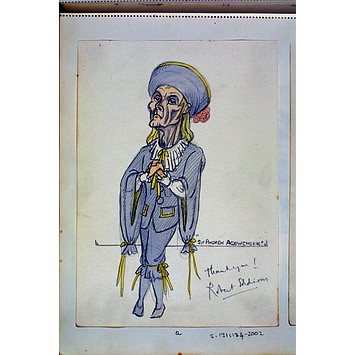
Robert Eddison as Sir Andrew

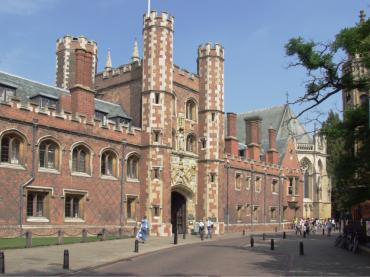
At Christmas, 1601, the students of St. John’s College, Cambridge, put on a three part, satirical ‘revue’ – The Pilgrimage to Parnassus and The Return from Parnassus. It had been delayed from Christmas 1600  because of the tense  political situation at the Court.

St. John's, founded by Queen Elizabeth's father

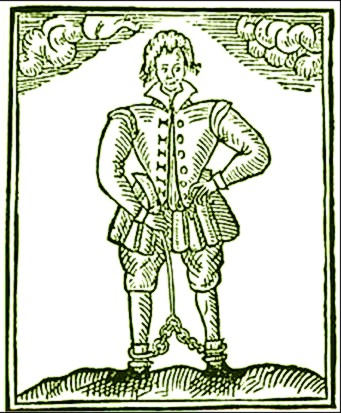
One of the characters in the play is called Ingenioso.

He makes his money from writing pamphlets, complains about the meanness of patrons and the inevitable poverty of scholars. 

The character is clearly based on Thomas Nashe – and, The Shakespeare Code believes – was written by him.

It would also have been played by him had he not died in the course of 1601.

Thomas Nashe

Another of the characters in the entertainment is called Gullio, who, The Shakespeare Code believes, is also based on a real person. 

Gullio can be described with exactly the same dozen adjectives as Sir Andrew Aguecheek!

1. Foolish.

Ingenioso introduces Gullio with:

Now gentleman you may laugh if you will, for here comes a gull…

2. Rich.

Gullio says to Ingenioso:

 I have restored thy dylaniated [torn to pieces] back and ruinous estate to those pretty clothes whererin thou now walkest…

He also claims to maintain other ‘poetical spirits’ that live upon [his] ‘trenchers’.

3. Prodigal

I am never seen at the court twice in one suit of apparrel: that’s base. As for boots, I never wore one pair above two hours…

4. ‘Musical’

How often of yore  have I sung my sonnets under her window to a consorte of music, I myself playing upon my ivory lute most enchantingly.

5. Polyglottal

My Latin was pure Latin, and such as they speak at Rheims and Padua.

And:

 It is  my custom in my common talk to make use of my reading  in the Greek, Latin, French, Italian, Spanish poets…

6. Vain

I had in my days not unfitly been likened to Sir Phillip Sidney, only with this difference, that I had the better leg, and more amiable face….

He adds:

 I stood stroking up my hair, which became me very admirably….

7.  Quarrelsome

Since my arrival in England (which is now six months I take sithens) I have been the death of one of our puling Liteltonians for passing by me in the Moor fields unsaluted, but that there was no historiographer by to have recorded it…..

8. Cowardly.

Ingenioso says of Gullio:

He never heardest the report of a gun without trembling –

9. Maladroit with women.

 He steals articles of women’s clothing (the ‘humble retainer to [a] busk’ and a ‘shoe-string’) to satisfy his ‘luxuriousness’.

He also demonstrates how he makes love to women by making love to Ingenioso!

10. Plagiaristic.

Ingenioso says Gullio

never spok’st witty thing but out of a play…[his] body is nothing a but a fair inn of fairer guests that dwell therein…

He has used William Shakespeare’s verse to seduce his Lesbia and says to Ingenioso that he…

will bestow on them [the ladies of the court] the precious stones of my wit, a diamond of invention that shall be above all value and esteem. Therefore, sithens I am  I am employed in some weighty affairs of the court, I will have thee, Ingeniosos to mke them, and, when thou hast done, I will peruse, polish and corrrect them.

11. Deluded.

He claims that ‘many dainty cout nymphs’ have ‘with petitioning looks’ ‘sued ‘ for his love’ and he has had  a great affair with a ‘Lady Lesbia’ of the court.

12. Manipulable.

Ingenioso, by flattering Gullio and promising to make him immortal, gains a commission from him.

OTHER SIMILARITIES….

In Twelfth Night Sir Andrew accepts the fact that other people describe him as a ‘fool’.

Malvolio says (quoting the letter): Besides you waste the treasure of your time with a foolish knight.

Sir Andrew: That’s me, I warrant you.

Malvolio: One Sir Andrew…

Sir Andrew: ‘I knew ’twas I , for many do call me fool’

Like Sir Andrew Aguecheek, Gullio also accepts the fact that other people describe him as a ‘fool’.

Igenioso, quoting Lesbia, says: ‘What? Gullio, that known fool?’ said she.

Gullio: Why that’s very true, my fame is spread far and near.

Brothers and Sisters of The Code will realise that….

THESE JOKES ARE EXACTLY THE SAME BECAUSE THEY ARE WRITTEN BY THE SAME PERSON:

THOMAS NASHE.

SIMILARLY….

In Twelfth Night Sir Andrew, asking about his hair, says:

It becomes me well enough, does’t not?

Sir Toby replies with:

Excellent, it hangs like flax on a distaff; and I hope to see a housewife take thee between her legs, and spin it off…

In The Return to Parnassus, Gullio says:

 I stood stroking up my hair, which became me very admirably….

 And a character called Sir Roderick says:

 Her viol de gamba is her best content

For twixt her legs she holds her instrument….

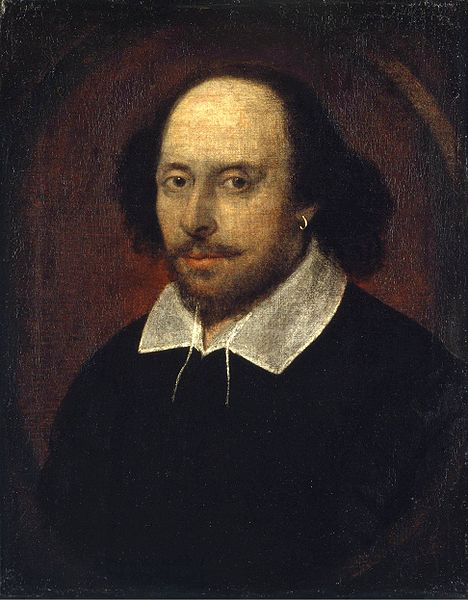
Gullio, we also learn, claims to be well-travelled and worships the work of William Shakespeare.

Let this duncified world esteem of Spencer and Chaucer, I’ll worship sweet Mr. Shakespeare, and to honour him will lay his Venus and Adonis under my pillow…I’ll have his picture at my study in the court…

The Chandos Portrait of William Shakespeare

In the course of the play, Ingenioso offers himself to Gullio as the poet who can make him immortal:

You have gotten a suppliant poet that will teach mossy posterity to know how that this earth in such a reign was blest with a young Jupiter.

But left alone, Igenioso’s true feelings about Gullio come out. He lambasts himself that, in his need for money, he’s had to creep around Gullio, listen to his lies, applaud his boasts and feed his lust by writing pornography for him:

He starts  with the line:

Farewell base carle clothed in a satin suit,

This is a parody of  Robert Greene’s death-bed attack on Shakespeare (which, as Brothers and Sisters of The Code well know, was really written by Nashe)

A tiger’s heart wrapped in a player’s hide

 This, in turn, is a parody of Queen Margaret in the Henry VI plays:

A tigers’ heart wrapped in a woman’s hide..

Ingenioso continues:

Farewell guilty ass, base broker’s post. 

Too oft have I rubbed o’er thy mule’s dead head,

Fed like a fly on thy corruption:

Now had I rather live in poverty

Than be tormented with the tedious tales

Of Gullio’s wench and of his luxuries,

To hear a thousand lies in one short day

Of his false wars at Portingale or Calls.

My freer spirit did lie in tedious woe

Whiles it applauded bragging Gullio

Applied my vein to sottish Gullio

Made wanton lines to please lewd Gullio.

Attend henceforth on Gulls for me who list,

For Gullio’s sake I’ll prove a Satirist.

So, if Ingenisos is Thomas Nashe, who is Gullio?

 Here are two more clues:

Clue A:  Thomas Nashe wrote a pornographic poem, The Choice of Valentines, which he dedicated to:

The Right Honourable, the Lord S.

It begins:

Pardon, sweet flower of matchless Poetry,

And fairest bud the red rose ever bare…

Clue B:  There was an English Earl whose crest contained four silver falcons: but many people mistook them for sea-gulls as his favourite estate was near to the coast.

 In 1618 one ‘ H.G.’ wrote in The Mirrour of Majestie:

 No storm of troubles, or cold frosts of friends,

Which on free greatnesss too too oft attends

Can, (by presumption), threaten your free state;

For these presaging sea-birds do amate

 Presumption’s greatness; moving the best minds

By their approach, to fear the future win

Of all calamity, no less than they

Portend to sea-mean a tempestuous day;

 Which you forseeing, may beforehand cross

 As they do them, and so prevent the loss….

ANSWERS.

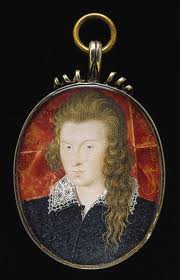
Clue A:  The Shakespeare Code believes that the right Honourable the Lord S. is Henry Wriothesley, the third Earl of Southampton.

Henry Wriothesley, third Earl of Southampton

Charles Nicholl has shown that Nashe must have written his Valentines  poem by April 1593. This is because Gabriel Harvey, in an attack on Nashe, threatened to:

 decipher thy [Nashe’s] unprinted packet of bawdy and filthy rhymes’ and denounce the ‘ruffianism of thy brother muse’. 

Southampton in 1593 was nineteen years old. His mother, Mary, the second Countess of Southampton, had commissioned Shakespeare to write seventeen poems for his seventeenth birthday to try to get him interested in girls.

Venus and Adonis and The Rape of Lucrece both border on the pornographic and both were dedicated to Southampton.

Nashe was simply carrying on a family tradition…

‘The fairest bud the red rose ever bore’ also refers to Southampton.

In his Sonnets, Shakespeare refers to him as ‘my rose’ – an allusion to the family name Wriothesley (which we know from the Titchfield Parish Register was pronounced ‘Riosely’ ) and the emblem of the town of Southampton.

Southampton Town Crest

The only other contender for the ‘Lord S.’ title would be Ferdiando Stanley, Lord Strange.

Ferdinando Stanley, Lord Strange

But by 1593 he was in his mid-thirties and with three daughters – scarcely in need, The Code would have thought, of  ‘wanton lines’ from Nashe

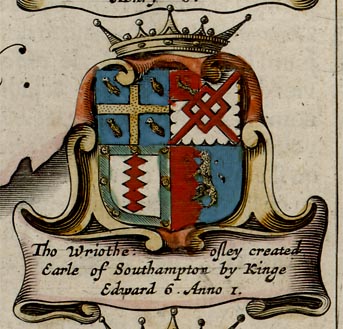
Clue B: The crest with ‘gulls’ that ‘H.G.’ is describing belonged to the Southampton family.

Falcons or Sea-gulls in upper left-hand corner?

So Gullio, The Shakespeare Code firmly believes, is:

 Henry Wriothesley, third Earl of Southampton.

 ACKNOWLEDGEMENT

The Code has learnt that the great German scholar, Dr. Gregor Sarrazin (1854-1915) was also of the opinion that Gullio was the third Earl of Southampton, and wrote so in:

Shakespeare Jahrbuch, XXXI, 217 ff.

If Gullio is the Earl of Southampton, then by implication, Sir Andrew Agueecheek is the Earl of Southampton as  well…..

(It’s best to read Part Seven now).


Recently the Chief Agent of ‘The Shakespeare Code’, with Trixie the Cat on his arm, attended a performance of Being Shakespeare at the Trafalgar Studios in London.

The script is by Jonathan Bate….

 and it is performed by Simon Callow….

The Agent and the Cat were so moved by the show that they told Simon afterwards over a glass of wine (and a saucer of milk) that his SUBLIME performance was even better than Robert Speight’s!!!

(For the significance of Speight, please click on the ‘Biography’ button at the top of the page).

What made the evening particularly thrilling was that the first half closes with an evocation of Shakespeare’s life with the Earl of Southampton in Titchfield!!!

THE CODE’S THEORIES ARE STARTING TO PERMEATE MAINSTREAM THOUGHT!

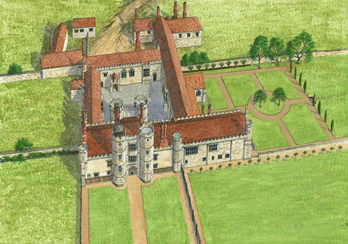
How 'Place House' (Titchfield Abbey re-built) looked in Shakespeare's time.

 To quote Prof. Bate’s script…

The Earl of Southampton’s household was at Titchfield Abbey in rural Hampshire. Here, the brilliant twenty-year-old, with his deep dark eyes, his tumbling locks, his earrings and his slashed doublet and hose, liked to hold court, entertaining poets, painters and philosophers in high style. It must have seemed a million miles away from plague-infested London: a huge formal garden in which to walk and think; limitless supplies of food and drink; servants; witty banter; access to a great library. One of Southampton’s guests was his language tutor, the formidable John Florio, who at that time was translating the work of the most modern thinker in Europe, Michel de Montaigne, who in his essays questioned everything, placing man, not God, at the centre of the universe. “What a piece of work is a man!”, Montaigne might have cried, had he been an English dramatist of genius, “How noble in reason! How infinite in faculty! In form and moving how express and admirable! In action how like an angel! In apprehension how like a god! The beauty of the world! The  paragon of animals!”

Hamlet was still only a glint in Shakespeare’s eye, of course, but already, almost overnight, his writing has changed. The plays are filled with new voices: courtship and courtiership, intellectual banter and philosophical speculation. Sonnets and love songs are woven into the their very texture. He’s already mastered barnstorming tragedy and knockabout comedy, sword fights and bawdy jokes for the gaping groundlings; but now he mixes it all together. Now he learns how to put the whole world on the stage. This is the moment, if there is a moment, at which Shakespeare becomes Shakespeare…

(At this point in the evening Trixie passed out in pleasure).

The Code thanks Simon and Jonathan, Roll of Honour Inductees.

Both gentlemen were kind enough to read  Love’s Labour’s Found  – the basis of The Shakespeare Code – when it was published in 2002.

To read Prof. Bate’s endorsement of The Code’s ‘Apis Lapis’ Theory, click here.

To read Simon Callow’s endorsement of the The Code’s ‘Titchfield’ and ‘Apis Lapis’ Theories, click here.


A STATEMENT FROM THE HEAD OFFICE OF THE SHAKESPEARE CODE

Thank you, Brothers and Sisters, from all over the world, for your continued – and rapidly growing – support.

We would like to present you with a bouquet of Southampton Roses…

Thank you, Brothers and Sisters of The Code


 It is our sworn intention to appoint a new Fellow every thousand views – and Brothers and Sisters will be delighted to learn that the Honour has fallen to the actress, singer and musician….

KAREN GLEDHILL

She now has the inalienable right to use the designated letters F.S.C. (Fellow of The Shakespeare Code) after her name and is already an Inductee of the coveted Roll of Honour.

On being told of her appointment, so great was Karen’s joy she burst into verse…..

A fellowship, you say, bestow’d on me?

Delightful, and such unexpected news!

This honour I accept most graciously,

It would be quit ill-mannered to refuse.

My humble contribution has been small,

‘Tis Trotter who has all the revelations,

An insight here or there as I recall

During some of our extensive conversations.

I must confess to finding it quite hard

To deal with all this public recognition,

The credit surely lies with our dear Bard

Without whom none of this would have been written.

In gratitude I dedicate this Ode

To Stewart, Trixie and The Shakespeare Code!

The Shakespeare Code has decided to limit the number of Fellows to 35 – the number of Shakespeare plays listed in the First Folio. Each Fellow will ‘adopt’ a Shakespeare play as his or her area of special interest.

Our first Fellow (Janet St. John-Austen, F.S.C.) has chosen Hamlet as she believes it to be the Shakespeare play that follows most closely the contours of her own complex mind.

 Karen Gledhill, F.S.C., has chosen A Midsummer Night’s Dream for an equally special reason which Trixie the Cat will now reveal…

Trixie writes:

Blonde, smiling, cooly intellectual but warmly human, the lovely Karen knew she was going to be an actress at the age of five!  A  parent came in’ to do drama’ at her North London primary school.

Karen was HOOKED!

Most of her childhood and teen age years, however, were spent playing music and singing in a variety of music schools and at the highly prestigious, highly competitive, Camden School for Girls.

But she went on to study Classics at the even more prestigious (and even more competitve) Newnham College, Cambridge, where she  embarked on what she calls….

the alternative theatre training offered there…

Newnham College, Cambridge, a closet Academy of Drama.

Her first job was as an actress/musician with a children’s company in which she played a kidney, a tooth-rot gangster, a rain cloud, and a cowgirl with a six foot high banana puppet called Rocky! This was in the days when you had to earn your equity card…

There followed a few years of repertory and touring, including six months at the Northcott Theatre in Exeter,  then run by The Code’s own Stewart Trotter.

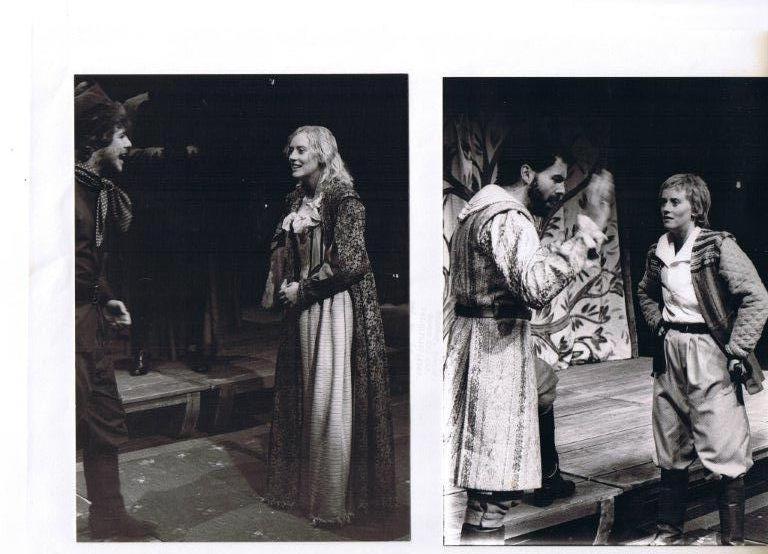
It was here that she played a spirited and touching Viola in  Twelfth Night, set on a frozen river. She made a spectacular  first entrance, drenched  in sea-water and walking barefoot on the ice…

Karen as Viola and Caesario.

To read the late, great B. A. Young’s review of the production in The Financial Times, click here (We’ve added new photographs to this Post).

Some peachy T.V. roles followed her Exeter season,  including Poirot and the English nation’s favourite T.V. show, Dr. Who.

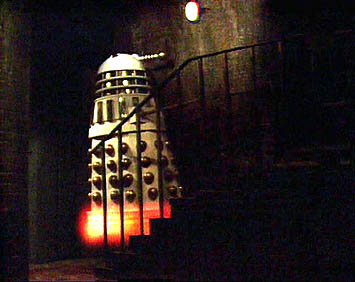
Karen has the distinction of being in the famous episode when the Daleks learned to walk up stairs!  Children all over England ran  to the ‘safety’ of their bedrooms, but TO NO AVAIL! 

Dalek climbing stairs.

 In 1990 life changed with the birth of her first daughter, and she has been acting as chauffeur, cook, psycho therapist, teacher nanny – in other words ‘mother’  for the last 21 years…

But, interspersed with other jobs (breast-feeding counsellor, school governor, swimming club secretary, etc. etc.) she has sustained a spordic acting career and was recently spotted in Wallander

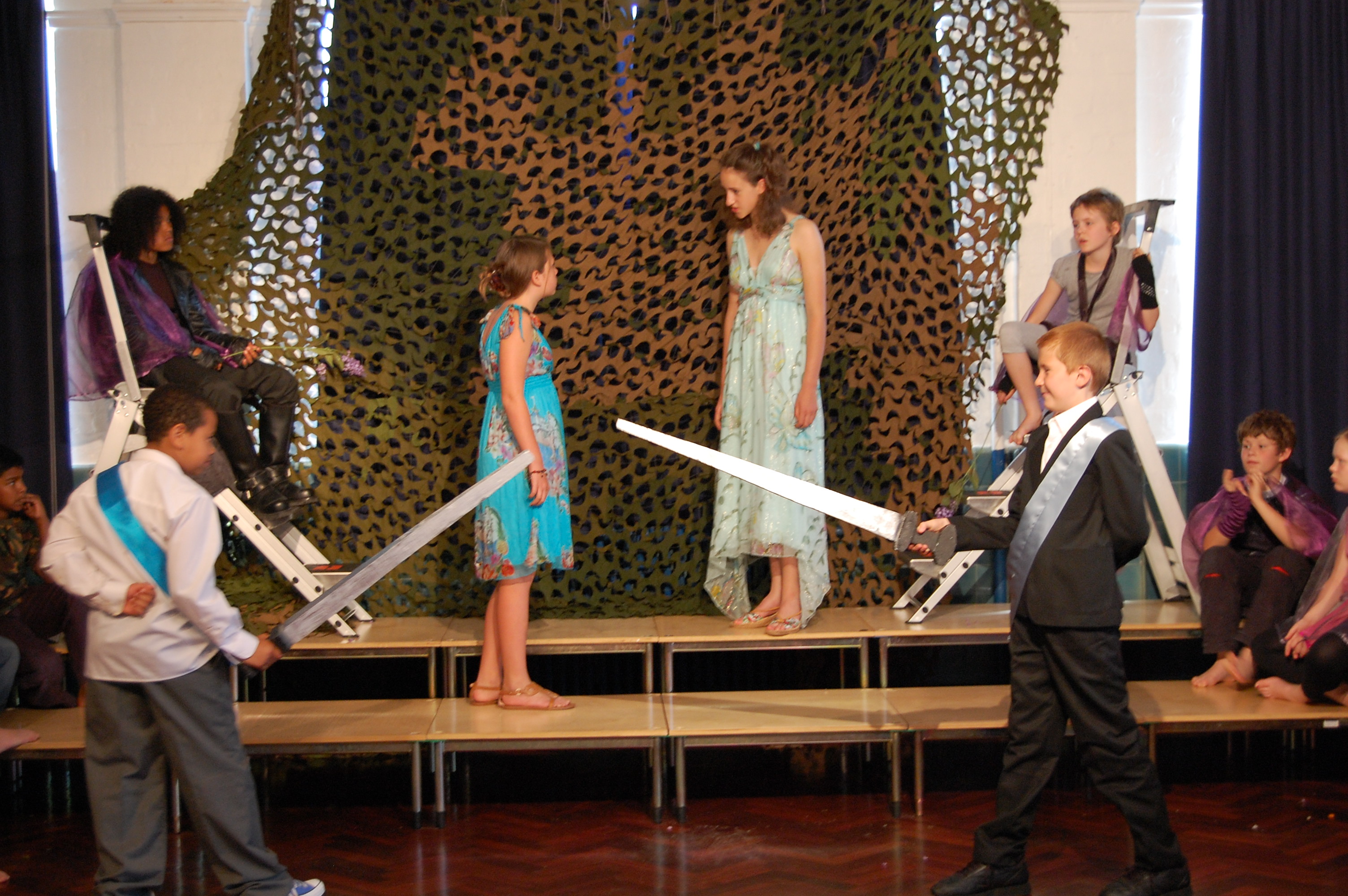
In 2008 Karen suddenly got the idea of adapting A Midsummer Night’s Dream for the Hanover Primary School in North London, where her daughter was in her final year.

Karen turned it into a musical with choral narrative and commentary.  All the spoken parts are original Shakespeare, but much of the play is sung to modern lyrics – all written and composed by Karen.

The Headmistress of the school, Amanda Reese, writes:

The show was a resounding success on many levels. Children gained a real understanding of the story and were quite un-phased by the Shakespearian language. They performed with fantastic confidence and great skill both in their delivery of the lines and in their singing.

 Karen’s musical adaptation appealed to all with its catchy melodies and great humour. The children in the production clearly enjoyed every moment and spoke with tremendous enthusiasm about their experience.


Parents of children at the school were equally enthusiastic. One wrote to Karen:

Just to say again how touching, witty, stylish and altogether stunningly enjoyable I found today’s production.   I think the lyrics and music quite exceptional and think you are truly gifted as a lyric and song-writer.   Shakespeare would have burst into tears with delight.   I am quite sure this version of ‘MND’ will be done over and over again…

The parent was quite right: the adaptation has been performed in 4 other schools and many more are lining up to perform it…

..It even received a rave review from Rosie Millard in The Sunday Times who reported that Professor Jonathan Bate (another Roll of Honour Inductee) thoroughly approved.

(To read Professor Bate’s endorsement of The Code’s ‘The Strange Case of Mr. Apis Lapis’ click here.)

IF YOU ARE INTERESTED IN PRODUCING THIS GREAT SHOW,  CONTACT US AT THE CODE AND WE”LL PASS ON YOUR DETAILS TO KAREN!!!

Karen’s link and interest in The Shakespeare Code is through a long friendship with The Code’s Chief Agent, Stewart Trotter. 

He is is also her Acupuncturist…

HE  COULD BE YOURS IF YOU LIVE IN LONDON!!!

(He practises in South Kensingtgon and Kilburn)

See: www.stewarttrotter.com

Bye, now….

THE SHAKESPEARE CODE EXTENDS ITS WARMEST CONGRATULATIONS TO KAREN GLEDHILL, F. S. C., A FINE ACTRESS AND A STAUNCH AND LOYAL FRIEND.

To read Karen’s own endorsement of The Shakespeare Code, click here.

To read about The Code’s appointment of its first Fellow (Sister Janet St.John-Austen, F. S. C. )

click here.


(It’s best to read The Introduction and Parts One, Two Three and Four first.)

LOVE-SICKNESS…

When William Shakespeare and Thomas Nashe re-wrote the old play What You Will and turned it into Twelfth Night, they changed the leading character’s name to Orsino.

This was to flatter Queen Elizabeth’s Twelfth Night guest, Don Virginio Orsino, Duke of Bracciano.

But who did Orsino really represent?

At the start of the play he lies ‘love-sick’  for the Countess Olivia…

 He hopes that by listening to excessive amounts of music ( ‘the food of love’)  his appetite for it…

may sicken and so die….

When a servant suggests he goes hunting, he compares ‘the hart’ he would chase to the ‘heart’ of Olivia…

O when mine eyes did see Olivia first,

Methought she purg’d the air of pestilence;

That instant was I turned into a hart,

And my desires, like fell and cruel hounds,

E’er since pursue me…

When the Court audience heard these words, they would have known immediately who Orsino was…

Orsino is comparing himself to Acteon, a hunter who stumbled upon the naked Goddess Diana when she was bathing with her nymphs….

Titian's depiction of Acteon and Diana

In a fury the Goddess transformed Acteon into a stag and he was torn to pieces by his own hounds…

Titian again

 The same story was told by Ben Jonson in his Cynthia’s Revels, an entertainment performed at the  Court  by the Children of the Chapel…

 On exactly the same day as Twelfth Night!!!

Jonson has the nymph Echo say

Here young Acteon fell, pursued and torn

By Cynthia’s wrath (more eager, than his hounds)

And Cynthia/Diana herself says..

For so Acteon, by presuming far

Did (to our grief) incur a fatal doom…

Seems it no crime to enter sacred bowers,

And hallowed places, with impure aspect,

Most lewdly to pollute?  Seems it no crime,

To brave a deity?  Lewd mortals learn

To make religion of offending heaven;

And not at all to censure powers divine.

To men, this argument should stand for firm,

‘A Goddess did it, therefore it was good:

We are not cruel, nor delight in blood…

The ‘sacred bowers’ Jonson refers to are Queen Elizabeth’s private chambers at Nonesuch Palace and the ‘impure aspect’ belonged to Robert Devereux, the second Earl of Essex, when he burst into them before the Queen  had time to put on her wig and make-up.

Or, as contemporary Rowland White put it…

she not being ready, and he so full of dirt and mire that his very face was full of it…..

After the initial shock, the Queen was glad to see the man she loved. He’d returned, unannounced, from his Irish campaign to counter the rumours that were circulating about him at the Court.

Sir Robert Devereux, second Earl of Essex

But it was too good an opportunity for his enemies to miss. Sir Robert Cecil and Sir Water Raleigh poisoned the Queen’s mind against Essex. He was banished from her sight and kept for a long time under house arrest………..

….despite his illness (he had the ‘Irish flux’) and

….despite his protestations of love (for the Queen)…

He was suffering, in fact, from a very literal  form of  ‘love-sickness,’ very similar to Count Orsino’s….

Shakespeare, by giving  Orsino great verse to speak…

O it [the music] came o’er my ear like the sweet sound

That breathes upon a bank of violets,

Stealing and giving odour…

…is inviting the Queen to empathise with the character of Orsino and so pity the sufferings of Essex.

Jonson, on the other hand, is stating that the Queen was right to punish Essex. He knew that if Essex was destroyed, Shakespeare his rival might be destroyed along with him.


On Twelfth Night there was a third ‘Essex’ play performed at Court, Phaeton by Thomas Dekker. This lost piece was based on the ‘Sun-Chariot’ myth. Phaeton insists, in his arrogance, on driving his father’s sun-chariot. In the process, he nearly destroys the world….

Phaeton struck by Jove's thunderbolt.

 He certainly destroys himself. An indignant Jove dispatches him with a thunderbolt.

This play was put on byThe Admiral’s Men. The Admiral concerned was Charles Lord Howard (later Earl of Nottingham) Essex’s bitter enemy.

The punishment Jove gives Phaeton (death) is, Lord Howard suggests, the one Elizabeth should give to Essex.

Nottingham’s hatred for Essex, as The Shakespeare Code will reveal in a later post, led not only to the death of Essex, but to to the deaths of his own wife and of the Queen herself…

Essex had finally been freed from house arrest in London to live on his country estates; but when, in 1600, he declared to the Queen…

That he kissed her royal hand and that rod which had corrected him, not ruined him: but he could never be possessed of his wonted joy till he beheld again those benign looks of hers which had been his Star to direct and guide him….

The Queen drily observed…

All is not gold that glistereth….

She was well aware that  Essex’s farm on sweet wines – his main source of income – was due for renewal.

She refused to do this. So Essex was ruined.

His relationship with the Queen had always been a sado-masochistic one.  He was half  her age – and the game was one of  who would dominate whom, Essex with his youth or Elizabeth with her power…

In 1594, Essex had  written an extraordinary  letter to her:

If my horse could run as fast as my thoughts do fly, I would as often make mine eyes rich in beholding the treasures of my love , as my desires do triumph when I seem to myself in a strong imagination to conquer your resisting will…

Now he was grovelling on the ground before her, doing a good impersonation of Sir Walter Raleigh’s cloak…

‘Consumed by silence, solitariness and sighs’,  Essex even wrote a poem to Elizabeth in which he yearned to…

…..finish forth his  fate

In some enchanted desert, most obscure

From all society, from love, from hate

Of  worldly folk, then would he sleep secure

Then wake again and yield God ever praise

Content with hips and haws and bamble berries,

In contemplation passing still his days,

 And change of holy thoughts to make him merry;

 And when he dies, his tomb may be a bush

Where harmless robin dwells with gentle thrush…

‘Harmless Robin’ here sounds just like Orsino who is…

Best when least in company….

But he sounds even more  like Timon of Athens who, when he ran out of money and was deserted by his ‘friends’, retreated ‘to the woods’ and lived, without husbandry, on the spontaneous produce of nature. As Timon says to a group of Banditti…

….Behold the earth hath roots;

Within this mile break forth a hundred springs;

The oak bears mast, the briar scarlet hips;

And bounteous housewife nature on each bush

Lays her full mess before you…

The Shakespeare Code believes that Shakespeare wrote Timon to try to convince Essex to take up a Stoical position to his fate. (It also believes that Shakespeare himself wrote ‘Essex’s’ poem to the Queen).

Shakespeare wanted Essex to cut all ties with London and the Court and to live in isolation in the countryside like Timon, indifferent to the world and its ways….

This was a real possibility. Essex, a dreamy, romantic country boy, loved the Welsh landscape and might never have come to the Court if his family had been wealthy.

He would certainly never have become Elizabeth’s toy-boy…

Many thought Essex, who surrounded himself with many ‘kindle-coals and make-bites’ , was, by this stage, completely mad. The Queen’s godson, Sir John Harington (who claimed to have invented the water-closet) wrote:

'Ajax' Harington

he [Essex] shifteth from sorrow and repentance to rage and rebellion so suddenly, as well proveth him devoid of good reason as of right mind. In my last discourse he uttered strange words, bordering on such strange designs, that made me hasten forth and leave his presence…His speeches of the Queen become no man who hath mens sana in corpore sano[a healthy mind in a healthy body]. The Queen well knoweth how to humble the haughty spirit; the haughty spirit knoweth not how to yield, and the man’s soul seemeth tossed to and fro like the waves of a troubled sea…

But Theseus in A Midsummer Night’s Dream declares that

The lunatic, the lover and the poet

Are of imagination all compact..

Shakespeare in Twelfth Night  is trying to take a similar attitude to Essex’s ‘madness’. He is suggesting that Essex’s ravings, like Orsino’s in the play, are the expression of a thwarted love for a beautiful woman…i.e. Elizabeth.

Shakespeare also hoped there would be a ‘wisdom’  in Essex’s  ‘madness’ as there is in Timon’s. Timon develops a coherent,  philosophical indifference to the world and its ways, a true ‘contemptus mundi’.

Shakespeare also hoped that  the ‘troubled sea’ of Essex’s spirit might find the same sort of resolution as Timon’s, who hopes to make…

…..his ever-lasting mansion

Upon the beached verge of the salt flood,

Who once a day with his embossed froth

The turbulent surge shall cover…

But Shakespeare was certain of one thing:

the Earl of Essex was in no mental state to take any kind of political action himself.

We also know, from the great Regency historian Lucy Aikin, that Essex was drinking heavily…

Unfortunately there were others in the Essex entourage who were urging rebellion…

Shakespeare was in basic support of Essex’s ideals. But there was one area in which the two men differed – sex.

Shakespeare had never been happy that Essex’s political influence resided in his liaison with the ageing, capricious Queen. In Sonnet 25 he had written:

Great Princes’ favourites, their fair leaves spread

But as the marigold at the sun’s eye,

And in themselves their pride lies buried,

For at a frown they in their glory die…

The image of the marigold evokes the image of Essex in his orange-coloured Devereux armour….

But after the Rebellion, when Essex had betrayed all his followers, Shakespeare reveals his open contempt for him in Sonnet 25:

Have I not seen dwellers on form and favour

Lose all, [Essex’s money] and more, [Essex’s head] by paying too much rent [semen]

For compound sweet, [farm on sweet wines] forgoing simple savour,

Pitiful thrivers in their gazing spent…[Essex’s ‘gazing’ on the ‘naked’ Queen]

But there was another aspect of Essex that Shakespeare despised:

he was secretive about his homosexuality.

Shakespeare, good Catholic boy that he was, was not always happy about his own bi-sexual orientation. He talks about his ‘outcast state’  in Sonnet 29 and presents the two gay Antonios in his plays (The Merchant of Venice and Twelfth Night) as sad, old losers.

But he was as open as possible as he could be about his overwhelming love for Southampton – even defiant about it in Sonnet 121 where, parodying God in The Book of Job,  he writes:

For why should others false, adulterate eyes

Give salutation to my sportive blood?

Or on my frailties why are frailer spies

Which in their wills [penises] think bad which I think good?

No, I am that I am, and they that level

At my abuses reckon up their own,

I may be straight though they themselves be bevel

By their rank thoughts my deeds must not be shown…

Queen Elizabeth was well aware of Shakepeare’s sexual inclinations: she described him to the scholar William Lambarde as a man who had ‘forgotten God’.

She would have been appalled if she had known that her lover, Essex,  had ‘forgotten God’ as well….

The Shakespeare Code is indebted to Roll of Honour Inductee and great Shakespearean scholar, Martin Green, for his work in this area, included in his ground-breaking book Wriothesley’s Roses [Clevedon, 1993].

An endorsement from Mr. Green of The Shakespeare Code can be read in the ‘About The Shakespeare Code’ Section (click button above). He is currently putting his finishing touches to a new book on Willobie his Avisa.

Mr. Green has discovered that the moment the Earl of Essex was admitted into the Inner Temple (a month before his twenty-first birthday in 1588) he constructed a hexagonal bath in the Strand  (from an overflow from a Roman Bath) for fellow ‘Templars’.

This alone, of course, doesn’t prove that Essex was gay: but we know from John Aubrey that the homosexually-inclined Sir Francis Bacon used his Bath House at Gorhambury as a ‘stuffe’ [brothel].

Sir Francis Bacon

Bath House Devotee

Also at the time of  the Essex Rebellion Trial, one William Reynolds wrote anonymously to Sir Robert Cecil, saying:

I do marvel also what became of Pearse Edmones, called Captain Pearse or Captain Edmones, the Earl of Essex’s man, born in Strand near me, one which has had many rewards and preferments by the Earl of Essex. His villainy I have often complained of.  He dwells in London. He was Corporal General of the Horse in Ireland under the Earl of Southampton. He ate and drank at his table and lay in his tent. The Earl of Southampton gave him a horse, which Edmondes refused a 100 marks for him. The Earl of Southampton would cole and huge [embrace and hug] him in his arms and play wantonly with him.

Delving through Essex’s papers, Mr. Green has  found…

a great number of receipts in 1599 and 1600 of sums of money paid by the Earl of Essex to various persons, including ‘Captain. P. Edmonde’ who was ‘so favoured as he often rode in a coach with him [Essex], and was wholly of his charges maintained, being a man of base birth in St. Clement’s Parish..’.

Men riding together in coaches was thought highly suspect. Mrs. Bacon wrote to her son Francis:

Though I pity your brother [Anthony, also gay] yet as long as he pities not himself but keepeth that bloody Perez [Antonio Perez, a Spanish homosexual], yea, as a coach-companion and a bed-companion, a proud, profane costly fellow, whose being about him I verily fear the Lord God doth mislike, and doth less bless your brother [Francis] in credit, and otherwise in his health, surely I am utterly discouraged…

Antonio Perez who loved to ride in coaches with Anthony Bacon.

Perez, who was part of Essex’s spy-ring, reported to Essex a conversation he’d had at Windsor with Dom Antonio de Crato, the exiled half-Jewish claimant to the throne of Portugal and Rodrigo (Ruy) Lopez, the Jewish chief physician to the Queen.

According to Geoffrey Goodman (who heard the story from Sir Henry Savile) Lopez had been ‘making merry’ [i.e. getting drunk] with Crato and Perez then…

began bitterly to inveigh against the Earl of Essex, telling some secrecies, how he had cured him and of what diseases, with some other things that did disparage his honour. But as soon as Lopez was gone, they went instantly to the Earl of Essex, and, to ingratiate themselves in his favour, did acquaint him with all the several passages. Here the Earl was so much incensed, that he resolved to be revenged on him and now he began to possess the Queen that Lopez was a very villain…and did intend to poison the Queen..

Rodrigo Lopez 
 

Lopez, who pleaded his innocence to the end, was hanged drawn and quartered so that Essex could stay ‘in the closet’.

Even the official history of Elizabeth’s reign mentions one Essex’s young boyfriends, Henry Tracey. Essex picked him up in Dublin, made him his page and employed him as  post-boy between himself and Queen Elizabeth.  Killed during the RebellionTracey was afterwards described by the historian William Camden as…

…a young gentleman whom Essex dearly loved…

Shakespeare ‘outs’ Essex in the course of Twelfth Night, but in the gentlest of ways.

 Orsino gradually  falls in love with his own beautiful page and post-boy, Caesario

But all’s well…

As Brothers and Sisters of The Code well know, Caesario is really a girl…

(It’s best to read Part Six now.)

(It is best to read The Introduction and Parts One, Two and Three first)

GREATNESS THRUST UPON THEM…

As Brothers and Sisters of The Code well know, Malvolio is the Countess Olivia’s steward..

Sir Henry Irving as Malvolio.

In a big household like Olivia’s – more like a small town than a house – the steward’s job was of tremendous importance, even more so as Olivia’s brother has unexpectedly died.

William Shakespeare would have seen, at first hand, the pressures on a single woman running a big household at Titchfield. …

'Reconstruction' of Place House, Titchfield

The Countess of Southampton’s husband had died in 1581, so when Shakespeare was ‘adopted’ by her (in 1590) Countess Mary would have been in charge there for nearly a decade…

A single woman, with power and money, is always a target for an unscrupulous man…

Malvolio is one of these. He has come from ‘nowhere’, his ambition is endless and he’s ‘in it’  for himself alone….

He wants control over the whole household, to destroy Sir Toby and Feste and marry the beautiful Countess Olivia.

Like the other ‘Puritan’ in Shakespeare, Angelo (in Measure for Measure) Malvolio has a massive, repressed sex-drive. It is, we learn in the play, his fantasy to share a ‘day-bed’ with Olivia where he could leave her sleeping after day-time sex….

 Then, whilst waiting to reprimand his ‘cousin Toby’ he could…

frown the while, and perchance wind up my watch , or play with my – some rich jewel….

(‘Jewel’,  as Brothers and Sisters of The Code well know, could also have the same phallic association that the phrase ‘Crown Jewels’ has today)

The brilliant Maria sums Malvolio up as…

a time-pleaser, an affectioned ass, that cons state without book, and utters it by great swarths: the best persuaded of himself so crammed (as he thinks) with excellencies, that it is his grounds of faith that all that look on him love him…

The parallels between Olivia’s rule of her household and Queen Elizabeth’s of England are, The Shakespeare Code believes, obvious. It was the unexpected deaths of her half-brother (King Edward) and half-sister (Queen [‘Bloody’] Mary)  that brought Elizabeth to the throne.

After the death of Robert Dudley, the Earl of Leicester in Armada year (1588)  there was a power vacuum at the court.

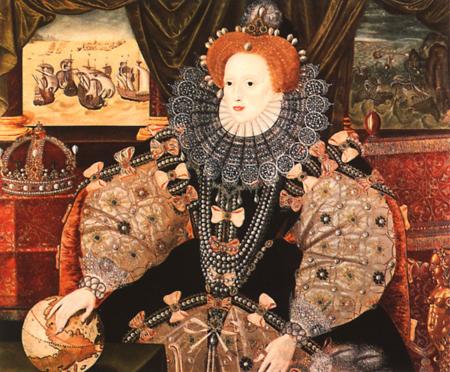
Queen Elizabeth's Armada Portrait (1588)

Men who wanted that power had to woo Elizabeth. Mostly they came from established families, but they all had one thing in common….

No wealth of their own.

Even Robert Devereux, the second Earl of Essex (Leicester’s stepson) was penniless after the Queen had called back her loans to Leicester from Essex’s mother, the hated Lettice.

Elizabeth adopted, as so many ‘tyrants’ have done, a policy of ‘divide and rule’. Whoever, for example, was first with news at the Court had the upper hand – so all the ambitious coutiers developed spy networks throughout Europe.  At their own expence, of course….

Elizabeth got a thrill from seeing young men fighting – often literally – for her favour. They might form temporary alliances with one another – but their basic desire was to eliminate rivals to gain her attention. And if money and wealth meant sleeping with the ageing Queen – who by then had no fear of conceiving a child – they were prepared to pay the price.

By 1601 (the year of Twelfth Night) Essex had lost out in the struggle.  Sir Robert Cecil and Sir Walter Raleigh (in an unholy alliance) had set him up to fail.

They persuaded a reluctant Queen Elizabeth to send him to Ireland to fight the ‘rebel’ leader, Tyrone,  a job for which he was completely unsuited. He was gallant and brave on short campaigns, but a piece of sustained warfare was beyond his volatile, romantic nature.

Essex preparing to joust.

Essex, to crush the negative whispers against him at the Court, had left Ireland without the Queen’s permission. He had rushed, unannounced, into her morning chamber.

Before she’d had time to put on her wig or make-up…

Cecil and Raleigh made sure he was never to be forgiven.

Essex and Southampton wanted to kill these two ‘caterpillars’: but many of Essex’s followers, including Shakespeare, favoured appeasement.

When Sir Toby learns that Malvolio wants to sleep with his niece, Countess Olivia, his first thought is violence. But Maria convinces him that to make Malvolio a laughing-stock is a far more powerful option.

This idea was in  the minds of Shakespeare and Nashe when they re-wrote What you Will. Let the Court audience laugh at ‘the caterpillars’ and their influence over the Queen will cease…

Sir Robert Cecil was small and round-shouldered….

Sir Robert Cecil

….. but  had his share of sexual triumphs, including the Countess of Pembroke

A contemporary lampoon went…

Robert Cecil, Robert Cecil

All back and all pistle….

…..Queen Elizabeth, though, was not one of Sir Robert’s triumphs.

 The man in the sites of Shakespeare and Nashe, when they created Malvolio, was…….

 Sir Walter Raleigh

(pronounced ‘Rawley’)

The Code believes Raleigh is the model for Malvolio because:

1. Raleigh claimed, in private conversation, he was the lover of the Queen

Francis Osborn, who was 10 years old when Elizabeth died, heard Sir Walter Raleigh say….

That minions were not so happy as vulgar judgements thought them, being frequently commanded to uncomely and sometimes unnatural imployments.

Osborn indicates that the Queen’s ‘amorous caresses’, by ‘age and a unversal distribution’  had become ‘tedious if not loathsome…

Sir Walter, rather like Malvolio, seems to have had ‘greatness thrust upon him’ by the Queen.

2. Raleigh had a massive sex-drive. According to John Aubrey, he had ‘vertical’ sex against a tree with one of Elizabeth’s ladies-in-waiting…

who seemed at first boarding to be somewhat fearful of her honour, and modest, she cried ‘Sir Walter, what do you ask me? Will you undo me? Nay sweet, Sir Walter! Sweet Sir Walter! Sir Walter!’  At last as the danger and the pleasure at the same time grew higher, she cried in the ecstasy ‘Swisser Swatter Swisser Swatter…

As Captain of the Guard, Raleigh even had a key to the dormitory of the young ladies-in-waiting….

3. Raleigh  was, according to Aubrey, ‘damnable proud’.  (Olivia describes Malvolio as ‘sick of self-love’).

4.  Raleigh  was a personal enemy of the Earls of Essex and Southampton. So he was consequently the enemy of William Shakespeare.

He was also the enemy  of Thomas  Nashe who (with Shakespeare) had lampooned him as the figure of  the penniless ‘Braggart’ in the 1592 version of Love’s Labour’s Lost.

Raleigh had promised Nashe money for a book he was writing, but in the end gave him nothing. Nashe launched a coded attack on ‘the upstart’, Raleigh in his pamphlet  Pierce Pennilesse, by asking…

what reason have I to bestow any of my wit upon him that will bestow none of his wealth upon me? Alas it is easy for a goodly tall fellow [Raleigh was six feet] that shineth in his silks [Raleigh dressed to the nines] to come and outface a poor simple pedant in a threadbare cloak and tell him his book is pretty but at this time he is not provided for him…

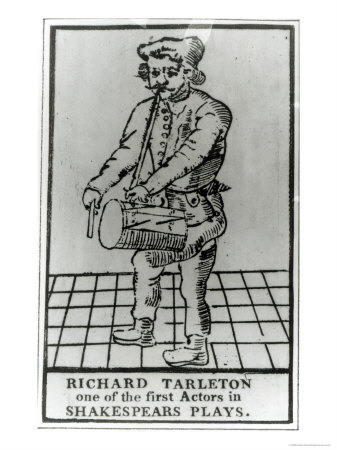
  • Nashe used Twelfth Night to dramatise his own clash with Raleigh in the confrontations between Feste and Malvolio. Also, by suggesting he was the ‘spirit’ of the Queen’s favourite jester, Tarleton…..


…..Nashe was obliquely referring to a  famous incident earlier in Queen Elizabeth’s reign….

 Edmund Bohun (1645-1699) writes:

Tarleton, who was then the best comedian in England had made a pleasant play – and when it was acted before the Queen, he pointed at Sir Walter Raleigh and said ‘See the Knave commands the Queen’. For which he was corrected by a frown from the Queen; yet he had all the confidence to add that he was of too much and too intolerable a power….

Nashe, playing Feste, is saying exactly the same thing about Raleigh to exactly the same person!

5. Raleigh wore flashy outfits to catch the eye of Queen Elizabeth.

Raleigh came from an old, but impoverished family (his father rented the family house); but from the beginning Raleigh wore expensive outfits to try to look rich. As Nashe points out..

the weaver’s looms first framed the web of his honour…

And Raleigh was prepared to sacrifice this ‘honour’ to gain more ‘honour’.  As Thomas Fuller (1608-1661) reported in his Worthies….

Captain Raleigh found the Queen walking, till meeting with a plashy place, she seemed to scruple going thereon. Presently Raleigh, though his clothes were then a considerable part of his esate, cast and spread his new cloak on the ground; whereon the Queen trod gently, rewarding him afterwards with many suits…

Raliegh lays down his honour...

An essential part of Raleigh’s ensemble was a tall hat with a pearl band and a large, black-jewelled feather….

Sir Walter Raleigh

Nashe tells us that Raleigh would…

sonnet a whole quire of paper in praise of Lady Swine-Snout, his yellow-faced Mistress, and wear a feather of her rain-beaten fan for a favour, like a fore-horse…

In older productions of Twelfth Night,  Malvolio often wore ‘a tall hat with a large feather’  in the famous ‘letter-scene’ to make sense of Fabian’s line…

O peace, Contemplation makes a rare turkey-cock of him: how he jets under his advanced plumes….

6. Raleigh wore white ribbons in his shoes….

It’s difficult to tell who is more absurd, Malovolio with his yellow stockings and cross-gartering….

                                                                                                                                                                                                                                                                                                                                                                                                                                                                                                                                                                                                                                                                           rSir or Sir Walter with his shoes studded with gems and white ribbons…

Raleigh and Son…
7.  According to Aubrey, Raleigh’s ‘beard turned up naturally’ as we can see from Nicholas Hilliard’s miniature….
 

Sir Walter Raleigh


As we can also see from the illustration of Sir Henry Irving playing Malvoilio above, and Beerbohm Tree below…
 

Beerbohm Tree as Malvolio

 
………it was once  a theatrical convention to play Malvolio with an upturned beard. 


Shakespeare and Nashe were trying to warn the Queen that, like Olivia, she was advancing the men who were out to harm her…
 
Even Malovolio’s yellow stockings would have signalled Raleigh’s disloyalty: yellow was the colour Philip II had used as the base of his Armada flag….
 

Philip II's flag

 
Maria tells us that Oliviaabhors’ the colour yellow. We do not know if the Queen  herself shared this dislike, but  Lucy Aikin, the great Regency historian, tells us that during the Armada celebrations Elizabeth was…
 borne along on a sumptuous chariot formed like a throne, with four pillars supporting a canopy, and drawn by white horses. The streets through which she passed were hung with blue cloth, in honour doubtless of the navy, and the colours taken from the enemy were borne in triumph…
So the colour yellow would have been publicly associated with the defeated Spanish Armada, rather in the way swastikas are nowadays associated with the Nazis.
 

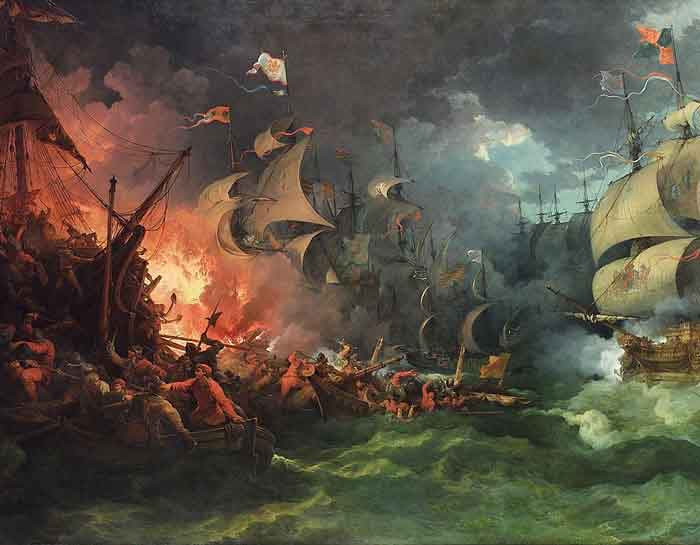
The Armada off Gravelines. Note the yellow streamers from the Spanish ships.

 Shakespeare and Nashe were suggesting in code what Coke, the Crown prosecutor, was to say openly about Raleigh at his trial for treason at Winchester two years later:
 Thou  [Raleigh]art the greatest Lucifer that ever lived. Nay I will prove all. Thou art a monster. Thou hast an English face but a Spanish heart.
 Shakespeare and Nashe also believed that Elizabeth was cutting out those who had her good at heart – men like her cousin, Sir George Carey (the model for Sir Toby) who was at daggers drawn with the Cecil faction….
 
Men like Essex and Southampton who were also at daggers drawn with the Cecil faction….
 
And men like Shakespeare and Nashe who were just trying to survive…
 
It was a massive act of courage on Shakespeare and Nashe’s part to lampoon a powerful, ruthless courtier like Raleigh.  But there was an anarchic spirit in both men…
 
As a teenager, Shakespeare had lampooned his powerful enemy, Sir Thomas Lucy. He had gone on to satirise the Brooke family, even when the 10th Lord Cobham, as the Lord Chamberlain was his employer.
 
He had even attacked the Queen by portraying her as Richard II…
 
Nashe had also lampooned everyone in sight (including Shakespeare). His books had been burnt by the Archbishop of Canterbury and he himself had been exiled from London…
 
So when Malvolio says….
 I’ll be revenged on the whole pack of you
 Shakespeare and Nashe knew it was a real possibility.
 
In fact, less than two months after the first night of Twelfth Night,  Raleigh watched (in secret, from the Tower of London Armory) the Earl of Essex have his head hacked off with three blows of an axe…
Luckily, Southampton was repreived by the Queen and spent two years in the Tower with Trixie…
 
 
 But Feste was ultimately right.
 
‘The whirligig of Time’ did indeed bring in his ‘revenges’
 
Sir Walter Raleigh was himself beheaded at the Palace of Westminster on 29th October, 1618…
 
 
(It’s best to read Part Five now.)


(Note: It is best to read The Introduction and Parts One and Two first)

CAKES AND ALE…

Lionel Brough as Sir Toby in Tree's 1901 Production of 'Twelfth Night'.

Twelfth Night , in a version similar to the one that has come down to us, was first performed before Queen Elizabeth, and her guest, Don Virginio Orsino, Duke of Bracciano, at The Royal Palace of  Whitehall, on 6th January, 1601.

On 10th May that year, the Privy Council reported that:

Certain players at the Curtain in Moorfields do represent in their interlude the persons of some gentlemen of good desert and quality that are yet alive, under obscure manner but yet in such sort that all the hearers may take notice both of the matter and the persons that are meant thereby.  All are to be examined….

If the Privy Council had ‘examined’  (i.e tortured) The Lord Chamberlain’s Men to find out whom they were satirising in Twelfth Night, what would they have said?

What ‘matter and person’ did hey have in mind with, say….

Sir Toby Belch…

Richard James Lane as Sir Toby Belch

 Sir Toby, as Brothers and Sister of The Code will well know, is the Countess Olivia’s drunken, raucous, but very loving uncle.

Like Feste, he thinks it’s wrong for Olivia to persist in her mourning for her brother. He believes life is to be celebrated – and does so every night of the week.

And sometimes during the day as well.

This drives his young niece, the Countess Olivia, to distraction….

His main enemy, though, is the Puritan steward, Malvolio…

Beerbohm Tree as Malvolio

….who hates all fun and laughter, wants complete control of the household and lusts after Belch’s niece,  Olivia.

Matters come to a head with a drunken sing-song in the middle of the night with Toby, Feste and  the ‘foolish knight’ Sir Andrew Aguecheek.  

Watch out, lads! Malvolio's on his way....

Malvolio arrives with the message from Countess Olivia that, unless Sir Toby mends his ways he must leave the household…

Sir Toby’s instinct is to challenge Malvolio to a duel (or rather to get Sir Andrew to challenge him). But Olivia’s witty waiting-gentlewoman, Maria, convinces Sir Toby to play a joke on him instead…

William Evans Burton and his wife as Sir Toby and Maria

 Sir Toby was clearly based on someone  Shakespeare and Nashe  liked a lot.  At one level, he’s a violent, quarrelsome  old drunk; but at another he is loyal, generous, romantic and brave

He is prepared to risk his position in Olivia’s household to expose the truth about Malvolio and  does not hesitate to draw his sword on Sebastian, a much younger man.

But, most important, he so relishes the genius of Maria that during the course of the play he falls deeply in love with her and finally marries her…

If The Shakespeare Code is right and we take Countess  Olivia to represent Queen Elizabeth, then…

IT TAKES NO ‘SHERLOCK HOLMES’ TO DE-CODE SIR TOBY BELCH…

Queen Elizabeth’s only remaining family were the Careys – descended from her mother Anne Boleyn’s sister, Mary, now famously known as:

 the Other Boleyn Girl.

But rumour had it that Mary’s son, Henry Carey, was the bastard son of Queen Elizabeth’s father, King Henry VIII. This would explain a lot…

Henry Carey, first Lord Hunsdon, bastard son of Henry VIII?
 Henry Carey, later first Lord Hunsdon, supported a beautiful, mixed race mistress, Amelia Bassano, over forty years younger than himself.
 
She later became William Shakespeare’s mistress.

Henry also supported his own company of players, ‘Lord Hundson’s Men’. Later, when he was appointed Lord Chamberlain, these actors became known as the ‘The Lord Chamberlain’s Men’, one of whom was Shakespeare…

Thomas Nashe wrote that the actors felt ‘settled’ under Henry’s patronage. He gave them freedom to be critical of the government and even allowed them to stage Richard II – a play he knew the Queen would interpret as an attack on herself.

He even went to so far as to write…

I was never one of Richard II’s  men…’

… meaning, of course, Elizabeth.

For, though he was ‘family’ he wasn’t close to her. He was a ‘sword and buckler man’, a plain-speaking, no-nonsense soldier who earned the affection of his troops and who took more pleasure in hanging ‘Scotch thieves’ than he did in hunting or hawking.

However, during the Rebellion of the Roman Catholic Northern Lords, he was prepared to risk his life to protect his kinswoman, the Queen.

The great Regency historian, Lucy Aikin, records how, even on his death-bed, Henry was prepared to tell Elizabeth where to get off. Hearing of his illness, she…

finally resolved to grant him the title of Earl of Wiltshire[and making] him a gracious visit, caused the patent and robes of an Earl to be brought and laid upon his bed; but the old man, preserving to the last the blunt honesty of his character, declared, that if her majesty had accounted him unworthy of that honour while living he accounted himself unworthy of it now he was dying, and with this refusal he expired…

But the FIRST Lord Hunsdon was not the direct model for Sir Toby. It was his son, the SECOND Lord Hunsdon, Sir George Carey, a true chip off the old block…

The second Lord Hunsdon, George Carey

Sir George, like his father, was a gallant soldier who had been knighted, by the Earl of Sussex, on the field of battle.

In 1583 he was given the stewardship of Carisbrooke Castle on the Isle of Wight, a few miles from Titchfield

It was here that Sir George began to morph into  Sir Toby…

 He quarrelled so badly with a local gentleman that it reached the ears of the Privy Council and, as Sir John Oglander noted:

any attorney coming to settle in the island was, by his [Sir George’s]command with a pound of candles hanging at his breech lighted, with bells about his legs, hunted out of the island…

Sir George entertained sumptuously with, as Oglander again noted:

 the best hospitality at the castle as ever was or will be.

He protected and supported Thomas Nashe when he was in trouble with the Privy Council and (as The Shakespeare Code has discovered) even sent some of his ‘precious’ Paracelsean medicine to a simple husbandmen in Titchfield who was ill. (See ‘The Strange Case of Mr. Apis Lapis’).

In 1593 a ‘storm of discord’  broke out between Sir George and Sir Robert Cecil – one of the most powerful of Elizabeth’s courtiers and an ally of Sir Walter Raleigh.

In 1596, when his father died, Sir George became the second Lord Hunsdon, but did not immediately become the Lord Chamberlain. This position fell to William Brooke, 10th Lord Cobham.

This was disaster for the first Lord Hunsdon’s actors. Through Shakespeare they were closely associated with the Earl of Southampton and through him with the Earl of Essex.

Essex and the Brooke family were mortal enemies!

Essex called William Brooke’s son, Henry, The Sycophant because he despised the way he crept around Queen Elizabeth.

William Brooke, 10th Lord Cobham, with his family.

Sir George leapt to the defence of the endangered actors. He revived the title ‘Lord Hunsdon’s Men’  and supported them in a tour of Kent. But ‘The Lord Chamberlain’s Men’ were still appearing at the Court, heavily overseen by Brooke…

So what did Shakespeare do?

With the full support of Sir George, he wrote the Falstaff plays!

As Brothers and Sisters of The Code will know, the fat knight was first named ‘Sir John Oldcastle’,

This was one of Brooke’s most honoured ancestors. He had been a Lollard – a heretic in the days of King Henry V but now, in Protestant Elizabeth’s reign, a hero and martyr. Shakespeare had turned him into a liar, coward and thief…

The furious Brooke family immediately demanded that the character be re-named – and commisioned their own hagiographic Oldcastle play.

In March, 1597, William Brooke died. The position of Lord Chamberlain passed back to theCarey family…

So  Sir George was now in control of Court entertainment.

He immediately commissioned his men to write and perform The Merry Wives of Windsor….

The first performance, like Twelfth Night, was given, (amidst much feasting) at Sir George’s expense, in the Royal Palace in Whitehall to celebrate his investiture as a Knight of the Garter.

Shakespeare still wouldn’t let go. He took the opportunity to satirise a living Cobham instead of a dead one!

In the play, Ford, in disguise, describes how:

I have long loved her and, I protest to you, bestowed much on her; followed her with a doting observance; engrossed opportunities to meet her; fee’d everyslight occasion that could but niggardly give me sight of her; not only bought many presents to give her, but have given largely to many to know what she would be given: briefly, I have pursued her as love hath pursued me; which hath been on the wing of all occasions…

This sycophantic behaviour would have reminded everyone in the  audience of The Sycophant himself, Henry Brooke, who would lavishly entertain the Queen at his Blackfriars’ House.

But for anyone in the audience who was a bit slow on the uptake, Ford calls himself ‘Brook’.

(Again, Shakespeare was asked to change the name….)

The play not only pleased Sir George, it pleased ‘cousin’ Elizabeth as well.  According to Nicholas Rowe, The Queen had wanted to see the fat knight fall in love….

But two years later, Sir George (like Sir Toby and his niece Olivia) was to have a major bust up with the Queen…

Lord Semple of Beltreis,the Scottish Ambassador in London, wrote to to James VI of Scotland:

 At her Majesty’s  [Elizabeth’s] returning from Hampton Court, the day being passing foul, she would (as her custom is) go on horseback, although she is scarce able to sit upright, and my Lord Hunsdon [Sir George Carey] said, ‘It was not meet for one of her Majesty’s years to ride in such a storm.’ She answered, in great anger, ‘My years! Maids, to your horses quickly’; and so she rode all the way, not vouchsafing any gracious countenance to him for two days.

Lord Semple is too discreet to mention how much the second Lord Hunsdon had to drink that day…

The same year, though, Sir George leapt to the protection of Elizabeth. He warned the Privy Council that the Earl of Essex, with an army in Ireland, was a threat to the Queen’s safety. Sir George was right: Essex was having secret talks with the rebel  Tyrone who was tempting him to sieze the English Crown…

So, two years later, when Sir George asked his company  to prepare another  production for the Royal Palace at Whitehall he had no intention of provoking another quarrel with Elizabeth.

He requested that the entertainment  be…

 of a subject that may be most pleasing to her Majesty

What he’s really saying is:

Flatter the old boot…

He needed to appease Elizabeth as much as Shakespeare and Nashe did.

By 1601, Sir George’s life of excess was taking its toll. Sir George had often taken the waters at Bath, where he had entertained the Queen, but now his sister was secretly buying him mercury cures for his venereal disease…

If the King of Scotland knew all about Sir George’s quarrel with the Queen, we can be sure the coterie, first night audience to Twelfth Night would have known about it as well. They would also have been primed by a scurrilous ditty going round the court  about  Sir George’s  palsey, fornication, syphilis, mercury posioning,  hair loss and stupidity…

Chamberlain, chamberlain,

He’s of her grace’s kin [Queen Elizabeth’s]

Fool hath he ever been

With his Joan silverpin (prostitute)

She makes his cockscombe thin

And quake in every limb

Quicksilver is in his head

But his wit’s dull as lead..

In Twelfth Night,  Sir Toby gets into all the same drunken scrapes and anarchic practical jokes that Sir George got into – and both men hate pompous authority. When, after getting into a fight with her lover ‘Caesario’ (a real boy this time!) the Countess Olivia finally screams at Belch:

……Ungracious wretch

Fit for the mountains and the barb’rous caves

Where manner ne’er were preach’d! Out of my sight!

The audience would have been reminded of Elizabeth’s huge row with her cousin Sir George.

They might even have been reminded of the ‘barb’rous caves’ of the Isle of Wight…

The Countess Olivia forgives Sir Toby because he is ‘family

Also,  because he has a big heart…

Throughout the play, Sir Toby, for all his faults,  is redeemed by his love for his ‘metal of India’,  his ‘excellent devil of wit’, Maria, whom he finally marries.

Sir George was lucky enough to have his own ‘witty piece of Eve’s flesh’, his wife Elizabeth nee Spencer of Althorp  (the same family as the late Princess Diana). 

Elizabeth was a great patron of the arts, translated Petrach, and appears to have been an author in her own right. Edmund Spenser writes coded praise of her as Phyllis in Colin Clout comes Home:

Phyllis the flower of rare perfection

Fair spreading forth her leaves [her compositions] with fresh delight

That with their beauty’s amorous reflexion

Bereave of sense each rash beholder’s sight..

She seems to have loved the old reprobate, Sir George, and he seems to have worshipped her as much as Sir Toby ever did Maria…

When, a couple of years after Twelfth Night, Sir George finally died, he had described his wife in his will as..

‘the sweetest companion that ever man hath found in this life….’

Zeffie Tilbury in Tree's 1901 Production of 'Twelfth Night'.

(It’s best to read Part Four now.)

The Swan Theatre in Paris Gardens

In 1596 a Dutch tourist, Johannes de Witt, travelled to London and wrote a Latin account, now lost, of his journey. 

One of the things de Witt saw was the splendid new Swan Theatre in the Paris Gardens. He made his own sketch of it, and, though the original (like the book) was lost, Arendt van Buchell had made a copy of it.

 It depicts the best theatre in London, one that held 3,000 spectators and boasted columns so beautifully painted one would swear they were made of marble, just like the Theatre at Rome…

De Witt also drew a scene from one of the productions.  It is clearly the moment in Twelfth Night when Malvolio shows off his cross-gartering to the Countess Olivia and her waiting-woman, Maria….

Swan Theatre

Except it cannot be Twelfth Night.

Shakespeare hadn’t written it in 1596.

Or had he…?

The Shakespeare Code believes it has solved this puzzle. 

The Twelfth Night that has come down to us from the 1623 First Folio is not the original version played by William Shakespeare’s company.

The original was the play at the Swan which de Witt sketched.

It was called What You Will – the sub-title to Twelfth Night. The only sub-title in the whole of Shakespeare…

How the play ended up at the Paris Gardens is a story in itself….

What You Will started life as an Italian play called Gl’Ingannati (The Deceived Ones) written and presented in Siena in 1531 by the Academy of the Intronati.

In 1543, one C. Estienne translated the work into French as Le Sacrifice.

In 1546/7, The Fellows and Scholars of Queen’s College, Cambridge translated the play into Latin and performed it at the College as Laelia Modenas. (Laelia is the original name of Viola).

On 1st March, 1595, two Fellows of Queens’ (George Meriton and George Mountaine) produced a new version of the play, probably in English, for the visit to the College of Robert Devereux, second Earl of Essex . He stayed at the President’s Lodge, one of the most beautiful buildings in the world…

Essex stayed here in 1595

Laelia was performed  ‘after dinner’ [i.e. our ‘lunch’] ‘the day being turned into night..’ [i.e. a dark, wet, March, fenlands afternoon…]

John Weever, a Queens’ man (and one of Shakespeare’s first champions) wrote in his book of Epigrams that:

 ‘far-famed’ Laelia [had made Queens’] the ‘Queen of Colleges’…

John Weever, Shakespeare fan, with hand on skull...

The Shakespeare Code  believes that  Shakespeare would have seen this College production for the following reasons:

1. He was part of the Essex/Southampton entourage, acting sometimes as amanuensis and secretary to both Earls.

2. He was starting, especially through his narrative poetry, to be famous in the two Universities.

3. Just two Epigrams after his Epigram on Laelia, Weever writes a Sonnet in praise of  ‘Honey-tongued Shakespeare’ (iv.22).

4. The book of Epigrams itself was dedicated to ‘the Right Worshipful and worthy honoured gentleman, Richard Houghton of Houghton Tower’ – the same Roman Catholic Houghton family that had sheltered Papist Shakespeare in Lancashire when he was a teenager.

Weever clearly knew Shakespeare both as a writer and a man. So Shakespeare (through Weever) had his own strong links with Queens’ College.

Thomas Nashe would also have been at the performance because:

a.  He was a Cambridge man.

b. He was Shakespeare’s collaborator.

c. He would go anywhere for a free lunch.

The Shakespeare Code believes that Shakespeare and Nashe re-wrote the Laelia play, named it What You Will and took it to the new Swan Theatre in London.

The reasons for this belief are as follows:

a.  The Weever Epigram placed directly after the Sonnet in praise of Shakespeare mentions the new ‘Thames’s Swan’ [theatre] which Weever claims has eclipsed the Theatre at Rome.

b. Shakespeare’s habit (and that of his company) was to ‘utilise’ the work of university scholars.

See…

i. ‘Robert Greene’s’  Groats-worth of Wit  ‘upstart crow’ pamphlet [penned, in reality, by Thomas Nashe] which accuses Shakespeare of plagiarising the writings of University Scholars i.e. Nashe himself.

'Robert Greene' i.e. Thomas Nashe, penning his attack on Shakespeare's plagiarism in his shroud...

ii.  The Parnassus Plays, performed at St. John’s College, Cambridge Christmas/New Year, 1601/2 which have a scene showing  Burbage and Kemp plotting to employ Cambridge students as writers ‘at a low rate’.

c. Shakespeare’s  company was, at the time, playing at the Swan Theatre in the Paris Gardens.

The Code believes this because:

(i) Shakespeare’s name, in 1596, was closely and indeed criminally attached to that of  the crook  Francis  Langley, who built the Swan Theatre and owned the Paris Gradens.

1596 restraining order issued to Shakespeare and Langley to 'keep the peace'.

(ii) Thomas Lodge, in 1596, in Wit’s Miserie writes about..

the visard of the ghost which cried so miserably at the Theatre like an oyster-wife, Hamlet, Revenge..

(iii) In 1601/2, Thomas Dekker (in Satiro-Mastix ) has the character Tucca say:

My name’s ‘Hamlet,  revenge’. Thou hast been at Paris Garden, hast thou not?

The Ghost of Hamlet's father.

(iv) In 1596, Henry Carey, the first Lord Hunsdon (and Lord Chamberlain) died. William Brooke, 10th Lord Cobham became the Lord Chamberlain in his place.
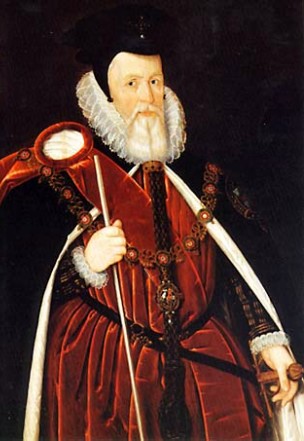

The Lord Chamberlain was automatically in charge of The Lord Chamberlain’s Men of which Shakespeare was a member.  And the Lord Chamberlain was also automatically in charge of the entertainment at Court.

Brooke was the mortal enemy of the Earl of Essex – and consequently a mortal enemy of the Earl of Southampton and Shakespeare. 

Sir George Carey, the first Lord Hunsdon’s son, leapt in to protect the group, as his father had done. 

 He’d had a furious row with Sir Robert Cecil in 1593 and hated the ‘Cecil faction’ at the Court of which Brooke was a leading member.  

As ‘Lord Hunsdon’s Men’ (the name they had used before the first Lord Hunsdon, Sir George’s father, had become Lord Chamberlain) they toured Kent.

They also played a season at the Swan to assert their independence of Brooke and the Court. They even provoked Brooke’s enmity by staging the ‘Falstaff’ plays.

The fat knight was originally called Sir John Oldcastle, one of Brooke’s revered ancestors…

Sir John - Falstaff or Oldcastle?

Luckily for Shakespeare – and for British drama – Brooke died the following year (1597) and Sir George Carey, second Lord Hunsdon, became the Lord Chamberlain…

Sir George Carey, second Lord Hunsdon and bon viveur.

On Christmas Day, 1600, the Court learnt that Don Virginio Orsino, Duke of Bracciano was going to visit England. He would be at the Court for the Twelfth Night celebrations on 6 Janaury, 1601.

Sir George Carey realised there was no time to produce a completely new play for the occasion, so he asked his acting company to make, from their existing repertoire…

a choice of play that shall be furnished with rich apparel, have great variety and change of music and dances, and of a subject that may be most pleasing to Her Majesty…

So, as usual, William Shakespeare and his team (i.e. Thomas Nashe) tarted up an old play….

But, in the same way that Hamlet puts a political spin on The Mousetrap, so did Shakespeare and Nashe when they turned What you Will into Twelfth Night…

(It’s best to read Part One now.)