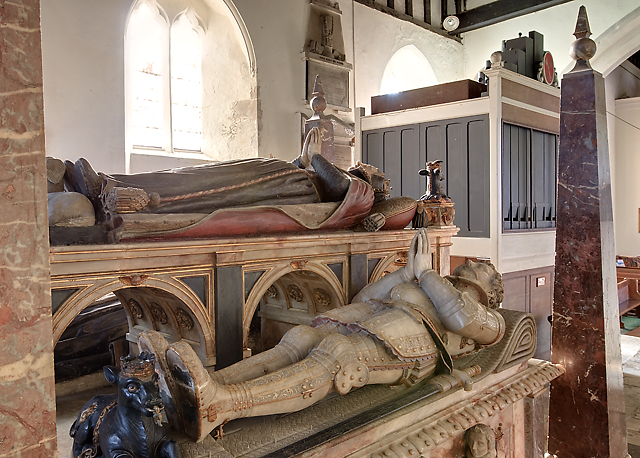
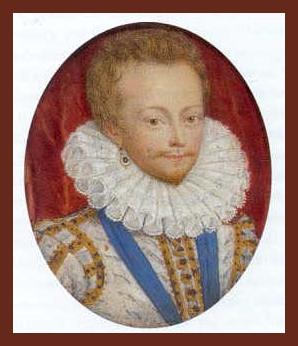
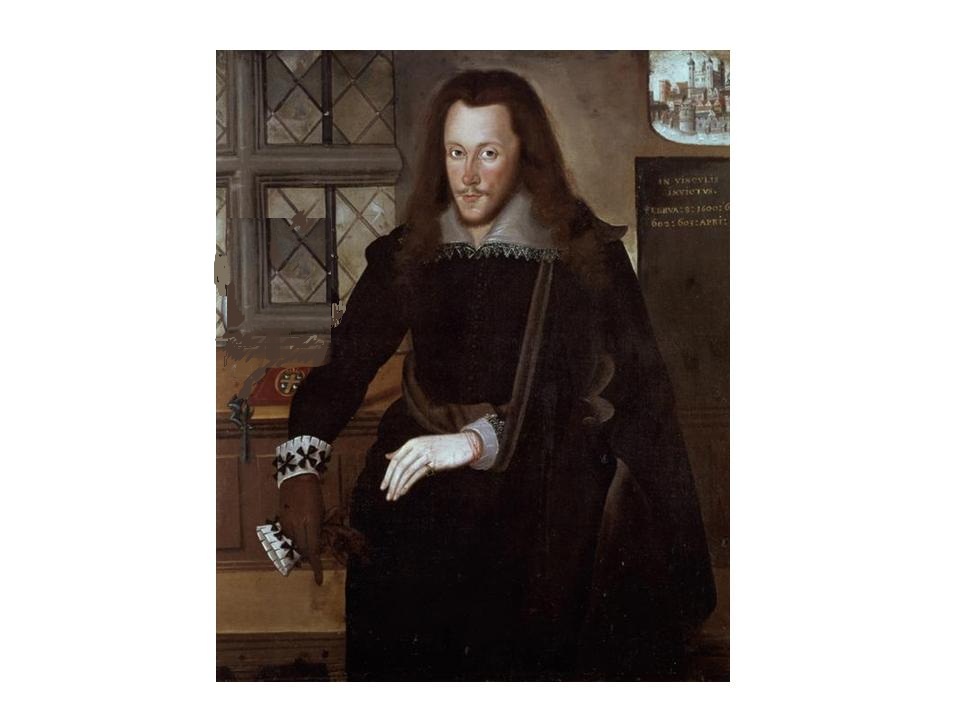
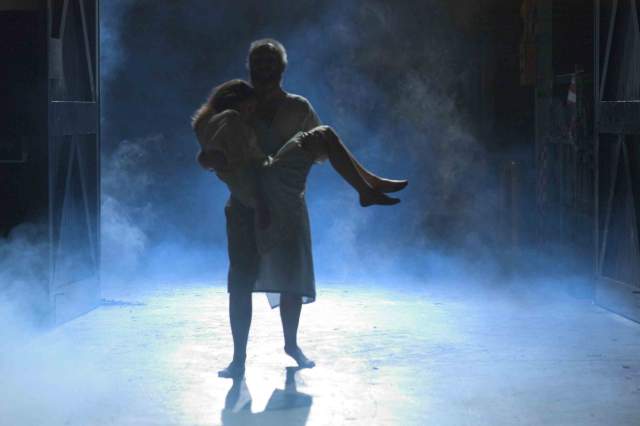
The Authorities have released William Shakespeare from Purgatory for a single day to fess up about his scandalous life. You the audience will decide whether he goes to Heaven, returns to Purgatory or WORSE!
.THE SEVEN AGES OF SHAKESPEARE
By Stewart Trotter
© 16th September, 2016.
PART ONE
A nearly bare stage, hung with blacks. Stark lighting pre-set. A lectern downstage right – with a modern small table and a chair beside it. Downstage left two modern small tables together – one a Prompt Table the other to be used in the action and liftable by one person. By the tables a bench without a back that three can sit on – also liftable by one – and a chair. Five chairs in a line at the back. Black bags set by each chair for the actors’ ‘add-ons’. Actors speak from both downstage right and left positions so they need to be well lit. Note: The feeling should be ‘Purgatorial’ – the colour being given by the language, music and lighting of the show.
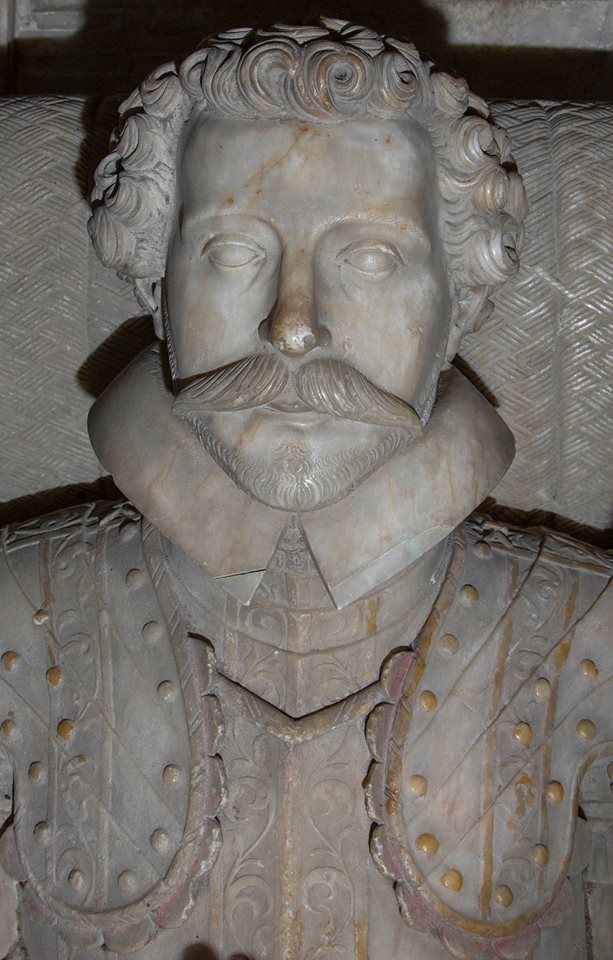
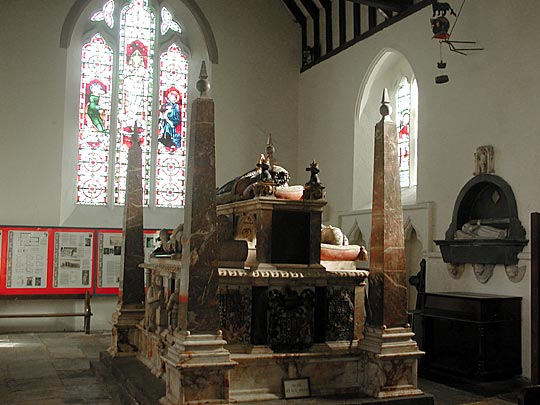
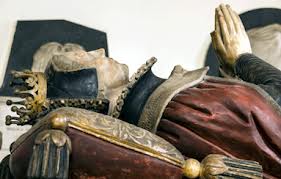
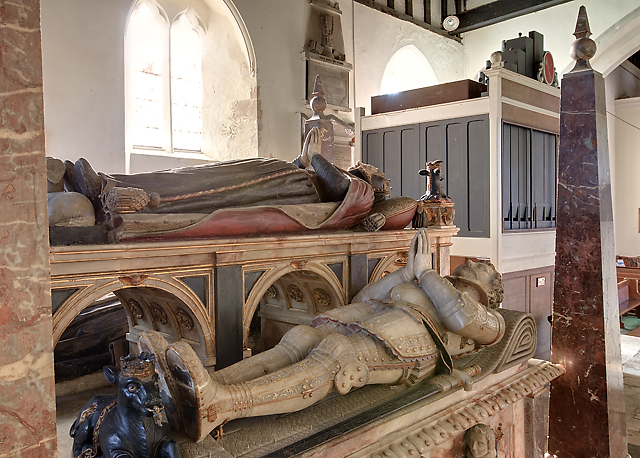
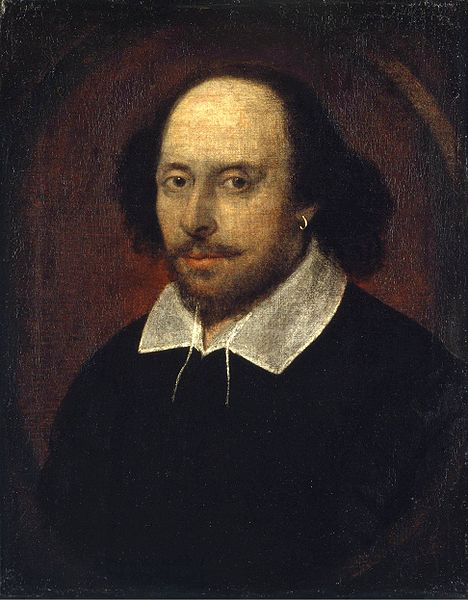
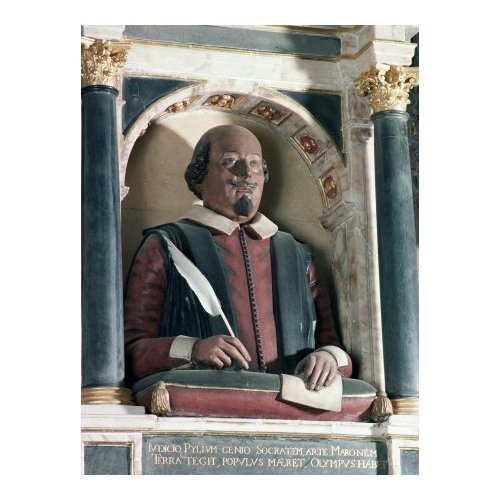
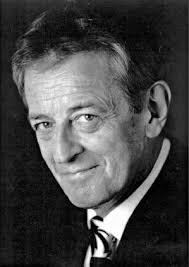
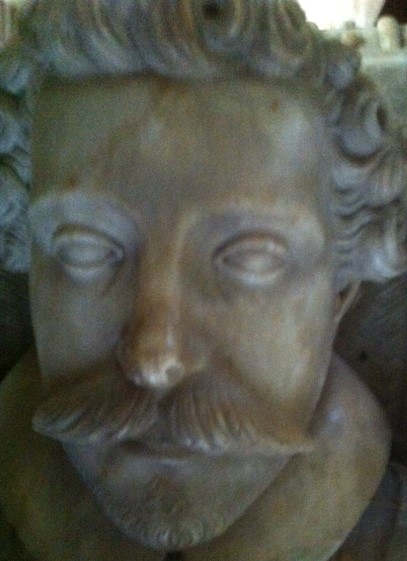
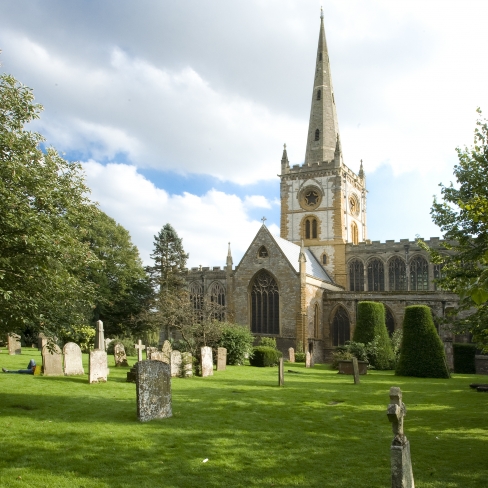
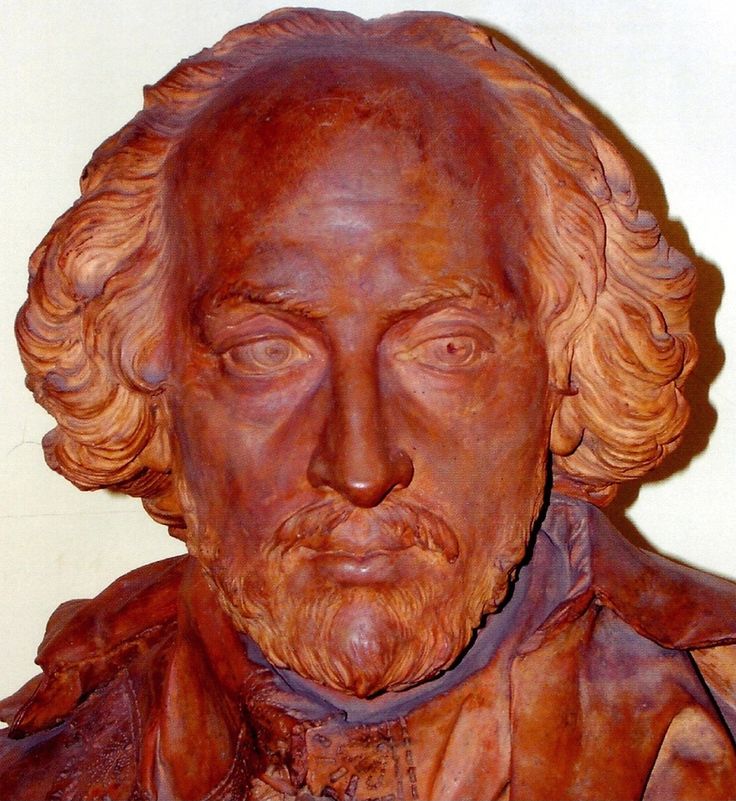
The Spirit of William Shakespeare – looking very much like his bust in the Stratford Parish Church……

……enters from up left wings in complete Jacobean dress but holding a modern folder.
He bows, places the folder on the lectern down right. He then returns to the middle of the stage. As he speaks the verse the lighting becomes warm and theatrical and follows the mood of the speech.
SPIRIT SHAKESPEARE
All the world’s a stage,
And all the men and women merely players:
They have their exits and their entrances;
And one man in his time plays many parts,
His acts being seven ages. At first the infant,
Mewling and puking in the nurse’s arms.
And then the whining school-boy, with his satchel
And shining morning face, creeping like snail
Unwillingly to school. And then the lover,
Sighing like a furnace, with a woeful ballad
Made to his mistress’ eyebrow. Then a soldier,
Full of strange oaths and bearded like the pard,
Jealous in honour, sudden and quick in quarrel,
Seeking the bubble reputation
Even in the cannon’s mouth.
And then the justice,
In fair round belly with good capon lined,
With eyes severe and beard of formal cut,
Full of wise saws and modern instances;
And so he plays his part. The sixth age shifts
Into the lean and slipper’d pantaloon,
With spectacles on nose and pouch on side,
His youthful hose, well saved, a world too wide
For his shrunk shank; and his big manly voice,
Turning again toward childish treble, pipes
And whistles in his sound. Last scene of all,
That ends this strange eventful history,
Is second childishness and mere oblivion,
Sans teeth, sans eyes, sans taste, sans everything.
(SPIRIT SHAKESPEARE snaps his fingers – and the lighting returns to its ‘reality’ state. SPIRIT SHAKESPEARE returns to the lectern and addresses the audience directly.)
I didn’t make it to the seventh age. To be honest I didn’t even make it to the sixth. I died of drink at the age of fifty-two. I am the spirit of William Shakespeare, released from Purgatory for a single day…Yes, Purgatory! We Papists were right! I even wrote about it!
(GHOSTLY VOICE – played by ANGEL E offstage – intones through PA system all round the auditorium. Think Vincent Price. Echo effect. Lighting becomes red and hellish.)
GHOSTLY VOICE offstage (ANGEL E)
I am thy father’s spirit,
Doom’d for a certain term to walk the night,
And for the day confined to fast in fires,
Till the foul crimes done in my days of nature
Are burnt and purged away. But that I am forbid
To tell the secrets of my prison-house,
I could a tale unfold whose lightest word
Would harrow up thy soul, freeze thy young blood,
Make thy two eyes, like stars, start from their spheres,
Thy knotted and combined locks to part
And each particular hair to stand on end,
Like quills upon the fretful porcupine….
(SPIRIT SHAKESPEARE snaps his fingers and the reality state returns. He addresses the audience from centre stage position.)
SPIRIT SHAKESPEARE
To be honest, it’s not as bad as that…Except when they force me to watch productions of my own plays…in modern dress…But when they really want to torture me they run old episodes of East Enders…HOWEVER it’s kept me in touch with the world as it is now – and it means I speak the same English that you do…‘You do’. Ugh! THOU DOST!
But a word about Purgatory before we proceed….You are not SENTENCED to Purgatory – it’s very non-judgemental up there…..You choose it because you are not yet ready to be with God. And believe me, as I fell to the floor in a birthday piss up with Ben Jonson, I was by no means ready….
An added torment is that you have to decide what your sins are – and sins change fashion all the time….In Queen Elizabeth’s day you could be hanged, drawn and quartered for things you do every night of the week! (Peers at audience) Well perhaps not EVERY night…
Purgatory is more like a course of psychoanalysis….Except, of course, that Purgatory comes to an end….
Which brings me to The Seven Ages of Shakespeare…..
You are probably wondering – quite deeply in some cases – why the hell you are here. Well, you don’t realise it – but you have been chosen by the Authorities to be my jury….You didn’t give up your tenners of your own free will – your hands were forced by angelic powers. Explains a lot, doesn’t it? I will now ‘fess up’ (holds folder aloft) and it is you who will then decide if I am ready for Heaven. To help me tell my story the Authorities have lent me a band of angels who are hovering in the wings – and whom I shall now introduce to you…The fabulous ‘Shakespeare’s Angels’….
(SPIRIT SHAKESPEARE introduces the ANGELS who enter one by one from the left – using the real first names of the actors – Angel Thomasina, Angel Dickon, Angel Harry etc….)
[Angel A: Young Woman Angel B: Middle Woman Angel C: Young Man Angel D: Middle Aged Man Angel E: Older Man]
(Each ANGEL come forward to bow then turns and walks upstage and sits in his or her chair. They are dressed in black. All other props are mimed. ANGEL X enters with five folders.)
[ANGEL X: Middle/Older woman. Wears trousers rather a dress.]
[Full list of which characters each Angel plays are listed at end of script.]
SPIRIT SHAKESPEARE
And Angel X. She is the Stage Manager. (A quick nodded bow from AN GEL X) She is also my Recording Angel who has written down everything I’ve ever said or done. She will help me tell the story of my life – and make sure I tell the truth, the whole truth and nothing but the truth…..
(A quick, nodded bow from ANGEL X. She has more important things to do. She gives the folders to ANGELS A, B, C, D and E then settlers herself at the Prompt Table down left.)
[Note: ANGEL X – SPIRIT SHAKESPEARE’s Recording Angel – loves Will – but because she loves him – and wants to rescue his soul – she can be very tough with him.]
The angels will play all the people I encountered in my life. They will read from scripts I have been working on all night – but which I have been thinking about for centuries. Ladies and Gentlemen, I give you The Seven Ages of Shakespeare……
ANGEL X
(Standing – speaking from the Prompt Table.) The First Age: The Infant, mewling and puking in the nurse’s arms…..
SPIRIT SHAKESPEARE
Well I certainly mewled and puked – but I didn’t have a nurse. I had eight aunts instead! Now I know that to be a great artist you are meant to be born into great misery. I was born into great happiness…My parents had been trying to have me long and hard. So when I finally arrived my father organised the greatest street party Stratford-upon-Avon had ever known. Well, he was Taster of Ale to the whole county. My mother Mary – straight from labour but strong as an ox – insisted on being the hostess ….
ANGEL E (as JOHN SHAKESPEARE)
(Standing and coming forward, remembering his wife. Rural accent.)
…….upon That day she was both pantler, butler, cook,
Both dame and servant; welcomed all, served all;
Would sing her song and dance her turn; now here,
At upper end o’ the table, now i’ the middle;
On his shoulder, and his; her face o’ fire
With labour and the thing she took to quench it,
She would to each one sip….
(ANGEL E as JOHN SHAKESPEARE returns to his seat and sits)
SPIRIT SHAKESPEARE
Dad was so rich he actually LENT money to the Stratford Council. He was the best glover in town – and the best butcher and the best wool dealer and the best property-developer and the best money-lender – all completely illegal of course. Queen Elizabeth wanted everyone to do only one job. We just ignored her. She also wanted everyone to be a Protestant. That was to prove more difficult to ignore.
When I was four, my father became Mayor of Stratford….not bad, eh, for a glover who couldn’t read or write? Mind you, gloves were big business then. A finely-stitched, flexible, leather glove was a first rate fashion accessory. It was also a first rate condom…..
ANGEL X
But a year later everything changed for Young Will. The Catholic Lords in the North of England rebelled against the Queen – they wanted to put Mary Queen of Scots on the throne. The Pope excommunicated Elizabeth and ordered Catholics not to obey her.
SPIRIT SHAKESPEARE
So – to be loyal to Rome we had to be traitors to England. We said the Old Latin Mass in our own homes, but we had to attend the Protestant Parish Church by law. However, we had an arrangement with the vicar there. He would give us communion wafers consecrated by a Catholic priest. My father claimed he could TASTE the difference.
ANGEL X
(Standing at Prompt Table) The Second Age: The whining school-boy, with his satchel
And shining morning face, creeping like snail
Unwillingly to school……
(ANGEL X takes a table to centre of stage. ANGEL D as WELSH SCHOOLMASTER takes his chair forward and sits stage left of the table.)
SPIRIT SHAKESPEARE
You’d have been unwilling as well….School started at 6 a.m. and finished at 5 p.m. SIX DAYS A WEEK. It was called a Grammar School – but they meant LATIN grammar….If you were caught speaking English, the schoolmaster birched you on Friday. I was to get my own back on him in The Merry Wives of Windsor. I turned him into a Welshman.
(SPIRIT SHAKESPEARE snaps his fingers. ANGEL B as MISTRESS SHAKESPEARE and ANGEL C as BOY SHAKESPEARE rise from their seats and approach ANGEL E as WELSH SCHOOLMASTER from stage right. BOY SHAKESPEARE – ANGEL C walking on his knees to look like 11- is terrified of his schoolmaster – but his mother is as strong-willed as the schoolmaster is.)
The Shakespeare Angels will now act out for you the scene where Mistress Page and her son William – in reality my mum and me – attend the Parents’ Evening from Hell….
ANGEL E as WELSH SCHOOLMASTER
(Strong Welsh accent) Come hither, William; hold up your head; come.
ANGEL B as MISTRESS SHAKESPEARE
(Rustic accent) Come on, sirrah; hold up your head; answer your master, be not afraid.
(BOY SHAKESPEARE holds up his head at his mother’s command.)
WELSH SCHOOLMASTER
What is ‘fair,’ William?
ANGEL C as BOY SHAKESPEARE
Pulcher.
(BOY SHAKESPEARE quickly lowers his head again. His mother raises it.)
MISTRESS SHAKESPEARE
Polecats! there are fairer things than polecats, sure.
WELSH SCHOOLMASTER
You are a very simplicity ‘oman: I pray you peace. What is ‘lapis,’ William? [Pronounced ‘larpis’]
BOY SHAKESPEARE
A stone
WELSH SCHOOLMASTER
And what is ‘a stone,’ William?
BOY SHAKESPEARE
(Brightening at speaking English) A pebble.
WELSH SCHOOLMASTER
No, it is ‘lapis:’ I pray you, remember in your prain.
BOY SHAKESPEARE
(Miserable again) Lapis.
WELSH SCHOOLMASTER
I pray you, have your remembrance, child, accusative, hung, hang, hog.
MISTRESS SHAKESPEARE
‘Hang-hog’ is Latin for bacon, I warrant you.
WELSH SCHOOLMASTER
Leave your prabbles, ‘oman.
What is your genitive case plural, William?
BOY SHAKESPEARE
Genitive,–horum, harum, horum.
MISTRESS SHAKESPEARE
Vengeance of Jenny’s case! Fie on her! Never name her, child, if she be a whore.
WELSH SCHOOLMASTER
For shame, ‘oman.
MISTRESS SHAKESPEARE
You do ill to teach the child such words! (To audience) He teaches him to hick and to hack, which they’ll do fast enough of themselves, and to call ‘horum:’ (To SCHOOLMASTER). Fie upon you!
WELSH SCHOOLMASTER
‘Oman, art thou lunatics? hast thou no understandings for thy cases and the numbers of the genders?
MISTRESS SHAKESPEARE
(Dominating the schoolmaster) Prithee, hold thy peace!!!
WELSH SCHOOLMASTER
(Crushed by MRS SHAKESPEARE) Show me now, William, some declensions of your pronouns.
BOY SHAKESPEARE
(Bursting into tears) Forsooth, I have forgot.
WELSH SCHOOLMASTER
(Giving up on William as hopeless) Go your ways, and play; go.
(BOY SHAKESPEARE gets off his knees and runs back to his seat)
MISTRESS SHAKESPEARE
(Beaming with motherly pride) He is a much better scholar than I thought he was!
(ANGELS FREEZE. SPIRIT SHAKESPEARE snaps his fingers to show the scene has ended. ANGEL B then returns to her seat, ANGEL D takes his seat back into line and ANGEL X clears the table back to down left.)
SPIRIT SHAKESPEARE
My schoolmasters looked down on English. They said it was more of a throat-disease than a language. But I loved it! I used to declaim it when I was killing calves for my father. And though I hated Latin, I loved Ovid! I loved his stories of Gods transforming themselves into animals to chase the nymphs –and of nymphs transforming themselves into trees to escape the animals. I loved his writings about time. I loved his writings about immortality. I loved his writing about love. I also loved the fact he was so easy to translate…..But as I was losing myself in Ovid, my father was losing his livelihood…
ANGEL X
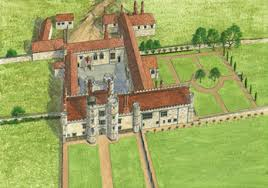
The year before Will was born, the Queen had given Kenilworth Castle as a gift to her lover, Robert Dudley, the Earl of Leicester – also known as ‘The Bear’ – as much for his savagery as his family crest. Kenilworth was half a day’s ride from Stratford. He turned it into a dream palace for the Queen….
SPIRIT SHAKESPEARE
….and a knocking shop for all his other tarts. And to pay for it he raised the rents of his tenants ten times over – and twenty times over if they were Catholics.
ANGEL X
When Will was eleven the Queen visited Warwickshire. The Bear complained that the local ale was so strong no-one could drink it. And when the Queen fell ill, he blamed the ale. And then he blamed the Taster of Ale for the County. …
SPIRIT SHAKESPEARE
My father was a dead man walking. I was taken out of school to try to help his business – but there WAS no business. Catholics friends tried to rally round – but they’d all been ruined by the Bear as well….In the end we were going hungry at night – so I started to poach hare. And the grounds I chose were those of Sir Thomas Lucy – the Bear’s henchman – a sadistic psychopath licensed by the Queen to search the homes of Catholics. Of course I was found out – and Lucy took great delight in stripping me naked and flogging me with his horsewhip. I swore, as only a schoolboy can, that one day I would have my revenge on him. I would become the most famous man in England….
ANGEL X
The underground Catholic Network came to Will’s aid. The new schoolmaster at Stratford was from Lancashire – and he knew the Hoghtons there – a grand old Catholic family. They took Will in as a likely lad and he kept their children amused with songs and games – and, of course, plays.….
SPIRIT SHAKESPEARE
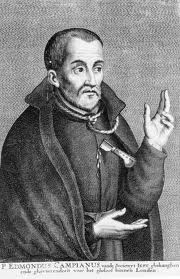
Edmund Campion (ANGEL D as CAMPION stands, kisses his stole and puts it round his neck.) the great Catholic saint and martyr (SPIRIT SHAKESPEARE and all the ANGELS – who are ardent Roman Catholics – cross themselves. William Byrd’s ‘Ave Verum Corpus plays. Lighting change – stained glass on floor) visited Hoghton Hall while I was there…He told us about the brave young Englishmen who had sailed to Europe to train as missionary priests – and read us his beautiful appeal to Queen Elizabeth….
ANGEL D as CAMPION
Many innocent hands are lifted up to heaven for you daily by those English students, whose fame shall never die, which beyond seas, gathering virtue and sufficient knowledge for the purpose, are determined never to give you over but either to win you back to Rome or to die upon your pikes…
(Lighting state and music fade as ANGEL D returns to his chair.)
SPIRIT SHAKESPEARE
Father Campion urged me to become a missionary priest. But I couldn’t do it. (Looks guiltily at the ANGELS ) I loved the Old Faith – with its feasts and fasts and splendour – but not enough to die for it. Ovid had awoken the Pagan in me – and Pagans love life.
ANGEL X
Elizabeth’s pogrom finally reached Lancashire. The Hoghtons were arrested and Will had to flee back to Stratford. By then he was old enough to notice girls…..
SPIRIT SHAKESPEARE
And my inner Ovid stirred….
ANGEL X
(Standing at Prompt Table) The Third Age:
The lover, Sighing like furnace, with a woeful ballad
Made to his mistress’ eyebrow……
SPIRIT SHAKESPEARE
(ANGEL X sets the bench centre stage. ANGEL A as ANN HATHAWAY rises and sits on it) I fell desperately in love with an old family friend – the ravishing Anne Hathaway. She was eight years older than me – but that just added to her allure. I wrote a ‘woeful ballad’ to seduce her – playing on her surname….
(Underscoring music taken from ‘Music for Shakespeare’s Theatre’. Naxos. ‘Heartsease’ Track 33. Time[1.24] ANGEL C as YOUNG SHAKESPEARE rises from his seat and approaches ANGEL A as ANNE HATHAWAY. Lighting change to romance.)
ANGEL C (as YOUNG SHAKESPEARE)
Those lips that Love’s own hand did make,
Breath’d forth the sound that said
ANGEL A (as ANNE HATHAWAY)
(Playfully, turning away from YOUNG SHAKESPEARE) I hate
YOUNG SHAKESPEARE
To me that languisht for her sake:
But when she saw my woeful state,
(ANNE HATHAWAY sneaks a look at YOUNG SHAKESPEARE – sees he is suffering and turns away again. We see she is taking pity on him.)
Straight in her heart did mercy come,
Chiding that tongue that ever sweet,
Was us’d in giving gentle doom:
And taught it thus anew to greet:
‘I hate’ she alter’d with an end,
That follow’d it as gentle day,
Doth follow night who like a fiend
From heaven to hell is flown away.
‘I hate’, from hate away….
SPIRIT SHAKESPEARE
Hathaway!
YOUNG SHAKESPEARE
….she threw,
And sav’d my life, saying….
ANNE HATHAWAY
Not you.
(The Two ANGELS kiss passionately….and freeze. Underscoring fades.)
SPIRIT SHAKESPEARE
(Pause) Unfortunately I wasn’t wearing gloves at the time…..
(SPIRIT SHAKESPEARE snaps his fingers. Snap change of lights. ANGEL A and ANGEL C return to their seats and ANGEL X clears the bench to down left.)
So we had to get married. And I wasn’t going to skimp on the wedding feast. It was back to Lucy’s place – only this time for deer. Of course I got caught again – and faced a massive fine and years of imprisonment…..My mother, though, was having none of it! She sat outside the gates of Kenilworth Castle day and night till the Bear agreed to see her. What she said or what she did I will never know. But the Bear ordered Lucy to forgive me…The only act of kindness he performed in his entire life….So now you know where all those bossy women in my plays come from…But Lucy wanted his pound of flesh….Ooops! Sorry! It’s vulgar to quote yourself. But difficult not to when you’re William Shakespeare…I had to kneel before him in the streets of Stratford and beg his pardon publicly….I vowed to become the most famous man in the world.
ANGEL X
Anne gave Will a daughter, Susanna, and followed it up two years later with twins, Hamnet and Judith…
(ANGEL X sets up table in centre and bench to stage left of table.)
SPIRIT SHAKESPEARE
I started to drink a lot….and spent most nights in the Bear Tavern…
(SPIRIT SHAKESPEARE clicks his finger. Tavern lighting and smoke. Evening. FULL COMPANY OF ANGELS, A, B, D and E are singing, clapping and dancing to a tune that doesn’t, yet, have words. ANGEL C as YOUNG SHAKESPEARE enters. ANGEL E as JOHN SHAKESPEARE sees his son and shouts over the singing…)
ANGEL E as JOHN SHAKESPEARE
WHY AREN’T YOU AT HOME WITH ANNE AND THE KIDS?
ANGEL C as YOUNG SHAKESPEARE
IT’S QUIETER IN HERE!
(YOUNG SHAKESPEARE sits on bench and mimes writing. The dance finishes and everyone cheers.)
JOHN SHAKESPEARE
Will, make up words for that tune – EXTEMPORE – and I’ll buy you a pottle pot!
(SPIRIT SHAKESPEARE snaps his fingers. ANGELS freeze)
SPIRIT SHAKESPEARE
A pottle pot contained four pints of wine….
(SPIRIT SHAKESPEARE snaps his fingers. ANGELS unfreeze.)
YOUNG SHAKESPEARE
(Rising happily to his father’s challenge) Let’s hear it again! (People hum through tune to him and YOUNG SHAKESPEARE drinks for inspiration…) Right! I’ll sing it and someone can write it down….(Silence…then)
JOHN SHAKESPEARE
You’re the only one who can write here, son. If you can sing it AND write it down, I’ll buy you TWO pottle pots!
(Cheers)
YOUNG SHAKESPEARE
You’re on!
(YOUNG SHAKESPEARE stands and sings…)
YOUNG SHAKESPEARE
A Parliament member, a justice of peace,
At home a poor scarecrow in London an ass,
If Lucy is lousy as some volke miscall it
Sing Lousy Lucy whatever befall it…..
CHORUS (ANGELS A,B,D, F)
If Lucy is lousy as some volke miscall it
Sing Lousy Lucy whatever befall it…
(During the Chorus Repeat YOUNG SHAKESPEARE runs back to the table and mimes writing down the lyrics he has just composed, takes a sip of ale then sings again…He repeats this throughout the song, getting drunker and drunker and staggering more and more.)
YOUNG SHAKESPEARE
He thinks himself great, yet an ass in his state,
We allow by his ears but with asses to mate….
If Lucy is lousy as some volke miscall it
Sing Lousy Lucy whatever befall it…..
CHORUS
If Lucy is lousy as some volke miscall it
Sing Lousy Lucy whatever befall it…
YOUNG SHAKESPEARE
To the sessions he went and did sorely complain
His park had been robbed and his hares they were slain
If Lucy is lousy as some volke miscall it
Sing Lousy Lucy whatever befall it…..
CHORUS
If Lucy is lousy as some volke miscall it
Sing Lousy Lucy whatever befall it…
YOUNG SHAKESPEARE
(by this time hardly able to stand or speak)
If a juvenile frolic he cannot forgive
We’ll sing Lousy Lucy as long as we live
And Lucy the Lousy a libel may call it
We’ll sing Lousy Lucy whatever befall it…
CHORUS
If Lucy is lousy as some volke miscall it
Sing Lousy Lucy whatever befall it…
(YOUNG SHAKESPEARE manages somehow to get back to the table and mimes writing the last verse down and finally holds aloft the completed ballad.)
YOUNG SHAKESPEARE
Here it is!
(Crowd cheers)
JOHN SHAKESPEARE
(presenting YOUNG SHAKESPEARE with a mimed pottle pot) Pottle pot Number One!
(YOUNG SHAKESPEARE downs it one. Cheers. Then JOHN SHAKESPEARE presents his son with a second.)
JOHN SHAKESPEARE
Pottle pot Number Two…
YOUNG SHAKESPEARE
Dad, a challenge! You down it in one!
(JOHN SHAKESPEARE takes up the challenge – and to everyone’s cheers, downs the tankard in one as well. The two men collapse, affectionately, into one another’s arms.)
YOUNG SHAKESPEARE
And now I shall hang this ballad on the gates of Sir Thomas Lucy’s estate!
(The company roars with laughter and JOHN SHAKESPEARE turns away to share the joke with ANGEL X. YOUNG SHAKESPEARE exits unseen by anyone into upstage right wings. Doubled over with laughter, JOHN SHAKESPEARE turns back to speak to his son.)
JOHN SHAKESPEARE
Will…..(realising in terror that his son has gone ) WILL! (He rushes out. All are aghast. He returns) Holy Mother of God. He meant it….
(ANGELS FREEZE. SPIRIT SHAKESPEARE snaps his fingers and the scene ends. Snap change of lights. ANGEL X clears set table and bench. The other ANGELS return to their chairs.)
SPIRIT SHAKESPEARE
I HAD to get out of town. London was the best place to hide and the Network put me in touch with Tom Kyd – another Catholic Grammar School boy. For me it was Ovid’s poetry – for Tom it was Seneca’s plays – full of ghosts, suicides, murders and madness. Tom wrote English versions that were every bit as bloody…and the public loved them! The Spanish Tragedy was one of them. Hamlet was another. Yes. Hamlet….more of that later….
We had to work by day as lawyers’ clerks but wrote pamphlets, ballads and plays by candlelight at night. (ANGEL E as THOMAS NASHE puts on a wig of wild ‘staring’ hair.) We got right up the noses of the University Wits – Oxbridge men who thought Grammar School oiks like us had no business writing. Little Tom Nashe (ANGEL E as THOMAS NASHE rises) – with his buck teeth and staring hair – was the worst….He called us…
ANGEL E (as TOM NASHE)
(Sarcastically – high pitched and nasal – think Brian Sewell)….deep read Grammarians who have no learning in their skull, nor Art in their brain. Seneca read by candlelight yields them many good sentences, and he will afford whole Hamlets. For recreation after their candle stuff, having starched their beards most curiously, they make a peripatetical path into the inner parts of the City……
SPIRIT SHAKESPEARE
….go on a pub crawl….
TOM NASHE
…..and spend two or three hours in turning over French ‘Dowdy’…..
SPIRIT SHAKESPEARE
…sleeping with French prostitutes. (TOM NASHE sits and takes off his wig). You’ll find out tonight that I’ve had a lot of sex in my life. I went through agonies of guilt about breaking my wedding vows. You see, we Catholics take them seriously. But I now think my REAL sin was this: I had a warm, caring, beautiful wife. But I found her goodness boring….
(SPIRIT SHAKESPEARE looks at ANGEL X who smiles. ANGEL D puts on a flamboyant silk scarf.)
It was impossible to go into the inner parts of the City without running into Kit Marlowe (ANGEL D as KIT MARLOWE rises) a man four hundred years ahead of his time. If you think London was swinging in the 1960’s you should have seen it in the 1580’s. The very first thing Kit said to me was….
ANGEL D as KIT MARLOWE
(Coming forward. Out front) All they that love not tobacco and boys be fools….
SPIRIT SHAKESPEARE
Kit somehow managed to combine Atheism with Devil Worship. But he had a soft spot for Catholics…
KIT MARLOWE
If there be any God or good religion then it is the Papists, because the service of God is performed with more ceremonies, as elevation of the mass, organs, singing men and shaven crowns. All Protestants are hypocritical asses….
SPIRIT SHAKESPEARE
He also said…..
KIT MARLOWE
(Out front) Whoever loved who loved not at first sight….
SPIRIT SHAKESPEARE
The trouble was he was looking at me at the time.
(MALOWE turns to look at SPIRIT SHAKESPEARE)
But he soon clocked I was a naïve country-boy Catholic.
(MARLOWE looks away from SPIRIT SHAKESPEARE with a mixture of pity and disdain.)
We became close friends, though…..
KIT MARLOWE
Be true, Will. Be yourself. And sing your own song.
(ANGEL D as KIT MARLOWE turns and goes back to his seat. He removes his silk scarf.)
SPIRIT SHAKESPEARE
Lucy chased me all the way to London – but I had a cunning ploy. I found out that when Lucy was in town he worshipped at St. Giles, Cripplegate. So I went to see the Rector there, Robert Crowley. He turned out to be an off-the-wall poet and radical who refused to wear surplices….
ANGEL E as ROBERT CROWLEY
(Rising) The devil’s conjuring robes….
SPIRIT SHAKESPEARE
….and got into fist fights with any priest that did….
(ANGEL C as YOUNG SHAKESPEARE enters from Stage Right. ROBERT CROWLEY calls him over.)
ROBERT CROWLEY
Will, come here boy. Sir Thomas has sent me the ballad you wrote about him. Now I write ballads to communicate God’s word. But your ballad is devilish. ‘Lucy is lousy’ – how would you feel if you were Sir Thomas?
ANGEL C (as YOUNG SHAKESPEARE)
But I’m not Sir Thomas. I don’t torture schoolboys.
ROBERT CROWLEY
It’s your job as a writer to empathise with everyone. You have to imagine, for example, what it’s like to be very poor….
YOUNG SHAKESPEARE
But I AM very poor!
ROBERT CROWLEY
(ignoring him)…And to imagine what it’s like to be very rich. If everyone did that, the rich would give everything they had to the poor…
YOUNG SHAKESPEARE
Then the poor would give it back….
ROBERT CROWLEY
Look, Will, I’ll get Lucy off your back, but I’ll want something in return….
YOUNG SHAKESPEARE
Of course (reaching into his pocket.)
ROBERT CROWLEY
I don’t want your money, Will. I want your soul! I want you to bring God to the great mass of the people….
YOUNG SHAKESPEARE
But I’m not a priest!
ROBERT CROWLEY
No! You are a writer and an actor! And I believe you could become a very great one. I want you to tour England with Biblical stories! The people will benefit – and so will you.
(ANGEL E as ROBERT CROWLEY and ANGEL C as YOUNG SHAKESPEARE freeze. SPIRIT SHAKESPEARE snaps his fingers. ANGELS unfreeze. ANGEL E returns to his chair while ANGEL C exits to stage right wings. On his next entry he will be HARRY – so needs a velcro red rose set in the wings or backstage.)
ANGEL X
So Will formed a company – mostly unemployed, alcoholic tradesmen – and started to tour the Midlands. All his plays had a high moral message, were packed with Biblical quotations and were aimed at the common man…
SPIRIT SHAKESPEARE
The common man didn’t want to know. Then the Armada came….
ANGEL X
(Standing at Prompt Table) The Fourth Age: Then a soldier,
Full of strange oaths and bearded like the panther,
Jealous in honour, sudden and quick in quarrel,
Seeking the bubble reputation
Even in the cannon’s mouth.
SPIRIT SHAKESPEARE.
I’ve told you I didn’t make it to the sixth and seventh age….well I didn’t make it to the fourth one either. A soldier? Moi? No way! Anyway, we Catholics were conflicted about the Armada. We wanted England to return to Rome – but we hated the Spaniards more than we hated the Queen. The good thing about the Armada year was that the Bear died – poisoned, it was said, by his second wife. My father’s business instantly picked up…
ANGEL X
But show-biz didn’t. Actors were hated for their lack of patriotism. Marlowe, Kyd and Will could no longer find employment in the theatre – so they joined aristocratic families as tutors to their children. (ANGEL D puts on a flamboyant silk scarf – but a different colour to MARLOWE’S) The Network swung into action again. ….
SPIRIT SHAKESPEARE
I joined the Southampton family at Titchfield, prematurely aged by touring and with my hair falling out….(ANGEL D as MIDDLE SHAKESPEARE stands. ANGEL B puts on a tiara.) Mary, the second Countess of Southampton, (ANGEL B as COUNTESS MARY stands) showed me the family portraits in the gallery….
(COUNTESS MARY walks forward and looks out front – at what we take to be her portrait gallery. Corridor effect with lighting. MIDDLE SHAKESPEARE walks behind her down to the front and stands stage left of her.)
ANGEL B as COUNTESS MARY
And this, Master Shakespeare, is my late husband, the second Earl of Southampton. If you are to become tutor to my son, you must be aware of the facts. The second Earl was a fine Catholic: he fought to bring the Blessed Mary Queen of Scots to the English throne. (COUNTESS MARY and MIDDLE SHAKESPEARE cross themselves. So do SPIRIT SHAKESPEARE and all the ANGELS.) He was imprisoned in the Tower and nearly lost his head. However, as a husband he was….unappreciative. He accused me – quite insanely – of falling in love with a common person…(Looking at MIDDLE SHAKESPEARE, discreetly, up and down)…I can see you’ll be needing some new clothes….(Recovering herself – she is clearly taken with MIDDLE SHAKESPEARE). And an allowance…
My husband snatched my young son, Harry, away. He turned his manservant into his wife and left him everything. I overturned the will, of course, but could not overturn the damage done to poor Harry…. (COUNTESS MARY points to another painting that is out front, further to stage right.) That is a portrait of him…(MIDDLE SHAKESPEARE looks startled.) As you can see, he loves to dress up as a girl. Other than that, has no interest in women whatsoever. This, Master Shakespeare, is where you come in. (MIDDLE SHAKESPEARE looks startled again.) You are a happily married man with children. I want you to get Harry excited by the idea of fatherhood. Soon it will be his seventeenth birthday… I want you to write seventeen sonnets to show him the joys of the opposite sex. I want you to ‘turn the vessel round’ as it were….Wait here…. (COUNTESS MARY exits into the upstage right wings.)
ANGEL D as MIDDLE SHAKESPEARE
(To himself, in horror, crossing down left) Sonnets! Aaah!
(COUNTESS MARY enters from the stage right wings and announces….)
COUNTESS MARY
Master Shakespeare, (MIDDLE SHAKESPEARE turns) my son, Henry Ryosely. (MIDDLE SHAKESPEARE kneels with his head down as ANGEL C as HARRY enters from the upstage right wings, wearing a Velcro red rose.) Third Earl of Southampton and Baron of Titchfield….
(HARRY crosses down left to MIDDLE SHAKESPEARE and offers him his ring to kiss. MIDDLE SHAKESPEARE does so, then looks up into HARRY’s face. A musical ‘ping’ from ANGEL X at a toy xylophone.)
COUNTESS MARY
I’m sure you two boys will get on like a house on fire…
(ANGELS freeze. SPIRIT SHAKESPEARE snaps his fingers and ANGELS unfreeze. Snap change of lights. It should be clear that HARRY fancies MIDDLE SHAKESPEARE – but that MIDDLE SHAKESPEARE is confused. ANGEL C and ANGEL B return to their chairs. ANGEL X sets a table centre. ANGEL D as MIDDLE SHAKESPEARE takes his chair from upstage and sits left of the table, miming writing.)
SPIRIT SHAKESPEARE
I managed the seventeen sonnets. English is the hardest language in the world to rhyme in – and in one sonnet you have to do it fourteen times. It crunches your brain – but your heart rides on air. I was starting to sing my own song…..To a commission, mind you. How do you turn a gay man straight? Well, first I flattered Harry’s beauty –
MIDDLE SHAKESPEARE
(From seat at table.) From fairest creatures we desire increase,
That thereby beauty’s rose might never die….
SPIRIT SHAKESPEARE
‘Rose’ was a reference to the Southampton rose – and the preposterous way the Southampton family pronounced its name – ‘Ryosely’. Everyone else said ‘Risley’
MIDDLE SHAKESPEARE
But as the riper should by time decease,
His tender heir might bear his memory….
SPIRIT SHAKESPEARE
It was Harry’s duty to pass on his beauty. By keeping it to himself he was not only robbing the world – he was robbing himself of the gift of a baby boy – what I called his ‘sweet self.’
MIDDLE SHAKESPEARE
For having traffic with thy self alone,
Thou of thy self thy sweet self dost deceive….
SPIRIT SHAKESPEARE
If Harry had a baby boy he would become like the moon – but a miraculous moon that waxed and waned at the same time. It would wane because Harry would get older and weaker – but it would wax in the figure of his son, who would get older and stronger.
MIDDLE SHAKESPEARE
As fast as thou shalt wane, so fast thou grow’st
In one of thine, from that which thou departests.
And that fresh blood which youngly thou bestow’st
Thou may call thine, when thou from youth convertest.
SPIRIT SHAKESPEARE
But perhaps my strongest argument was a threat: if you don’t have a child, you’ll end up like that toothless old hag, Queen Elizabeth….
MIDDLE SHAKESPEARE
….harsh, feautureless, and rude….
SPIRIT SHAKESPEARE
….and then….
MIDDLE SHAKESPEARE
….. barrenly perish…..
SPIRIT SHAKESPEARE
I gave the sonnets to Harry on his birthday – and then waited for his reaction….
ANGEL C as HARRY
(Rising from his seat, miming brandishing a sheaf of papers.) Master Shakespeare, these Sonnets are an utter failure… (MIDDLE SHAKESPEARE looks crestfallen) I still don’t like girls!
MIDDLE SHAKESPEARE
(On the attack) Even though you look like one?
HARRY
Are you being offensive?
MIDDLE SHAKESPEARE
No. It’s the theme of this new sonnet I’m writing about you….But if you don’t like them…..(Goes to tear the sonnet up)
HARRY
(Stopping him) I like BITS of them – especially the bits about my beauty. Let’s hear your new sonnet then! (HARRY pulls his upstage chair up to right of the table to listen.)
MIDDLE SHAKESPEARE
It’s not finished….
HARRY
Perhaps I can give you some ideas….
(HARRY touches MIDDLE SHAKESPEARE, suggestively on the arm – but MIDDLE SHAKESPEARE politely withdraws it.)
MIDDLE SHAKESPEARE
A woman’s face with nature’s own hand painted
Hast thou, the master-mistress of my passion….
(HARRY shows interest)
A woman’s gentle heart but not acquainted
With shifting change as is false women’s fashion….
An eye more bright than theirs, less false in rolling….
(HARRY can contain himself no longer)
HARRY
See! You don’t like girls either!
MIDDLE SHAKESPEARE
(Ploughing on) Gilding the object where-upon it gazeth,
A man in hue, all hues in his controlling
Which steals men’s eyes…
HARRY
(Excited) Ha!
MIDDLE SHAKESPEARE
….and women’s souls amazeth……
( HARRY, disappointed, groans.)
And for a woman wast thou first created
Till Nature as she wrought thee, fell a-doting….
HARRY
Go on….
MIDDLE SHAKESPEARE
That’s as far as I’ve got, sir….
HARRY
Would you like me to finish the Sonnet for you, Master Will….
MIDDLE SHAKESPEARE
(Appalled at the idea) The greatness of your words, sir, would utterly eclipse my own…I shall finish the sonnet in my own time.
HARRY
(Banging his fist on the table) Finish it NOW! HERE! (MIDDLE SHAKESPEARE rises and for a moment we think he is about to storm off. But HARRY, sensing this, immediately lightens his tone and starts to flirt.) As Master-Mistress of your passion, I command you! (MIDDLE SHAKESPEARE sits. He mimes scribbling a few lines…then hands them to HARRY.)
HARRY
‘Till Nature as she wrought thee fell-adoting….
And by addition me of thee defeated
By adding one THING to my purpose nothing….’
(HARRY looks down at his crutch.)
Master Shakespeare, does this mean what I think it means? Your conclusion, please…..
(MIDDLE SHAKESPEARE mimes scribbling again – and hands him the sheet)
HARRY
‘But since she prick’d thee out for women’s pleasure
Mine by thy love – AND THY LOVE’S USE THEIR TREASURE!!!’
Is this a poetic way of telling me to get stuffed?
MIDDLE SHAKESPEARE
No, sir. It’s a poetic way of telling you to stuff women…
(ANGEL B as COUNTESS MARY rises from her chair, looking white and shaken. She groans, walks to the table for support. MIDDLE SHAKESPEARE and HARRY both stand)
MIDDLE SHAKESPEARE
M’Lady….
ANGEL B as COUNTESS MARY,
Dreadful, dreadful news. ….
HARRY
The Armada’s re-grouped!
COUNTESS MARY
No – worse! Queen Elizabeth is coming to stay!
(HARRY and MIDDLE SHAKESPEARE groan out front. ANGELS freeze. SPIRIT SHAKESPEARE snaps his fingers and the ANGELS unfreeze. ANGEL B exits to stage left wings, ANGEL X strikes the table down left and ANGEL D and ANGEL C take their chairs back to the line and sit in them. ANGEL X places the bench centre stage and returns to her table. Angel A fixes her mask to her dress.)
SPIRIT SHAKESPEARE
And stay she did. With all her court. And with all her soldiers. They ate and drank the Southamptons out of house and home. Then Elizabeth slaughtered all their deer, rounded up and run before her, with a cross-bow at point blank range. Music accompanied the this carnage from Elizabeth’s Italian band – the Basanno family – who included the voluptuous mixed-race Amelia. (ANGEL A as AMELIA – stands and curtsies and sits again.) Elizabeth then returned to town and disembowelled Catholics in front of Countess Mary’s London house.
ANGEL X
One of them was a young missionary priest – Edmund Jennings – forced to wear a jester’s outfit on the scaffold…….
SPIRIT SHAKESPEARE
Amelia, though, stayed on at Titchfield.
(ANGEL A as AMELIA rises crosses to the bench and mimes playing music – Lady Hunsdon’s Puffe 37. [1.22]’Romantic comedy’ lighting.)
She was mistress to the Queen’s randy old goat of cousin, Lord Hunsdon. He paid her £40 a year for her services. I wanted to find out if that gave him exclusive rights…
ANGEL D as MIDDLE SHAKESPEARE
(Stands and approaches ANGEL A as AMELIA, who continues to play, from her right.) Did not I dance with you in London once?
ANGEL A as AMELIA
Did I not dance with you in London once?
MIDDLE SHAKESPEARE
I know you did.
AMELIA
How needless was it then to ask the question.!
MIDDLE SHAKESPEARE
You must not be so quick.
AMELIA
‘Tis long of you to spur me with such questions.
MIDDLE SHAKESPEARE
Your wit’s too hot, it speeds too fast, ‘twill tire.
AMELIA
Not till it leave the rider in the mire.
MIDDLE SHAKESPEARE
What time of day?
AMELIA
The hour that fools should ask.
(MIDDLE SHAKESPEARE turns away right. AMELIA mimes putting down her lute – music cuts out. She covers her face with her mask.)
MIDDLE SHAKESPEARE
Now fair befall your (He is about to say ‘face’ – but turns left to her and sees she is wearing a mask) mask!
AMELIA
Fair fall the face it covers.
MIDDLE SHAKESPEARE
And send you many lovers.
AMELIA
Amen, so you be none….
MIDDLE SHAKESPEARE
(After a pause, in which he can’t think of anything to say) Nay then will I be gone.
(MIDDLE SHAKESPEARE exits into the upstage right wings. AMELIA mimes ticking off another man to her list. She then returns to her chair and ANGEL X strikes the bench to down left.)
SPIRIT SHAKESPEARE
Forsooth I was in love….
MIDDLE SHAKESPEARE
(‘Romantic comedy’ lighting fades. MIDDLE SHAKESPEARE springs back from the wings walks into central downstage area – and addresses the audience directly and goes into the auditorium. House lights gently up. Behind MIDDLE SHAKESPEARE ANGEL X sets the table – then sets ANGEL D’s upstage chair stage left of it.)
I, that have been love’s whip;
A very beadle to a humorous sigh;
A critic, nay, a night-watch constable;
A domineering pedant o’er the boy;
Than whom no mortal so magnificent!
This whimpled, whining, purblind, wayward boy;
This senior-junior, giant-dwarf, Dan Cupid;
What, I! I love! I sue! I seek a wife!
A woman, that is like a German clock,
Still a-repairing, ever out of frame,
And never going aright!
Nay, to be perjured, which is worst of all;
And, among three, to love the worst of all;
A wightly wanton with a velvet brow,
With two pitch-balls stuck in her face for eyes;
Ay, and by heaven, one that will do the deed
Though Argus were her eunuch and her guard:
And I to sigh for her! to watch for her!
To pray for her! Go to; it is a plague
That Cupid will impose for my neglect
Of his almighty dreadful little might.
Well, I will love, sigh, pray, sue, groan…..
….AND WRITE SONNETS TO HER!!!
(MIDDLE SHAKESPEARE turns upstage and sits stage left of the table and mimes writing. House lights fade. ANGEL C as HARRY rises and approaches him quietly from behind and peers over his shoulder. MIDDLE SHAKESPEARE senses he is there and looks round. He quickly turns the page over so that HARRY cannot read it.)
ANGEL C as HARRY
It’s another Sonnet, Will. I saw it. (He grabs his chair from the upstage line and sits stage right of the table with MIDDLE SHAKESPEARE) Read it to me. I don’t care if it isn’t finished….
MIDDLE SHAKESPEARE
(Reddening, reads) My (hesitates) master’s eyes are….nothing like the sun…. (HARRY looks startled)
Coral is far more red than his lips red,
If snow be white, why then his breasts are dun;
If hairs be wires, black wires grown on his head…..
HARRY
(In a fury) Breasts? Black wires? (Mimes snatching sonnet from MIDDLE SHAKESPEARE) My MISTRESS eyes are nothing like the sun! HER breasts! HER head! (ANGEL A as AMELIA rises from her chair and stands stage right, behind HARRY) Will, you’re not writing to me – you’re writing to that dreadful….(MIDDLE SHAKESPEARE coughs and indicates to HARRY that AMELIA has entered. HARRY turns to look at her.)
ANGEL A (as AMELIA)
(Curtsying beautifully) Good day, m’Lord….
(HARRY bows stiffly and exits down right to the wings. AMELIA gazes rapturously after HARRY, glancing surreptitiously back at MIDDLE SHAKESPEARE to make sure he’s noticing)
SPIRIT SHAKESPEARE
Amelia liked playing hard to get….
MIDDLE SHAKESPEARE
(Rising and crossing right and turning AMELIA around to face him.)
Tell me thou lov’st elsewhere; but in my sight
Dear heart, forbear to glance thy eye aside…
What need’st thou wound with cunning, when thy might
Is more than my o’er press’d defence can hide….
(Looking into AMELIA’S eyes) Thine eyes I love, and they, as pitying me,
Knowing thy heart torments me with disdain,
Have put on black, and loving mourners be,
Looking with pretty ruth upon my pain…..
(MIDDLE SHAKESPEARE starts to hug AMELIA closely.)
Will’t thou, whose will is large and spacious
Not once vouchsafe to hide my will in thine?
(He holds her even closer)
Shall will in others seem right gracious
And in my will no fair acceptance shine…..
(AMELIA breaks away left. MIDDLE SHAKESPEARE crosses left to pursue her.)
He rises at thy name and points out thee
As his triumphant prize, proud of this pride:
He is contented thy poor drudge to be,
To stand in thy affairs, fall by thy side…..
(He pulls ANGEL A as AMELIA to him and tries to make love to her. AMELIA pushes him away…)
AMELIA
Get lost, baldy!
(AMELIA exits to down left wings of stage. MIDDLE SHAKESPEARE, recovering, muses to himself…)
MIDDLE SHAKESPEARE
(MIDDLE SHAKESPEARE sits on seat stage left of the table and muses)
Then will I swear beauty herself is black
And all they foul that her complexion lack…..
SPIRIT SHAKESPEARE
I asked Harry to plead my love-suit with Amelia. What a mistake ! Amelia pounced. A young rich aristocrat – however gay – was more of a catch than a playwright with alopecia….
(The lighting transforms into a dream-like, nightmarish state.)
MIDDLE SHAKESPEARE
Two loves I have of comfort and despair
Which like two spirits do suggest me still:
The better angel is a man right fair…..
(HARRY enters from the upstage right wings and walks downstage right.)
The worser spirit, a woman coloured ill.
(AMELIA enters from the upstage left wings and walks downstage left.)
To win me soon to hell my female evil
Tempteth my better angel from my side….
(AMELIA crosses left across the front of the stage, in front of MIDDLE SHAKESPEARE and approaches HARRY and kisses him.)
And would corrupt my saint to be a devil,
Wooing his purity with her foul pride…
(AMELIA turns HARRY round so his back is to the audience and makes love to him.)
And whether that my angel be turned fiend
Suspect I may, yet not directly tell;
(AMELIA leads HARRY into the wings right. She takes off her Add-On and mask in the wings. )
But being both from me both to each friend….
I guess one angel in another’s hell…
(MIDDLE SHAKESPEARE crosses down left.)
SPIRIT SHAKESPEARE
I left Titchfield and went on tour again…..
MIDDLE SHAKESPEARE
(Musing – realising that it is the loss of HARRY that upsets him most.)
That thou ha’st her it is not all my grief
And yet it may be said I loved her dearly…
That she hath thee is of my wailing chief
A loss in love that touches me more nearly….
SPIRIT SHAKESPEARE
I finally had to admit I was in love with Harry. So I wrote to him to tell him so…
(MIDDLE SHAKESPEARE sits and starts writing sonnet. Underscoring. ‘Bonny Sweet Robin’12.[1.20] After a bar or two he looks up at audience and shares his thoughts with them. The lighting changes to a bright sunlit state – suggesting summer.)
Shall I compare thee to a summer’s day?
Thou art more lovely and more temperate.
Rough winds do shake the darling buds of May
And winter’s lease hath all too short a date….
Sometime too hot the eye of heaven shines…
And often is his gold complexion dimm’d,
And every fair, from fair, sometime declines,
By chance, or nature’s changing course untrimm’d….
But thy eternal summer shall not fade,
Nor lose possession of that fair thou owest….
Nor shall death brag thou wander’st in his shade,
When in eternal lines to time thou growest….
So long as men can breathe or eyes can see,
So long lives this, and this gives life to thee….
(‘Bonny Sweet Robin fades. SPIRIT SHAKESPEARE snaps his fingers. Snap change in lighting state. RAPID ACTION. MIDDLE SHAKESPEARE exits down stage left wings. ANGEL X clears the table while ANGEL A enters from the stage right wings without her mask and puts ANGEL C’s chair – which is right of table – back in place and sits in her own seat. ANGEL E puts ANGEL D’s chair left of table back in place and sits back in his own seat and puts on his ‘staring wig’.)
SPIRIT SHAKESPEARE
Amelia fell pregnant – God knows by whom – and was married off to a musician. I returned to Titchfield and Harry….
(Underscoring ‘Light o’ Love’ 26.[0.45] ANGEL C as HARRY enters from upper stage right waiting for MIDDLE SHAKESPEARE’S arrival. MIDDLE SHAKESPEARE enters from down stage left wings. Happy, dreamlike, lighting state.)
HARRY
(Smiling.) Will!
(MIDDLE SHAKESPEARE crosses right, kneels to HARRY and kisses his ring. HARRY raises him, embraces him and kisses him. ANGEL E as THOMAS NASHE stands and clocks this. The two men exit arm in arm wings stage right without noticing TOM NASHE. ‘Light o’ Love’ fades. Lighting state fades back to normal.)
SPIRIT SHAKESPEARE
There was, of course, a problem in all this….(ANGEL B as COUNTESS MARY enters, wearing tiara, from wings left) Mother Mary. (TOM NASHE pulls up her chair for her. COUNTESS MARY sits and mimes doing needlework) I wasn’t exactly fulfilling my job description. Tom Nashe told the Countess what he had seen. (TOM NASHE whispers in COUNTESS MARY’s ear. She looks shocked. TOM NASHE whispers again) And one or two things that he hadn’t. (COUNTESSMARY looks even more shocked. ANGEL E returns to his seat and takes off his wig.) The Countess summoned me….
(MIDDLE SHAKESPEARE enters and kneels in front of COUNTESS MARY. )
COUNTESS MARY
Do you love my son?
MIDDLE SHAKESPEARE
(Feigning ignorance) Your pardon noble mistress?
COUNTESS MARY
Love you my son?
MIDDLE SHAKESPEARE
(Evading the issue) Do you not love him, madam?
COUNTESS MARY
Go not about. My love hath in’t a bond,
Whereof the world takes note. Come, come, disclose
The state of your affection, for your passions
Have to the full been witnessed.
MIDDLE SHAKESPEARE
Then I confess
Here on my knees, before high heaven and you,
That before you, and next unto high heaven,
I love your son. My dearest madam,
Let not your hate encounter with my love,
For loving where you do….
SPIRIT SHAKESPEARE
I reminded her that when she was young, SHE had loved in a way that defied convention…
MIDDLE SHAKESPEARE
…..but if yourself
Whose aged honour cites a virtuous youth,
Did ever in so true a flame of liking,
Wish chastely and love dearly, that your Diane
Was both herself and love – o then give pity
To him whose state is such that cannot choose….
(A pause. Then COUNTESS MARY stands and raises MIDDLE SHAKESPEARE to his feet. She kisses him on the cheek. She is accepting him into the family.)
COUNTESS MARY
Cousin Will….
(The two ANGELS freeze. SPIRIT SHAKESPEARE snaps his fingers and ANGEL B picks up her chair, sits upstage and takes off her tiara. ANGEL D sits upstage and removes his scarf. ANGEL X sets the bench centre stage.)
SPIRIT SHAKESPEARE
Harry and I celebrated our love with a secret holiday in Europe….Ostensibly as spies for Harry’s great friend, the Earl of Essex. We were probably the most incompetent spies in the whole of English history….
ANGEL X
When King Philip II of Spain had been King of England, he had made Countess Mary’s father his Master of Horse and his Ambassador to Rome. So Harry and Will visited Philip in Madrid. He showed them something that was to change Will’s life for ever….
SPIRIT SHAKESPEARE
The paintings of Titian!….Painting in England was entirely political and hieratical. Every time Queen Elizabeth had her portrait painted, she got younger.
(Underscoring ‘Callino’ 8.[1.07]Play through this twice. Lights begin to transform to highly coloured states)
But Titian seemed to enter the very souls of his subjects – through the twists and turns of their bodies –
(ANGEL B and ANGEL C rise, and using the bench, take up the pose in ‘Venus and Adonis’ and freeze…The stage is flooded with colours – especially purple.)

Venus and Adonis! Venus pleads with Adonis to make love to her in the purple dawn – and begs him not to join the boar-hunt. Adonis, torn between the two great giants, love and death, gazes at her with the ambiguity of life itself…
(SPIRIT SHAKESPEARE snaps his fingers and ANGELS B and C break and return to their seats. The light transforms to the ‘Rape of Lucrece’ state.ANGEL C puts on his rose, cap and shoulder cape.) ANGEL A and ANGEL E take up the pose from ‘The Rape of Lucrece’ and freeze. The stage is flooded with colour again – with red predominant.)
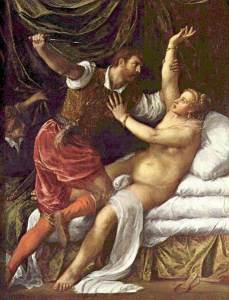
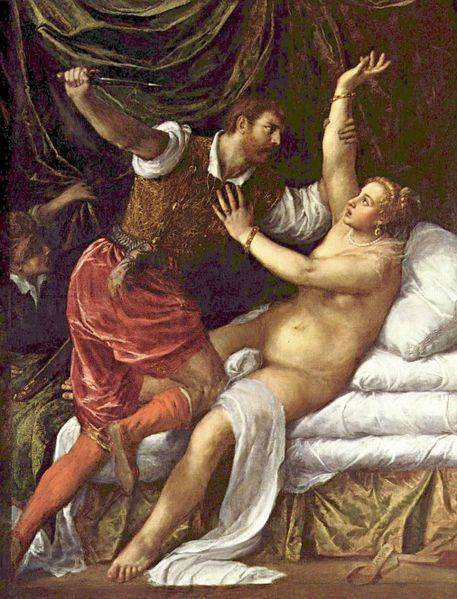
The Rape of Lucrece! Tarquin rapes Lucrece. His scarlet-hosed legs force her naked legs apart – and his exposed knee inches towards her groin. And Lucrece – threatened by Tarquin’s dagger which hovers like a falcon in the air, fixes her eyes on something far more terrifying – Tarquin’s twisted face…
(SPIRIT SHAKESPEARE snaps his fingers. ANGELS A and E unfreeze and return to their seats. Coloured lighting state and music fades. ANGEL X clears bench to down left. ANGEL C as HARRY and ANGEL D as MIDDLE SHAKESPEARE put on bonnets and shoulder capes)
I tried to recreate these two great paintings in two long poems – using the same colours and postures that Titian had used. But the wind of words got in the way. They were failures. I came to realise that the only way for me to touch the sublime – to touch life itself – was through the drama….
Harry and I then travelled on to Rome, the Eternal City…
(ANGEL C as HARRY and ANGEL D as MIDDLE SHAKESPEARE rise, come forward to the central downstage position and look into the audience as though they are looking at Rome in awe. Underscoring: Byrds ‘Ave Verum Corpus’. Stained glass lighting on floor.)
Ovid was right: Time IS ‘edax rerum’ – the eater of things…..
MIDDLE SHAKESPEARE
When I have seen by time’s fell hand defaced
The rich-proud cost of outworn buried age;
(MIDDLE SHAKESPEARE looks to his right – HARRY follows his gaze.)
When sometime lofty towers I see down razed
And brass eternal slave to mortal rage…..
ANGEL X
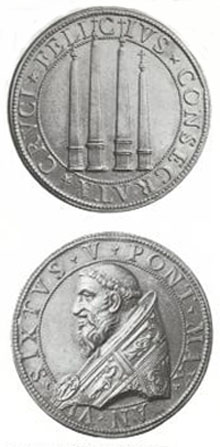
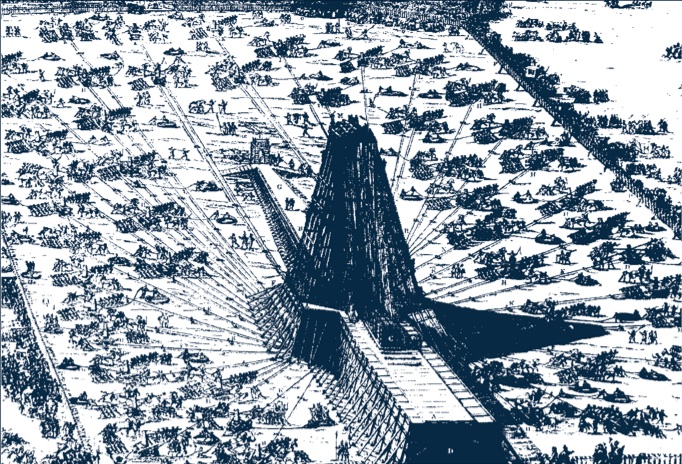
Every obelisk – sacked from Egypt and borne in triumph to Rome – had collapsed except one – the obelisk St. Peter saw moments before he was crucified by Nero….
(MIDDLE SHAKESPEARE looks up in awe to his left. HARRY follows his gaze. They are looking at the Holy Obelisk.)
Its red granite was an object of veneration to Catholics from all over the world….
(MIDDLE SHAKESPEARE and HARRY take off their bonnets, kneel together and cross themselves. Then bow their heads in prayer. SPIRIT SHAKESPEARE moves from his lectern and stands behind MIDDLE SHAKESPEARE and HARRY. Like them, he kneels and crosses himself and prays. ANGEL X does the same, kneeling next to MIDDLE SHAKESPEARE. All the ANGELS rise and form a group behind the four, kneel, cross themselves and pray. After a moment of contemplation, HARRY rises and everyone follows him. ANGELS slowly go back to their chairs. Religious light and music gradually fade….)
SPIRIT SHAKESPEARE
But we had fun in Italy as well….
(Lights snap up to bright comic state.)
HARRY
(Getting an idea) I have it full….
We have not yet been seen in any house,
Nor can we be distinguished by our faces
For man or master. Then it follows thus:
Thou shalt be master in my stead,
I will some other be, some Florentine,
Some Neapolitan, or meaner man of Pisa.
‘Tis hatch’d, and shall be so. Will, at once
Uncase thee, take my coloured hat and cloak….
(HARRY and MIDDLE SHAKESPEARE exchange hats and cloaks.)
MIDDLE SHAKESPEARE
Sith it your pleasure is,
And I am tied to be obedient –
For so your mother charged me at our parting
‘Be serviceable to my son’ quoth she,
Although I think ’twas in another sense –
I am content to be Southampton
Because so well I love Southampton….
(HARRY and MIDDLE SHAKESPEARE freeze.)
SPIRIT SHAKESPEARE
So, BOTH of us could get up to no good – AT THE SAME TIME!
(SPIRIT SHAKESPEARE snaps his fingers. HARRY and MIDDLE SHAKESPEARE unfreeze and return to their seats and take of their bonnets and capes. Suddenly SPIRIT SHAKESPEARE looks guilty and sad.)
ANGEL X
(Gently) Tell them what happened when you got back to England…
SPIRIT SHAKESPEARE
I found Kit dead and Tom dying…
(SPIRIT SHAKESPEARE is reluctant to continue and sits. ANGEL X takes over…)
ANGEL X
Marlowe and Kyd had moved back to London – and were living together in lodgings there. But riots had started. The government had encouraged immigrants to come to England because, as ever, it brought in money. But the locals didn’t like it. Someone had written an ‘immigrants go home’ poem and had posted it up on a wall. The authorities raided the rooms of every writer in London – including Marlowe’s and Kyd’s. They didn’t find the poem there, but they found something far more dangerous: papers denying that Christ was the son of God. Marlowe was off in the country with a new boyfriend at the time – but he was never in any real danger. He was too valuable to the State. He was actually good at spying. But Kyd was arrested and racked….
SPIRIT SHAKESPEARE (recovring and standing)
To end the agony he betrayed his friend…
ANGEL E (as THOMAS KYD)
(Sitting – as though tortured). The papers were Marlowe’s – shuffled with some of my own….
SPIRIT SHAKESPEARE
Kit was killed in a brawl in a Deptford tavern . Over a bill. And over a boy. Tom was dropped by everyone. Including me. He wrote about his….
THOMAS KYD
(Still sitting) Bitter times and broken passions….
SPIRIT SHAKESPEARE
…and….
THOMAS KYD
Afflictions of the mind than which the world affords no greater misery….
SPIRIT SHAKESPEARE
I couldn’t forgive him for his betrayal. You might think A Midsummer Night’s Dream is full of magic and fun. And it is. But it’s also a savage piss-take of Tom’s best play – The Spanish Tragedy – a play that was far more popular than anything I ever wrote. When Titania says….
ANGEL A as TITANIA
(Stands) What angel wakes me from my flowery bed….
SPIRIT SHAKESPEARE
It’s a parody of Hieronimo when he says….
ANGEL E as (HIERONIMO)
(Stands) What outcries pluck me from my naked bed….
(ANGEL A and ANGEL E sit.)
SPIRIT SHAKESPEARE
And when Pyramus, mourning the dead Thisbe, says….
ANGEL D (as PYRAMUS)
(Stands. Rustic accent.) O wherefore, Nature, didst thou lions frame?
Since lion vile hath here deflower’d my dear:
Which is–no, no–which was the fairest dame….
SPIRIT SHAKESPEARE
….it is a send up of Hiernomo’s agony at finding the body of his son hanging from a tree…
ANGEL E (as HIERONIMO)
(Stands) Those garments that he wears I oft have seen,
Alas! It is Horatio, my sweet son!
O, no; but he that whilom was my son!
(ANGEL D and ANGEL E sit.)
SPIRIT SHAKESPEARE
Tom did the decent thing and died……
ANGEL X
Kyd was so much in debt that his parents refused to manage his literary estate. Harry had just come of age and had secretly given Will a gift of £1,000 – half a million in today’s money. So he bought the rights to Kyd’s plays – along with a share in the Lord Chamberlain’s Men.
SPIRIT SHAKESPEARE
People at the time described Tom as….
ANGEL A
(Stands) Famous Kyd!
ANGEL B
(Stands) Industrious Kyd!
ANGEL X
(Stands at Prompt Table) Sporting Kyd…
(SPIRIT SHAKESPEARE clicks his fingers and all three ANGELS sit simultaneously. ANGEL E puts on a flamboyant silk scarf – but different from MARLOWE’S or MIDDLE SHAKESPEARE’s.)
SPIRIT SHAKESPEARE
But you have hardly heard of him. I made sure of that. Tom wrote early versions of King Lear, The Taming of the Shrew, King John, Henry IV, Henry V and Hamlet – yes Hamlet. I re-wrote them and took all the credit. I knew that the drama was my only path to greatness. But I couldn’t think up a plot to save my life – so I stole them. Ben Jonson (ANGEL E as BEN JONSON stands) – with whom I enjoyed a hate-hate relationship all my life – exposed me at once.….
ANGEL E (as BEN JONSON)
(Standing, crossing downstage right and confronting SPIRIT SHAKESPEARE directly in accusing tones.)
Poor Poet-Ape, that would be thought our chief,
Whose works are just the cast-offs of our wit
From piracy is become so bold a thief,
As we, the robb’d, leave rage, and pity it.
(To audience) At first he made low shifts, would pick and glean,
Buy up the rights to plays, now grown
To a little wealth and credit in the scene,
(looking at SPIRIT SHAKESPEARE) He takes up all, makes each man’s wit his own,
And told of this, he slights it.
SPIRIT SHAKESPEARE
But Ben had a strong suspicion I’d get away with it…
BEN JONSON
(Looking directly at audience with a grunt of disgust and moving to downstage central position )
Tut, such crimes the sluggish, gaping audience devours;
They mark not whose ‘twas first, and after times (Pointing directly at the audience.)
May judge it to be his (pointing at SPIRIT SHAKESPEARE)as well as ours.
Fools! As if half eyes will not know a fleece
From locks of wool, or shreds from the whole piece.
(ANGEL E returns to his seat. He takes off his scarf.)
SPIRIT SHAKESPEARE
So there you have it. I promised I would ‘fess-up’ and I have. I don’t know if you can forgive me for this. I don’t know if I can forgive myself. But Tom was to have a revenge on me far, far greater than I had on him. But before we go into all that, I hope you’ll join me for a drink in the bar – the first one I’ve had in four hundred years. Angels! The drinks are on me!
(ANGELS look alarmed. SPIRIT SHAKESPEARE strides off towards the Bar. The ANGELS form into a nervous huddle, discussing under their breath whether they should go to the bar – all except ANGEL X who remains making notes at her desk. SPIRIT SHAKESPEARE turns back and sees what is happening.)
SPIRIT SHAKESPEARE
(Shouting) ANGELS! (The ANGELS turn to look at SPIRITSHAKESPEARE.) To the Bar! (SPIRIT SHAKESPEARE snaps his fingers – and the ANGELS transform into zombies – obeying his every command. They file out to the bar – and when they have gone SPIRIT SHAKESPEARE says to his audience…)
SPIRIT SHAKESPEARE
Angels are all very well – but you’ve got to keep them in their place…
(SPIRIT SHAKESPEARE exits to the Bar. ANGEL X gets up from her desk and comes forward with her clip board.)
ANGEL X
We’ll see about THAT Mr. Shakespeare! Twenty minutes intermission please. Twenty minutes….
(ANGEL X exits into the wings. Audience find SPIRIT SHAKESPEARE in the bar with a tankard in hand – pouring prop wine for the ANGELS. The ANGELS get more and more animated as the Interval progresses as they are completely unused to alcohol. ANGEL X appears in the bar, takes the wine glasses out of the ANGELS’ hands and starts ushering the inebriated ANGELS backstage. She tries to take SPIRIT SHAKESPEARE’s tankard from him – but he runs away.She chases after him, snatches the tankard from him and pushes him to backstage…ANGEL X later announces to the audience….)
ANGEL X
Ladies and Gentlemen – the Second Half of ‘The Seven Ages of Shakespeare’ is about to begin….
PART TWO
(SPIRIT SHAKESPEARE enters from stage left alone. He is hiding something under his coat.)
SPIRIT SHAKESPEARE
At least you’ve come back. Most of you… X is pouring coffee down the throats of the angels. (SPIRIT SHAKESPEARE looks off left into the wings to check he’s not being watched – then produces the tankard from under his coat. He puts his finger to his lips – asking the audience not to split on him – then points at the tankard) It was all a bit too much for them….(He takes a sip from the tankard and places it on the small table next to his lectern.)
But while we’re waiting, can I tell you what really gets my goat? Movies about my life! I am NOT the Earl of Oxford….Do I look like the Earl of Oxford? If you’d MET the Earl of Oxford you’d know how deeply insulting the whole idea is!
No – I’m William Shakespeare. Now I DID collaborate with others, but NEVER WITH HIM. Everyone collaborated back then. But believe me, everything that SOUNDS like me in the plays IS me. Get it? Of course you do! But why did I need collaborators in the first place? When I came down to Titchfield things started to get very political…The Countess of Southampton teamed up with the Countess of Pembroke at Wilton. She was a Protestant – but you didn’t need to be a Papist to hate the Queen….Elizabeth had destroyed her brother, Sir Philip Sidney – a wannabe politician and soldier – by banishing him from the Court. He had eked out his days in the most degrading way known to an English aristocrat…
He had become a poet.
The two rich ladies decided to stage the Wars of the Roses in the grounds of their estates –using real soldiers and real horses…The plays may seem to be about the Houses of York and Lancaster – but they’re really about the House of Tudor. And Richard III is really the Earl of Leicester….….the Boar is the Bear in disguise….
But why the Wars of the Roses? Every age worries itself sick about something that never actually happens. EVERYONE then was terrified that when Elizabeth died, Civil War would break out. But in the event, King James simply walked into the job….Well, rode. He was coming from Scotland…Now I needed help on a big project like the Wars of the Roses – so I did what all theatre men do. I employed my enemies. I’d better add that in the theatre, EVERYONE IS YOUR ENEMY….Little Tom Nashe, who’d insulted me in London, came down to Titchfield to write my jokes…And then insulted me all over again….
ANGEL E (as TOM NASHE)
(Shouting drunkenly from offstage left) For there is an upstart crow, beautified with our feathers, that with his tiger’s heart wrapped in a player’s hide, supposes he is well able to bombast out a blank verse as the best of you….
SPIRIT SHAKESPEARE
(Going to the wings and shouting) X, a little more coffee for Angel E. (To audience) Nashe stayed with me as my gag writer till he died in 1601. I can tell you I feel NO GUILT WHATSOEVER that I didn’t credit him….
His jokes were truly terrible…
Now the Shakespeare movie I loathe, despise and fear beyond all others, the one that demeans not only me but the whole of humanity, the one that I would willing destroy, frame by frame, with my own bare hands is….
(ANGEL X re-appears from wings left and coughs. THE SPIRIT OF SHAKESPEARE looks at her and she nods.)
That’ll have to wait for another incarnation. Ladies and Gentlemen – I give you, for the second time, and a little the worse for wear, the fabulous Shakespeare’s Angels…
(The ANGELS enter from stage left wings, indeed a little worse for wear, then bow in unison and sit. ANGEL C. puts on his rose. ANGEL C also needs to be wearing shoes he can slip off as ‘COMIC’. ANGEL D puts on his silk scarf. ANGEL E wears slippers for the Second Half.)
SPIRIT SHAKESPEARE
Every summer I visited my wife and children at Stratford . There I could settle down to serious writing. But my mind kept returning to Harry. Without him the summer seemed like winter….
(Underscoring. ‘Tarleton’s Ressurection. 16. [1.06]THE ANGELS make a miraculous recovery from their inebriation and recite beautifully! ‘Winter’ lighting.)
ANGEL A
(Stands) How like a Winter hath my absence been
From thee, the pleasure of the fleeting year!
What freezings have I felt, what dark days seen?
What old December’s bareness everywhere?
ANGEL B
(‘Summer lighting)
(Stands)And yet this time remov’d was summer’s time,
The teeming Autumn big with rich increase,
Bearing the wanton burthen of the prime,
Like widowed wombs after their Lords’ decease.
ANGEL X
(Return to ‘Winter’ lighting.)
(Stands at Prompt Table) Yet this abundant issue seem’d to me
But hope of Orphans, and un-father’d fruit;
For Summer and his pleasures wait on thee,
And thou away, the very birds are mute.
Or, if they sing, ‘tis with so dull a cheer,
That leaves look pale, dreading the Winter’s near.
(Underscoring concludes or fades. SPIRIT SHAKESPEARE snaps his fingers and the three ANGELS sit down.)
SPIRIT SHAKESPEARE
Yes, I know. I should have been supporting my wife and playing with my children. And to be honest, the honeymoon period with Harry was over. He was serially promiscuous and, like his mother, had a penchant for lower class men. But he was about to enter the snake-pit of Elizabeth’s court. I warned him in sonnet after sonnet that he should keep himself very much to himself or his sex-life would be used against him….
ANGEL D as MIDDLE SHAKESPEARE
(Rising) The summer’s flow’r is to the summer sweet,
Though to itself it only live and die;
But if that flow’r with base infection meet…..
SPIRIT SHAKESPEARE
….rough trade….
MIDDLE SHAKESPEARE
The basest weed out-braves his dignity… (Sits)
SPIRIT SHAKESPEARE
Mind you I was no angel myself. Well, it gets lonely touring. ‘A friend’ – probably Tom Nashe – told him what I’d been up to…
(ANGEL D as MIDDLE SHAKESPEARE rises and crosses down right trying to escape from ANGEL C as HARRY who rises and chases him in a fury.)
ANGEL C (as HARRY)
Well? Did you or didn’t you?
SPIRIT SHAKESPEARE
My only recourse was to a sonnet….
(Throughout the scene HARRY and MIDDLE SHAKESPEARE ignore SPIRIT SHAKESPEARE – and keep their focus on each other.)
MIDDLE SHAKESPEARE
(Turning round to face HARRY)
Alas, ‘tis true, I have gone here and there
And made myself a motley to the view,
Gored mine own thoughts, sold cheap what is most dear
Made old offences of affections new.
SPIRIT SHAKESPEARE
Yes. I have had sex with young men while on tour.
MIDDLE SHAKESPEARE
Most true it is that I have looked on truth
Askance and strangely……
SPIRIT SHAKESPEARE
I have, in fact, been lying in my teeth….
MIDDLE SHAKESPEARE
….but, by all above,
These blenches gave my heart another youth
And worse essays proved thee my best of love…
SPIRIT SHAKESPEARE
But it made me feel young again. And proved to me just how wonderful you are…
HARRY
(Crossing left, laughing sarcastically) Ha! Ha! Ha!
SPIRIT SHAKESPEARE
Then I went into attack mode….
MIDDLE SHAKESPEARE
(Following HARRY) That you were once unkind…..
SPIRIT SHAKESPEARE
…..that you once played away from home….
MIDDLE SHAKESPEARE
….befriends me now…
HARRY
Befriends you?
MIDDLE SHAKESPEARE
For if you were by my unkindness shaken,
As I by yours, you’ve passed a hell of time….
SPIRIT SHAKESPEARE
For if I have hurt you as much as YOU ONCE HURT ME, then you’ve been to Hell and back in a handcart…
MIDDLE SHAKESPEARE
And I, a tyrant, have no leisure taken
To weigh how once I suffered in your crime…..
HARRY
MY crime?
SPIRIT SHAKESPEARE
I then stormed the moral high ground with a bit of Tudor Gay Liberation…
MIDDLE SHAKESPEARE
(Crossing right) Why should others false adulterate eyes
Give salutation to my sportive blood?
Or on my frailties why are frailer spies,
Which in their wills count bad what I think good?
I am that I am, and they that level
At my abuses reckon up their own…..
(MIDDLE SHAKESPEARE stares HARRY out.)
ANGEL C as HARRY
(Caving in with a smile) Will, you could argue your way out of anything!
(MIDDLE SHAKESPEARE and HARRY freeze. SPIRIT SHAKESPEARE snaps his fingers and ANGEL C and ANGEL D return to their seats.)
SPIRIT SHAKESPEARE
I nearly had my come-uppance, though. A raging old queen called Georgie Chapman – who claimed to be in spirit contact with the ghost of Homer no less – started to write love-poetry to Harry. I’d already attacked him as the mincing, lisping, big girl’s blouse, Boyet in Love’s Labour’s Lost….
ANGEL D as MIDDLE SHAKESPEARE
(Standing – and affecting a masculine contempt for Chapman) This fellow pecks up wit as pigeons pease,
And utters it again when God doth please:
He is wit’s pedlar, and retails his wares
At wakes and wassails, meetings, markets, fairs;
And we that sell by gross, the Lord doth know,
Have not the grace to grace it with such show.
This gallant pins the wenches on his sleeve;
Had he been Adam, he had tempted Eve;
A’ can carve too, and lisp: (lisping) why, this is he
That kiss’d his hand away in courtesy;
……the ladies call him sweet;
The stairs, as he treads on them, kiss his feet:
This is the flower that smiles on every one,
To show his teeth as white as whale’s bone….
(ANGEL D sits. ANGEL X sets table centre then returns to desk.)
SPIRIT SHAKESPEARE
I’d flattered Harry myself – but you can’t go on flattering somebody FOR EVER. Gorgeous George took up where I’d laid off – and all but replaced me. That would have been a disaster – Harry was my meal-ticket at the time – and for some time after.
But the success of The Dream was enough to see Chapman off. This was followed by another big hit – the Henry the Fourth Plays starring the Fat Knight…my greatest, most popular creation. But even he was nicked from someone else…It all started, once again, with politics.
ANGEL X
Lord Cobham – known as ‘The Sycophant’- was the great enemy of the Earl of Essex. His claim to fame was that one of his ancestors was the Protestant martyr and saint, Sir John Oldcastle.
(ANGEL E puts on his staring wig as THOMAS NASHE.) Essex commissioned Will to write an attack on Cobham – so he summoned Tom Nashe back to Titchfield – and put him up in Posbrook Farm – a house of ill-repute just outside Titchfield – run by an old rogue called William Beeston . Nashe nick-named him….
ANGEL E as NASHE
(Rising) ‘Apis Lapis’. [Pronounced ‘Arpis Larpis] ‘Apis’ is Latin for bee. ‘Lapis’ is Latin for stone. ‘Apis Lapis’ translates as ‘Bee- Stone’ – Beeston – William Beeston – William Apis Lapis!!! –
(NASHE convulses with laughter – which he tries to hide as he pulls his chair to sit stage left of the table.)
SPIRIT SHAKESPEARE
Jokes like that ensured that Tom was destined for oblivion. In this scene I shall join the Shakespeare Angels and give you (SPIRIT SHAKESPEARE as BEESTON puts on cap) my William Beeston….
(NASHE mimes reading and writing. We are to imagine he has a tankard and a plate of cheese in front of him. SPIRIT SHAKESPEARE as BEESTON enters, miming carrying a jug of sack.)
NASHE
Where is Shakebag? (Silence) And why am I back in Titchfield?
SPIRIT SHAKESPEARE as BEESTON
(Deep rustic) The answer to the first is, ‘I dunno’. The answer to the second is ‘you needs the cash’. Willy’s cash.
NASHE
Harry’s cash. I only work for old money….
BEESTON
More sack?
NASH
(Pulling his tankard away) I’m working….
BEESTON
(Mimes pouring NASHE a drink anyway) Never stopped you before. Learning is a mere hoard of gold kept by a devil, till sack commences it and sets it in act and use…
(BEESTON mimes putting down the jug of sack on the table.)
NASHE
Be quiet. I’m trying to think…..
BEESTON
More cheese? I’ve got loads of it in the loft….
(NASHE shakes his head.)
BEESTON
What about Molly then? She’s in the loft as well….
(ANGEL D as MIDDLE SHAKESPEARE stands and brings his chair forward.)
ANGEL D as MIDDLE SHAKESPEARE
Sorry I’m late Tom. Trouble with a sonnet. (Sits stage right of table.) Got a rhyme for ‘impediment’?.
NASHE
Sediment….
MIDDLE SHAKESPEARE
(To BEESTON) Speaking of which….
BEESTON
Right away, Master Will…
(SPIRIT SHAKESPEARE as BEESTON exits Wings Right to collect MIDDLE SHAKESPEARE’s imaginary tankard.)
MIDDLE SHAKESPEARE
So what was Cobham’s ancestor called again?
NASHE
Sir John something or other….
MIDDLE SHAKESPEARE
And he was a friend of Prince Hal?
NASHE
Yes. And a Protestant martyr who was slowly burnt to death…
MIDDLE SHAKESPEARE
Mmmm….Not much comic mileage in that….
(Both sit brooding, trying to get an idea. They keep writing things and crossing them out.)
BEESTON
(Mimes carrying two empty tankards in one hand – and carrying his lectern chair in the other. He puts his chair down behind the table and the mimed tankards on the table. He mimes pouring the sack from the jug into a four pint tankard and gives it to MIDDLE SHAKESPEARE) Your morning pottle pot, Master Will. More sack, Tom? (NASHE shakes his head.) More cheese, anyone? (MIDDLE SHAKESPEARE and NASHE shake their heads. There is complete, gloomy silence. BEESTON sits, unasked, and pours the sack into his own tankard. More silence.) More Molly?
NASHE
SHUT UP – APIS LAPIS!!!
(NASHE almost chokes with laughter. BEESTON and MIDDLE SHAKESPEARE exchange looks. NASHE realises that no-one is laughing – so stops.)
MIDDLE SHAKESPEARE
What would Cobham really hate….?
NASHE
An attack on his family honour?
BEESTON
The Cobham family ain’t got none…
NASHE AND MIDDLE SHAKESPEARE
SHUT UP APIS LAPIS!!!
BEESTON
(Ignoring them as he always does) What is honour? Can honour set to a leg? No: or an arm? No: or take away the grief of a wound? No. (Sips) What is honour? A word. What is in that word, honour? Air. (Sips again…NASHE is still sunk in gloom but MIDDLE SHAKESPEARE begins to stare at BEESTON) Who hath it? He that died o’ Wednesday. Doth he feel it? No. Doth he hear it? No. Honour is a mere ’scutcheon: and so ends my catechism…..(BEESTON stands up and shouts off) Molly! I’m a-comin hup! I loves it when you smells of cheese!
(MIDDLE SHAKESPEARE jumps up and pulls BEESTON back to the table…)
MIDDLE SHAKESPEARE
What did you say about sherry sack yesterday?
BEESTON
No idea….
MIDDLE SHAKESPEARE
Try to remember….
(MIDDLE SHAKESPEARE slamming down an imaginary coin on the table. BEESTON’S memory immediately recovers…)
BEESTON
A good sherry sack hath a two-fold operation in it…. (During the following speech, MIDDLE SHAKESPEARE, standing behind BEESTON, does everything to gain NASHE’s attention. In sign language, he tries to indicate to him that they could base the character of Sir John on BEESTON. But NASHE is slow on the up-take and doesn’t know what on earth MIDDLE SHAKESPEARE is doing) It ascends me into the brain, dries me there all the foolish, dull and crudy vapours which environ it, makes it apprehensive and quick, full of nimble, fiery and delectable shapes, which delivered o’er to the voice, the tongue, becomes excellent wit. (BEESTON has become aware of something behind him and looks round. MIDDLE SHAKESPEARE puts his hands behind his back, looks up into the air and whistles. BEESTON continues…) The second property of your excellent sherry is the …
MIDDLE SHAKESPEARE
(MIDDLE SHAKESPEARE gags BEESTON’s mouth with his hands.) Now say it all over again. SLOWLY….
(MIDDLE SHAKESPEARE removes his hands from BEESTON’s mouth. He mimes writing to NASHE. The penny finally drops…)
NASHE
Aaaah….
(NASHE mimes seizing a quill and writing. BEESTON opens his mouth. ALL freeze.)
ANGEL X
And so the Fat Knight was born…
SPIRIT SHAKESPEARE
(Taking off his cap)
Ripped off rather, from Apis Lapis of Titchfield….
(SPIRIT SHAKESPEARE snaps his fingers. All unfreeze. SPIRIT SHAKESPEARE takes his chair back to his lectern. ANGEL D and ANGEL E take their chairs back to the back line – and ANGEL X clears the table down left.)
In the middle of all this knock-about though….
(SPIRIT SHAKESPEARE is suddenly overcome and sits. ANGEL X crosses to him and puts her arm round his shoulder.)
ANGEL X
(Without script) Will’s little boy, Hamnet, died. He was only eleven – and Will had hardly known him. He was off touring in Kent at the time…..So he even missed his funeral….
SPIRIT SHAKESPEARE
(Recovering a bit and standing. ANGEL X returns to her table Stage Left.)
Of course I should have returned to mourn with my wife and (Pause) daughters…But the show must go on…I turned Harry into my surrogate son….
(ANGEL D as MIDDLE SHAKESPEARE turns to ANGEL C as HARRY who is sitting next to him and puts his right arm round him.)
ANGEL D (as MIDDLE SHAKESPEARE)
As a decrepit father takes delight
To see his active child do deeds of youth,
So I, made lame by fortune’s dearest spite,
Take all my comfort of thy worth and truth…
(HARRY touches MIDDLE SHAKESPEARE’s left arm…then SPIRIT SHAKESPEARE snaps his fingers and the two men release their hold. ANGEL C removes his rose and ANGEL D removes his silk scarf.)
SPIRIT SHAKESPEARE
I told you that Tom Kyd was to have his revenge on me…The Spanish Tragedy is about a father who goes mad with grief at the death of his son….I owned the play – and, indeed, made money from it…I now added to it a speech of my own, the truest thing I ever wrote….And no-one knew it was me…
ANGEL E (as HIERONIMO)
(Stands and comes forward. He takes off the slippers he is wearing. This speech can be learnt.)
These slippers are not mine, they were my son Horatio’s.
My son? And what’s a son? (Feigning bravura) A thing begot
Within a pair of minutes, there-about;
A lump bred up in darkness, and doth serve
To balance those light creatures we call women,
And at nine months end creeps forth to light.
What is there yet in a son to make a father
Dote, rave or run mad? Being born, it pouts,
Cries, and breeds teeth. What is there yet in a son?
He must be fed, be taught to go and speak.
Aye, and yet? Why might not a man love
A calf as well, or melt in passion over
A frisking kid, as for a son? Me thinks
The more he grows in stature and in years,
The more unsquar’d, unlevell’d he appears,
Reckons his parents among the rank of fools,
Strikes cares upon their heads with his mad riots,
Makes them look old before they meet with age.—
This is a son! And what a loss were this,
Considered truly! (Breaking down) Oh, but my Horatio
Grew out of reach of those insatiate humours:
He lov’d his loving parents, he was my comfort
And his mothers joy, the very arm that did
Hold up our house, our hopes were stored in him…. (ANGEL E as HIERONIMO wanders slowly back to his seat and puts on his slippers.)
SPIRIT SHAKESPEARE
(Taking a swig from his tankard) I hit the bottle again big-time….I got into brawls with Southwark pond life and was up before the beak. Harry dropped me for a bit – I don’t blame him. But it did make me worry he might one day drop me for good….
Harry finally fell in love with a girl – Elizabeth Vernon – one of Queen Elizabeth’s Ladies-in-Waiting. I couldn’t complain: I’d written him seventeen sonnets urging him to do that very thing…But I was, as you say, ambivalent. I wanted him to get married and have children – as I had done – but I didn’t want to lose his love…You might say I was a bit like Mercutio in Romeo and Juliet – or you might say Mercutio was a lot like me. You see, I AM all the characters in my plays, for better AND for worse. I finally accepted the marriage….I convinced myself that Harry and I had a spiritual union that nothing could destroy…
(Underscoring ‘Light o’ Love’ 26. [0.45] ‘Confident, romantic, optimistic’ lighting state.)
ANGEL A
(Stands – brightly) Let me not to the marriage of true minds
Admit impediments: love is not love
Which alters when it alteration finds,
Or bends with the remover to remove.
ANGEL B
(Stands) O no, it is an ever fixed mark
That looks on tempests and is never shaken;
It is the star to every wand’ring bark,
Whose worth’s unknown, although his higth be taken.
ANGEL X
(Stands from Prompt Corner) Love’s not Time’s fool, though rosy lips and cheeks
Within his bending sickle’s compass come;
Love alters not with his brief hours and weeks,
But bears it out even to the edge of doom:
If this be error and upon me prov’d,
I never writ, nor no man ever lov’d.
(Underscoring concludes or fades)
SPIRIT SHAKESPEARE
But politics was about to take over our lives again…
(SPIRIT SHAKESPEARE snaps his fingers. Snap lighting cue. ANGELS sit.)
ANGEL X
The Earl of Essex and Harry decided that Queen Elizabeth should be deposed – and King James should become King of Britain. The two men were in Ireland at the time, engaging with rebels….
SPIRIT SHAKESPEARE
Harry was also engaging with his Corporal General of Horse…
ANGEL X
The plan was for Essex and Harry to return to England with the English army, join up with James and his Scottish army and march on London…Will’s job was to get King James on side.
SPIRIT SHAKESPEARE
I tried to do this by writing Macbeth….and playing it before him in Scotland. Yes, Scotland! All the Shakespeare scholars are wrong about this, except one. And he’s dead…..
ANGEL X
The play argues that it is right to overthrow tyrants – even to march into a foreign country to do so. For ‘Scotland’ read ‘England’ – and for ‘England’ read ‘Scotland’.
SPIRIT SHAKESPEARE
I even had a whole coven of witches in the play prophesying that James would become King of England…
ANGEL X
But James was having none of it….Elizabeth was pushing seventy. To get the English throne all he had to do was wait.
(ANGEL C puts on a cap as the Earl of Essex)
SPIRIT SHAKESPEARE
Ireland was a catastrophe for the Earl of Essex. (ANGEL C rises from his chair as the Earl of Essex) The Irish ran circles round him… (Earl of Essex mimes sword fighting with the Irish – who attack him from everywhere)
He returned to England and barged into Elizabeth’s bed-chamber. (Essex prostrates himself in front of Elizabeth who is out front) She hadn’t done her make-up. (Essex looks up at her and registers horror) She hadn’t put on her wig. (Essex looks up further, screams and rushes off stage left wings.) That was the end of him…..
ANGEL X
Half of Essex’s supporters – including Harry – wanted the rebellion to continue. The other half wanted appeasement with the Queen….
SPIRIT SHAKESPEARE
I was definitely an appeaser… I wrote Julius Caesar to show them all just how wrong rebellions could go. But they went ahead – and landed me right in it by staging Richard II on the eve of the rebellion itself. Everyone knew the play was an attack on the Queen. Including the Queen.
ANGEL X
Essex was beheaded – and Harry, under sentence of death, thrown into the Tower. All his gay romps in Ireland had been used against him at his trial. A letter from William Reynolds (Angel C emerges from wings left and goes to pick up his folder from the chair) – the brother of the Earl of Essex’s secretary – was passed round the court. Dated 13th February, 1601, it read….
ANGEL C as WILLIAM REYNOLDS
(Coming forward) I marvel what has become of Piers Edmonds, the Earl of Essex’s man, born in the Strand near me, who had many preferements by the Earl. His villainy I have often complained of. He was Corporal General of the Horse in Ireland under the Earl of Southampton. He ate and drank at his table and lay in his tent. The Earl of Southampton gave him a horse which Edmunds refused a hundred marks for. The Earl of Southampton would embrace and hug him in his arms and play wantonly with him….(Sits)
SPIRIT SHAKESPEARE
I fled to Scotland – believing, along with everyone else, that Harry would die in the Tower. Before I left I wrote him one last poem. It’s called The Phoenix and the Turtle. I compare Harry to the exotic, fabulous Phoenix – and myself to the humble, work-a-day turtle dove…..
ANGEL X
But the birds achieve union – parity even – in the purifying flames of love and death.
(Underscoring ‘The Sick Tune’28. [1.06] Lights become reddish – like a furnace.)
ANGEL A
(Stands) Let the bird of loudest lay,
On the sole Arabian tree,
Herald sad and trumpet be,
To whose sound chaste wings obey.
ANGEL B
(Stands) Here the anthem doth commence –
Love and constancy is dead;
Phoenix and the Turtle fled
In a mutual flame from hence….
(The red lighting state turns into moving flames.)
ANGEL C
(Stands) So they lov’d, as love in twain
Had the essence but in one
Two distincts, division none;
Number there in love was slain…
ANGEL D
(Stands) Hearts remote, yet not asunder;
Distance, and no space was seen
‘Twixt this turtle and his queen;
But in them it were a wonder….
ANGEL E
(Stands) So between them love did shine
That the turtle saw his right
Flaming in the Phoenix sight;
Either was the other’s mine….
ANGEL X
(Stands at Prompt Table) Beauty, truth and rarity,
Grace in all simplicity,
Here, enclos’d, in cinders lie.
Death is now the Phoenix nest….
And the turtle’s loyal breast
To eternity doth rest…..
(‘The Sick Tune’ either concludes or is faded. Red lighting fades. Silence – then single spot on SPIRIT SHAKESPEARE)
SPIRIT SHAKESPEARE
Truth may seem but cannot be;
Beauty brag, but ‘tis not she
Truth and beauty buried be.
To this urn let those repair
That are either true or fair:
For these dead birds sigh a prayer…..
(Single spot on SPIRIT SHAKESPEARE fades. In the darkness the ANGELS return to their seats. ANGEL D puts on his scarf and ANGEL A puts on a bright shawl. Lights snap up to bright)
SPIRIT SHAKESPEARE
But life was about to take another of its turns. (ANGEL X sets bench down stage left at a slight angle.) Two friends of mine had just moved to Oxford – John Davenant , a vintner and lover of literature, (ANGEL E as JOHN DAVENANT stands) and his beautiful, vivacious wife Jennet. (ANGEL A as JENNET stands. Her husband leads her to the bench. She sits stage right end of bench and he sits stage left.) I stayed with them on the way to Scotland. By chance they were playing one of my comedies there – so I went to see it with my hosts. (ACTOR D as MIDDLE SHAKESPEARE crosses and sits on bench between DAVENANT and JENNET.)
ANGEL C (as COMIC)
(Rises and puts on red nose and crosses down stage right with an imaginary dog.) Come boy! Good boy! Sit! (He then plays to his audience on the bench. JENNET laughs away at the jokes – as do the other ANGELS – but DAVENANT doesn’t crack a smile. MIDDLE SHAKESPEARE – on his right – starts to notice this – and becomes concerned.)
I think that Crab my dog be the sourest natured dog that lives. My mother weeping, my father wailing, my sister crying, our maid howling, the cat wringing her hands and all our house in a great perplexity, yet did not this cruel-hearted cur shed one tear. (Takes off right shoe) This shoe is my father. (Takes off left shoe.) No this left shoe is my father, nay that cannot be so either. Yes it is, So it is. (The big pay-off) It hath the worser sole…(COMIC bows – everyone laughs and applauds – except JOHN DAVENANT. COMIC returns to his seat removes his red nose and puts his shoes back on.)
ANGEL E (as JOHN DAVENANT)
Jennet, could you leave us a moment….
(ANGEL B as JENNET bobs to her husband and leaves the two men and exits into stage right wings – an awkward pause.)
ANGEL D (as MIDDLE SHAKESPEARE)
John. Can I make a confession? (Silence) I didn’t write all that crap about Crab the dog. Tom Nashe did…. (More silence)….
JOHN DAVENANT
Can I make a confession?
MIDDLE SHAKESPEARE
Of course.
JOHN DAVENANT
I thought it was funny. I just never laugh…..Never have done. Never will….(Silence) Trouble is, I like being with funny people. That’s why I run a tavern. I get them drunk so they don’t notice I’m not laughing…. (Silence) Can I make another confession? Jennet and I can’t have children…
MIDDLE SHAKESPEARE
Sorry to hear that…I had wondered…
JOHN DAVENANT
But the doctor says she could have children with someone else. Would you like another son?
MIDDLE SHAKESPEARE
Of course I would but…(It gradually dawns on MIDDLE SHAKESPEARE what DAVENANT means)
JOHN DAVENANT
I love your plays. I’d love my son to have just a smidgeon of your talent. I’d call him ‘Will’ so everyone would know….
MIDDLE SHAKESPEARE
But what about Jennet?
JOHN DAVENANT
She’s in agreement. She adores you, Will. Like me.
MIDDLE SHAKESPEARE
But how would you feel about….
JOHN DAVENANT
(He pauses) Some loves run very deep… (Calling) Jennet….( JENNET returns shyly from stage right wings) Jennet, it’s a done deal.
(JENNET approaches MIDDLE SHAKESPEARE, sits next to him on the bench and kisses him gently on the cheek. DAVENANT shakes him by the hand)
JOHN DAVENANT
Cousin Will….
(ANGELS freeze. SPIRIT SHAKESPEARE snaps his fingers – the ANGELS return to their seats and ANGEL X clears the bench down left. ANGEL A removes her shawl.)
SPIRIT SHAKESPEARE
Not only did I father a son. I fathered a whole surrogate family!….Queen Elizabeth died two years later – and everything turned round. To Queen Elizabeth, Harry had been a traitor – but to King James he was a hero. I wrote Harry a ‘Congratulations on getting out of jail’ sonnet.
ANGEL X
James’s Coronation Day, though, was a wash-out. The procession route was lined with paste-board obelisks. The heavens opened and the winds blew them away…
SPIRIT SHAKESPEARE
They reminded me of the real obelisk Harry and I had seen in Rome ten years before.…
ANGEL D (as MIDDLE SHAKESPEARE)
(Stands and comes downstage central and peers into the audience – as though he is looking at the pasteboard obelisks. Byrd’s ‘Ave Verum Corpus’ plays in background.)
No! Time, thou shalt not boast that I do change:
Thy obelisks built up with newer might
To me are nothing novel, nothing strange,
They are but dressings of a former sight…
SPIRIT SHAKESPEARE
What a difference there was between pasteboard and granite! Just like the difference between the fickle world of the court and the unchanging love between Harry and myself….
MIDDLE SHAKESPEARE
If my dear love were but the child of state
It might for fortune’s bastard be unfather’d,
As subject to time’s love, or to time’s hate,
Weeds among weeds, or flowers with flowers gather’d.
No, it was builded far from accident;
It suffers not in smiling pomp, nor falls
Under the blow of thralled discontent,
Whereto th’ inviting time our fashion calls:
It fears not policy that Heretic,
Which works on leases of short number’d hours,
But all alone stands hugely politic,
That it nor grows with heat, nor drowns with show’rs….
SPIRIT SHAKESPEARE
I even called on the Catholic Martyrs – like Edmund Jennings, slaughtered in his jester’s outfit – to endorse our love…
(SPIRIT SHAKESPEARE and all the ANGELS cross themselves.)
MIDDLE SHAKESPEARE
To this I witness call the fools of time,
Which die for goodness, who have lived for crime.
(Music fades – and ANGEL D as MIDDLE SHAKESPEARE returns to his chair.)
ANGEL X
King James made Will and his acting company Grooms of the Chamber and, dressed in red livery, Will held a canopy over King James during the Coronation Service…..
SPIRIT SHAKESPEARE
So I saw in close-up the handsome young Earl of Pembroke kiss the King full on the lips! Everyone had thought that Harry would become James’s new boyfriend – not least of all Harry. But James preferred younger men – and Harry’s time in the Tower had taken its toll.
ANGEL X
Hurled from the centre of power, Harry started to grow bitterly homophobic. And then his wife produced a son. Harry wanted him to grow up to be a bold and manly soldier. Unlike Shakespeare. The player had to go.
SPIRIT SHAKESPEARE
I wrote Harry a poison-pen letter – in the form of a malformed sonnet, its final couplet ripped away like a head from a body – or foetus from a womb…
ANGEL X
Will had told Harry that if he became a father he would become like a moon that could wax and wane at the same time. Now – fifteen years later – he developed this idea…..
SPIRIT SHAKESPEARE
I admitted that Harry was still so beautiful he seemed to have power over Time itself. But I called him ‘my lovely Boy’ – an insult to an English Earl, now in his thirties and in the violent throes of gay denial…
ANGEL D (as MIDDLE SHAKESPEARE)
(Stands – walks forward downstage centre and addresses HARRY out front with complete hatred and contempt.)
O thou my lovely Boy who in thy power
Dost hold time’s fickle glass, his sickle hour:
Who hast by waning grown, and therein show’st
Thy lover’s withering, as thy sweet self grow’st….
SPIRIT OF SHAKESPEARE
(Standing upstage right of MIDDLE SHAKESPEARE)
You might be growing in the form of your baby son – but I your lover, am withering away, denied your love…
MIDDLE SHAKESPEARE
If Nature (sovereign mistress over wrack)
As thou goest onwards still will pluck thee back,
She keeps thee to this purpose, that her skill
May Time disgrace, and wretched minute kill.
SPIRIT SHAKESPEARE
Dame Nature has kept you young-looking so she can show off in front of Old Father Time….
MIDDLE SHAKESPEARE
Yet fear her, O thou minion of her pleasure;
She may detain, but not still keep her treasure!
SPIRIT SHAKESPEARE
Be afraid, Harry! Be very afraid! You are a mere plaything of Nature. She can only slow down the process of aging, NOT reverse it.
MIDDLE SHAKESPEARE
(With savage triumph) Her Audit (though delayed) answer’d must be,
And her Quietus is to render thee.
(MIDDLE SHAKESPEARE turns sharply and walks briskly to his seat. SPIRIT SHAKESPEARE stands in the central place he has occupied.)
SPIRIT SHAKESPEARE
(Savagely) Dame Nature has got to pay off Old Father Time – and she will settle the bill with YOU! She will ‘render’ you by giving you up…And ‘render’ you by breaking down your body in the grave – like a lump of meat. I promised you immortality. Now I promise you death!
(Pause) I then went mad and wrote Lear.
(Lights snap off. In darkness SPIRIT SHAKESPEARE returns to his lectern. Lights slowly come up to bright.)
You will have noticed by now that revenge has played a large part in my life – and I still can’t, quite, believe it is a sin. (ANGEL X – and all the other ANGELS – look pained.) Perhaps I do need some more time in Purgatory. It’s up to you to decide.
Anyway I took the decision to publish my Sonnets. (ANGEL X sets the table centre stage.) I took all one hundred and fifty four of them to Thomas Thorpe…(ANGEL E as THOMAS THORPE, stands)…a printer friend of mine.
(ANGEL E as THOMAS THORPE takes his chair and sits stage right of the table, miming proof-reading and correcting. ANGEL D as MIDDLE SHAKESPEARE rises from his chair and crosses to left of the table miming carrying a pile of sonnets which he plonks down.)
ANGEL D (as MIDDLE SHAKESPEARE)
Tom, I want you to publish these.
ANGEL E (as TOM THORPE)
(Continuing to proof-read and correct) Are you selling by the pound?
MIDDLE SHAKESPEARE
Every sonnet I’ve ever written….
TOM THORPE
Not for me, Will. Sonnets don’t sell. People don’t like them….
MIDDLE SHAKESPEARE
But they’re by ME!
TOM THORPE
(TOM becomes interested and stops correcting) And you’ll put your name to them?
MIDDLE SHAKESPEARE
(Pulling up his chair and sitting stage left of table) I certainly will….
TOM THORPE
(Looking them over with a quick, practised eye) Some of these are a bit hot. You’ll be changing the ‘he’s’ to ‘she’s’….?
MIDDLE SHAKESPEARE
No…
TOM THORPE
Narrows the market….
MIDDLE SHAKESPEARE
Not in Southwark it doesn’t….
TOM THORPE
And what about libel? I don’t want Southampton’s thugs smashing up my press…
MIDDLE SHAKESPEARE
I won’t dedicate the book to the Earl of Southampton….
TOM THORPE
Thank God for that…
MIDDLE SHAKESPEARE
No. I’ll dedicate it to Mr. Henry Risley – remind him of his days in the Tower…When they stripped him of his title…
TOM THORPE
Are you mad?
MIDDLE SHAKESPEARE
Well, Mr. H. W. then….
TOM THORPE
(Sarcastically) Impenetrable code….
MIDDLE SHAKESPEARE
Look Tom, I want everyone to know it’s him….
TOM THORPE
How about Mr. W. H.….?
MIDDLE SHAKESPEARE
Would you publish if I agree?
TOM THORPE
(Not entirely sure) Y-e-s….
MIDDLE SHAKESPEARE
There’s another poem I’ve just written. I’d like it to go at the end – A Lover’s Complaint…
(MIDDLE SHAKESPEARE mimes handing over a manuscript to TOM THORPE.)
TOM THORPE
(Suspicious) What’s this one about?
MIDDLE SHAKESPEARE
Relax, Tom. It’s about a woman….She is seduced by a vain, psychotic, lover who abandons her….
TOM THORPE
Will Shakespeare in drag. Spare me tragedy, Will. We can’t give tragedy away….
MIDDLE SHAKESPEARE
But it’s got a triumphant, optimistic ending…..
(MIDDLE SHAKESPEARE mimes indicating the place in the poem. TOM THORPE reads it. ANGEL A rises from her seat, comes forward and directs her focus on the book from behind the table.)
ANGEL A
(Hurt and vengeful) O that infected moisture of his eye,
O that false fire which in his cheek so glow’d:
O that forc’d thunder from his heart did fly,
O that sad breath his spongy lungs bestow’d,
O all that borrow’d motion seeming owed,
(Pause –looks out front – a complete change of tone to one of triumph). Would yet again betray the fore-betray’d,
And new pervert a reconciled Maid!
TOM THORPE
(Laughing and shaking MIDDLE SHAKESPEARE’s hand) O.K. Will. You’re on…..
(SPIRIT SHAKESPEARE snaps his fingers. ANGEL A sits back in her chair, ANGEL E takes his chair back into line and sits on it. ANGEL D exits to wings left and puts on a cloak – which should be pre-set.)
SPIRIT SHAKESPEARE
My Sonnets were published and I waited for the explosion from Harry. Nothing happened. Out of sheer, bloody curiosity I rode down to Titchfield – and called on……
(SPIRIT SHAKESPEARE puts on his BEESTON hat – rustic accent)
Apis Lapis…..
(MIDDLE SHAKESPEARE enters from stage left wings, wearing a cloak. Suggestion of candlelight and night-time.)
SPIRIT SHAKESPEARE as BEESTON
Look what the cat’s brought in! Sit down. Get yourself warm.
(BEESTON indicates chair stage left of the table – left from the previous scene – and invites MIDDLE SHAKESPEARE to sit. MIDDLE SHAKESPEARE takes off his cloak and does so as BEESTON pulls up lectern chair and sits stage right of the table.)
BEESTON
Never thought we’d see you here again….
MIDDLE SHAKESPEARE
Never thought I’d be here.
BEESTON
Cheese? Sack? (Looking upwards) Molly’s a bit past it now….
MIDDLE SHAKESPEARE
No thanks, Will. Can’t stay long. (Looking down at an imagined volume of sonnets on the table) I see you’re reading them….
BEESTON
Everyone’s reading them!
MIDDLE SHAKESPEARE
And Harry?
BEESTON
It’s his copy….
MIDDLE SHAKESPEARE
He used to mark the lines he liked best…..
BEESTON
The spine cracked when I opened it….(A knife to MIDDLE SHAKESPEARE’S heart) Well, he’d read most of them before. And Baby James is taking up a lot of his time…(Another knife)
MIDDLE SHAKESPEARE
You think I’m a shit, don’t you?
BEESTON
Yes.
MIDDLE SHAKESPEARE
And I should never have published them….
BEESTON
No. They are sublime. Sublime but toxic.
MIDDLE SHAKESPEARE
He deserves it….
BEESTON
Toxic for you. (MIDDLE SHAKESPEARE looks startled. BEESTON mimes picking up the volume and looks through, quoting) ‘As a decrepit father takes delight’, ‘Like a deceived husband’, ‘Being your slave’….Will, you were none of these things. You were Will Shakespeare and he was Harry Southampton. Once you had something to give each other. Now you don’t…
MIDDLE SHAKESPEARE
(Rising to go and putting on his cloak) He took everything….
BEESTON
He gave you £1,000 pounds! (MIDDLE SHAKESPEARE looks shocked). Everyone knows, Will. Everyone. Without him and his mum you’d never have written a line….Look, I’m an old fart. But I do know this. Yesterday’s happiness is an old, worn out…. (pauses)….glove….(Both men smile) Get a new one, Will. Now I can’t give you a sonnet to take with you – but I can give you a nice lump of my cheese…..(Does so)
MIDDLE SHAKESPEARE
(Miming putting cheese into pocket in cloak) Bless you, Apis Lapis.
BEESTON
You still a Catholic?
MIDDLE SHAKESPEARE
Of course.
BEESTON
But you’re a bastard!
MIDDLE SHAKESPEARE
I’d be more of a bastard if I wasn’t one!
(BEESTON roars with laughter, rises and embraces MIDDLE SHAKESPEARE.)
BEESTON
Safe journey, Will….
(MIDDLE SHAKESPEARE exits into wings stage left. BEESTON returns to table and picks up book of sonnets.)
BEESTON
Love is not love which alters when it alteration finds
Nor bends with the remover to remove…..
(Lights fade down. In the darkness SPIRIT SHAKESPEARE quickly moves back to the lectern and takes off his hat. Lights snap up.)
SPIRIT SHAKESPEARE
My next play was The Tempest. As I’m sure you all know, it’s about a megalomaniacal magician – who forces an abject group of spirits to enact his every whim….
(Snaps his fingers on BOTH hands.)
ANGEL D as TRADE UNION REPRESENTATIVE
(Entering from wings left, tearing off his cloak and silk scarf and changing his voice to Cockney) Right. That’s it. We’ve all had enough! No more snapping fingers at us, Mr. Shakespeare. I’ll get you on bullying, harassment and threatening body language. One out – all out….
(ANGEL D ushers the ANGELS A, B, and C off stage left. Last off is ANGEL E)…..
ANGEL E
(Turning to ANGEL D) Can we get him on ageism?
TRADE UNION REPRESENTATIVE
Tricky one. But I’ll give it a go….
(ANGEL E leaves left – followed by ANGEL D. SPIRIT SHAKESPEARE calls after them…)
SPIRIT SHAKESPEARE
Angels! Come back! It’s only a play…..(to ANGEL X who has remained at her desk) At least you’re loyal, X…
ANGEL X
Forget loyal. I’m here to make sure you don’t escape…I’m your Guardian Angel as well…
SPIRIT SHAKESPEARE
(Looking hopelessly around….)
Our revels now are ended. These our actors,
As I foretold you, were all spirits and
Are melted into air, into thin air:
And, like the baseless fabric of this vision,
The cloud-capp’d towers, the gorgeous palaces,
The solemn temples, the great globe itself,
Yea, all which it inherit, shall dissolve
And, like this insubstantial pageant faded,
Leave not a rack behind.
We are such stuff
As dreams are made on, and our little life
Is rounded with a sleep….
It was when I wrote those lines that the penny finally dropped. Ovid and I were wrong. Life on earth is transient. We were trying to make it eternal. Life flows. We were trying to fix it. The problem wasn’t just me. It was art itself! I decided to retire from the stage and become a country gentleman.
ANGEL X
(Standing at Prompt Table) The Fifth Age:
And then the justice,
In fair round belly with good capon lined,
With eyes severe and beard of formal cut,
Full of wise saws and modern instances;
And so he plays his part…..
SPIRIT SHAKESPEARE
It didn’t work. I couldn’t be normal. So I didn’t make it to the Fifth Age either. I stayed in the Third Age – a lover – all my life. The Peter Pan of Stratford-upon-Avon….
(Crosses and picks up his tankard. Sits at the table)
True, I loved my daughter Susanna , her husband, Dr. John and my beautiful granddaughter, Elizabeth . My wife Anne and I had arrived at a modus vivendi. She said nothing to me and I said nothing to her. My second daughter, Judith, was a bit of a handful. (Indignantly) She was determined to marry a drunk! (Takes an angry swig from his tankard.)
But it was the Council who were the killers – a bunch of pompous, tee-total, do-gooders who had ACTUALLY BANNED THE PERFORMANCE OF MY PLAYS IN STRATFORD!!! (Takes another swig from his tankard) I went to their committee meetings but they bored me to death…I preferred spending my time with the old Catholic lags and villains in in the Bear…
And I started to drift back to London – doing a bit of re-writing here, a bit of collaborating there. I didn’t need the money – I was the richest man in Stratford…But not from writing plays, I can tell you. From property-dealing and money-lending like my dear old dad…
And from having invested heavily in his Post-Armada line of feather-lite ribbed gloves…
I tried to give up theatre in London – but found I was addicted to it. I tried to give up drinking in Stratford – but found I was addicted to that as well…(Takes another sip) I was addicted to everything! It couldn’t go on. And it didn’t. It’s now four hundred years, XXX months and XXXX days since I dropped down dead in the Bear! Cheers! (Drains tankard) So we’re back where we were at the beginning of the show – sorry, confession – and it’s make your mind up time!
(Quiz show chords on the Hammond Organ – SPIRIT SHAKESPEARE gives the nod to ANGEL X who exits to the stage left wings and SPIRIT SHAKESPEARE clears his chair back to the lectern.)
Now Ladies and Gentlemen, in a moment I shall perform the end speech from The Tempest – re-written specially for you. The volume of your applause will determine whether I stay in Purgatory or enter Heaven – and this will be measured by….
(Fanfare on organ)
The Clapometer!!!
(ANGEL X enters with the Clapometer and places it on the central table. She flicks a switch and it lights up. She places her chair behind the Clapometer. She puts on a pair of large headphones – which are hanging on the side of the Clapometer and are connected to the back by a cable. She goes behind the Clapometer to operate it.)
[The Clapometer is a box with a dial in front….looking a bit like this…
But instead of numbers there is writing: ‘Hell’ where O is, Purgatory where 50 is and Heaven where 100 is. When it is brought on it is set at ‘Purgatory’. It should give the appearance of being electrically operated – hence the lights at the top (battery operated) – but it is in fact secretly worked by hand by ANGEL X at the back. It must be light enough for X to carry by herself and able to fit on the table.]
SPIRIT SHAKESPEARE
Now I got this idea from Hughie Greene. He’s due for release soon, too. You will observe there is an indicator – currently set at ‘Purgatory’. You will also observe there is another setting ‘Heaven’. If you applaud enough, the indicator will move to the right, a bell will ring and I will go to Heaven…If you don’t, I will stay in Purgatory…
(ANGEL X – wearing headphones – pokes her head out from behind the Clapometer)
ANGEL X
Tell them about ‘Hell’. (ANGEL X disappears again)
SPIRIT SHAKESPEARE
(Reluctantly) In the very unlikely event that anyone boos, I will be sent to…
AUDIENCE ‘plant’ boos. The Clapometer lurches down towards ‘Hell’ Setting…
SPIRIT SHAKESPEARE
Look what you’ve done! I’ll never get in! You’ll all just have to clap harder. I’ve tried to tell you the truth about my life and I hope you will forgive me. I know I’ve been a bit of a scapegrace at times, but you still have my plays. And I’m not going to want them back…
(Moves to downstage central area. Addresses audience directly. Lights up gently on audience.)
‘Now my charms are all o’erthrown,
And what strength I have’s mine own,
Which is most faint: now, ’tis true,
I must be here confin’d by you,
Or sent to Heaven. Let me not,
Since I have my remission got
And fess’d up to my sins now dwell
In this bare stage set by your spell;
But release me from my bands
With the help of your good hands:
Gentle breath of yours my sails
Must fill, or else my project fails –
To get to Heaven.
Now I want Spirits to enforce, art to enchant,
And my ending is despair,
Unless I be relieved by prayer,
Which pierces so that it assaults
Mercy itself and frees all faults.
As you from sins would pardon’d be,
Let your indulgence set me free.’
(Audience claps encouraged to by SPIRIT SHAKESPEARE. Clapometer moves towards Heaven setting, but stops short of it.)
Good. But not enough….Let’s try again…
‘As you from sins would pardon’d be
Let your indulgence set me free…’
(Audience claps again – Clapometer inches a tiny bit further towards Heaven)
Still not enough….
(ANGEL X comes from behind the Clapometer without headphones and whispers in SPIRIT SHAKESPEARE’s ear.)
X – you are an ARCHANGEL!
(SPIRIT SHAKESPEARE kisses ANGEL X who exits into the wings.)
X has saved my bacon! And I’m not Francis Bacon either!
(ANGEL X pushes on the reluctant ANGELS who form a group upstage left. SPIRIT SHAKESPEARE welcomes them from down right.)
A! B! C! D! E! Can I ask you a great favour? Will you forgive me for my bullying, harassment and threatening body language?
ANGELS
(beaming smiles, in UNISON) Of course we will!
SPIRIT SHAKESPEARE
(Aside to audience) They have to. Goes with the territory. (To ANGELS) And will you all cheer me? (ANGELS hesitate…)
SPIRIT SHAKESPEARE
Of course you will!!!! Now, positions please, either side of the Clapometer…
(ANGELS form into two bunches, down right and down left of the Clapometer)
So here goes – for the last time, I hope….
‘As you from sins would pardon’d be
Let your indulgence set me free!’
(Applause and cheers from the Audience and Angels. The indicator moves to Heaven, a bell rings and a loud fanfare from the organ rings out)
We did it, folks! We did it!
(Music begins. Gracie Fields singing ‘Wish Me Luck as you wave me Goodbye’– 1941 version. Take from beginning of orchestral interlude. SPIRIT SHAKESPEARE goes into the audience and shakes hands with audience as ANGEL X clears the Clapometer and the chair and table– then returns to join in the celebration. SPIRIT SHAKERSPEARE returns to the stage and shakes hands with Angels – kisses the women angels – and leads them forward for individual bows. Then he joins in with Gracie…The ANGELS start their dance their routine behind him.)
SPIRIT SHAKESPEARE
Wish me luck as you wave me goodbye
Cheerio, here I go, on my way
Wish me luck as you wave me goodbye
Not a tear, but a cheer, make it gay
Give me a smile I can keep all the while
In my heart while I’m away
‘Till we meet once again, you and I
Wish me luck as you wave me goodbye
(SPIRIT SHAKESPEARE then dances with ANGEL X)
ANGELS (These lyrics should be learnt by everyone.)
Wish me luck as you wave me goodbye
Cheerio, here I go on my way
Wish me luck as you wave me goodbye
Not a tear, but a cheer, make it gay
SPIRIT SHAKESPEARE
Give me a smile I can keep all the while
In my heart while I’m away
(SPIRIT SHAKESPEARE mounts the stairs of the theatre…)
SPIRIT SHAKESPEARE and ANGELS
‘Till we meet once again, you and I
Wish me luck as you wave me goodbye
(SPIRIT SHAKESPEARE turns and waves goodbye to the ANGELS who wave back at him…He then enters Heaven…)
THE END
Curtain Calls.
ANGEL A: Young Woman. Plays Anne Hathaway/Chorus Tavern [‘Lucy is Lousy’.]/Amelia Bassano/Lucrece/Titania/Sonnet/Phoenix &Turtle/Lover’s Complaint/Wish me luck.
ANGEL B: Woman – glamorous middle age plays Mrs Shakespeare/Chorus Tavern/Countess Mary/Venus/Sonnets/P&T/Wish me Luck
ANGEL C: Young Man plays Boy Shakespeare, Young Shakespeare/Harry Southampton/Adonis/P&T/Comic/Wish me Luck
ANGEL D: Man – Middle Age plays Welsh Schoolmaster/Campion/Chorus Tavern/Kit Marlowe/Middle Shakespeare/Pyramus/P&T/Trade Union Rep/Wish me luck.
ANGEL E: Older Man plays John Shakespeare/Tom Nashe/Robert Crowley/Tarquin/Thomas Kyd/Hieronimo/Ben Jonson/Falstaff/William Reynolds/P&T/John Davenant/Tom Thorpe/Wish me Luck.
ANGEL X Woman – Middle age or older: must be able to lift a small table! Shifts chairs and benches – announces Each of the Seven Ages in Shakespeare’s language – joins in Tavern Scene Chorus/Sonnets/P&T/Banters with Shakespeare/Announces Intervals/Banters with Shakespeare/Operates the Clapometer/Dances with Shakespeare – and tries to stop him and the Angels from drinking too much!
SPIRIT of Shakespeare. Middle Age. Stocky, looks like the Bust in Stratford Parish Church. Also plays William Beeston.
© Stewart Trotter 12th August 2016.
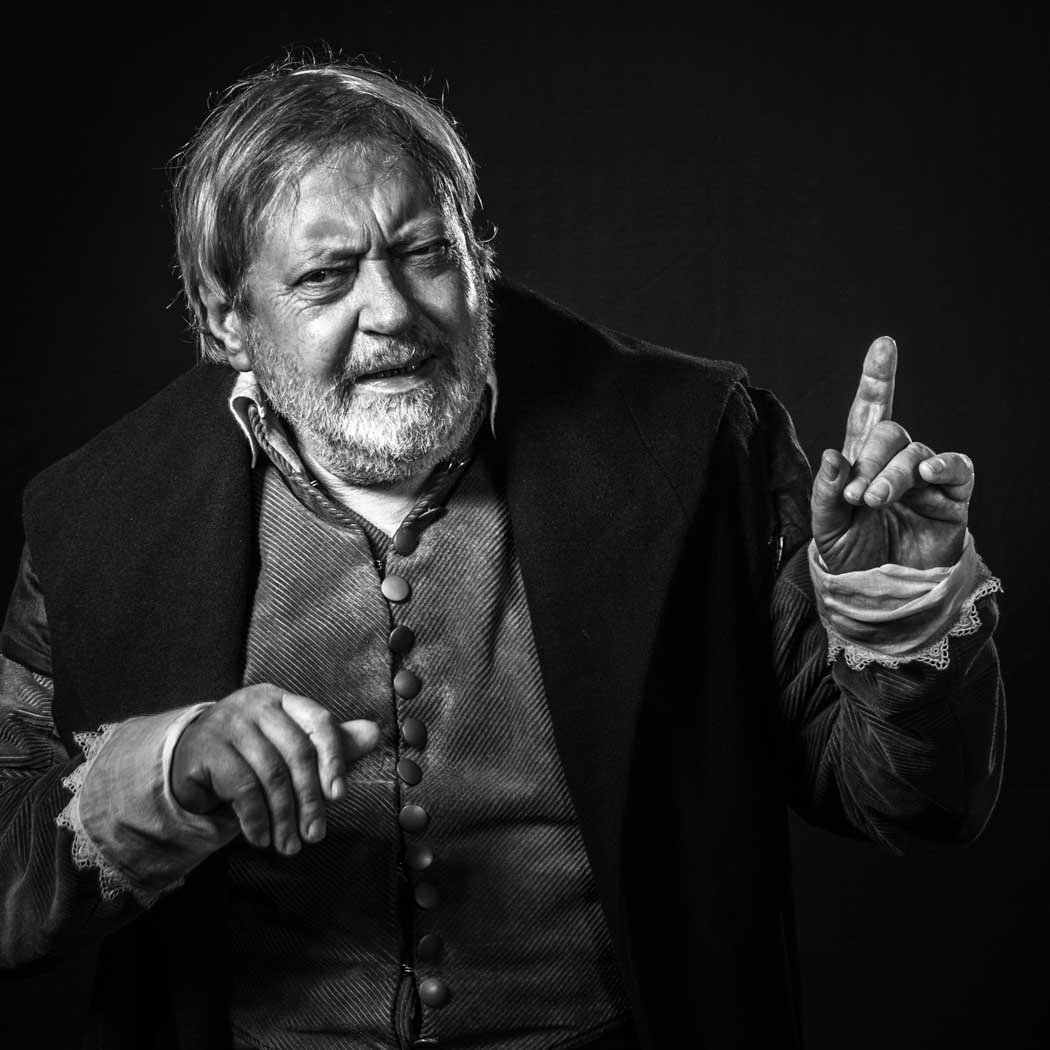


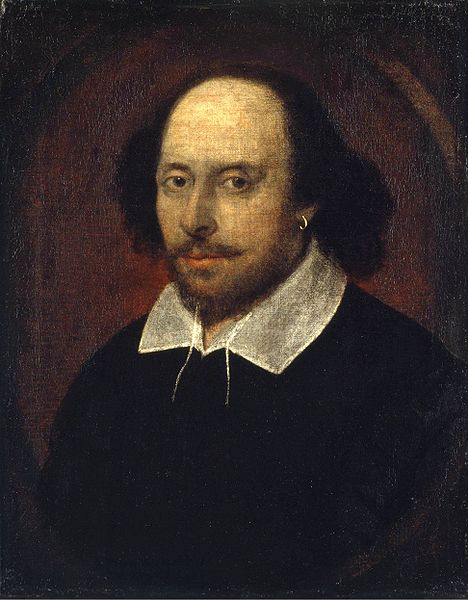

 …because he believed she had been unfaithful to him…..