Feeds:
Posts
Comments

Archive for the ‘Uncategorized’ Category

It’s best to read ‘Enter the Dark Lady’ Part Eleven first.

1591/2 LOVE IN A TIME OF PLAGUE

25. (130)

My Mistress’ eyes are nothing like the Sun;

Coral is far more red, then her lips red.

If snow be white, why then her breasts are dun:

If hairs be wires, black wires grow on her head.

Shakespeare changes tack. In a Sonnet 23 (Old 132) he has compared Amelia’s eyes to the sun in the morning: now she says her eyes do not resemble the sun at all. Coral is far redder than her lips – and her breasts are not snow-coloured – they are more a dull brown – and her hair resembles black wires. Amelia was mixed race.

I have seen Roses damaskt, red and white,

But no such Roses see I in her cheeks,

And in some perfumes is there more delight,

Than in the breath that from my Mistress reeks.

Shakespeare says he has seen roses with a variegated white and red colour – but Amelia’s cheeks do not resemble them. Her face was dark-coloured. Also perfume is far more attractive than the breath that reeks from her lips.

I love to hear her speak, yet well I know

That Music hath a far more pleasing sound:

I grant I never saw a goddess go;

My Mistress when she walks treads on the ground.

Shakespeare adores to hear Amelia speak – but knows full well that music sounds better. He admits that he has never seen a Goddess walk – but Amelia, far more substantial than a Goddess, walks firmly on the ground.

And yet by heaven I think my love as rare,

As any she beli’d with false compare.

In the final couplet, Shakespeare turns the whole argument around. It is not Amelia he is attacking, but poets who use untrue clichés about their loved ones – and ornate and far-fetched imagery. We can see Rector Robert Crowley’s influence here.

Shakespeare is trying to seduce Amelia by insulting her, making her laugh, then leaping at her – exactly as Berowne tries to seduce the dark-skinned Rosaline in Love’s Labour’s Lost.


Shakespeare wrote the play at Mary Southampton’s request: she wanted to ‘heterosexualise’ her son and the whole play is in praise of the love of women – as the Birthday Sonnets are. But Shakespeare hi-jacks the project – and writes a whole play to seduce Amelia – who played Rosaline in the first private performance in the grounds of Place House, Titchfield, in 1592.

Edmund Ironside was also produced around this time – another collaboration between Shakespeare and Tom Nashe. It has a good part for Amelia – Stich’s wife. Edricus says of her:

Thee old hag, witch, quean, slut, drab, whore and thief

How should I know thee, black Egyptian?’

In Sonnet 25.(Old 130) Shakespeare is again challenging Christopher Marlowe’s Hero and Leander:

Many would praise the sweet smell as she passed,

When ’twas the odour which her breath forth cast;

And there for honey bees have sought in vain,

And, beat from thence, have lighted there again.

26. (135)

Whoever hath her wish, thou hast thy Will

And Will to boot, and Will in over-plus,

More then enough am I that vex thee still,

To thy sweet will making addition thus:

Shakespeare says that other women may have exactly what they want – but Amelia must make do with Will. Will = Shakespeare’s name or Shakespeare’s penis – his ‘willy’ – or both. In addition she has more than the usual amount of Will – suggesting Shakespeare’s erection at the thought of Amelia. Amelia also has a ‘sweeter will’ of her own – her own wilfulness and her own pudend. ‘Will’ could mean the female genitals as well – which Shakespeare longs to make an addition to – by penetrating her.

Wilt thou whose will is large and spacious,

Not once vouchsafe to hide my will in thine?

Shall will in others seem right gracious,

And in my will no fair acceptance shine?

Shakespeare states that Amelia has a large pudend – but she refuses to let Shakespeare’s penis inside it. Other people’s penises are attractive – but not his.

The sea all water, yet receives rain still,

And in abundance addeth to his store,

So thou, being rich in Will add to thy Will

One will of mine to make thy large Will more.

The sea goes on accepting all the rain that falls in it – and so, though you have many penises at your disposal, accept mine and make your pudend even larger.

Let no unkind, no fair beseechers kill;

Think all but one, and me in that one Will

Do not refuse any well-intentioned wooers with an act of unkindness. Think all your wooers as one wooer – and that one wooer as me.

‘Think all but one’ is a play on the Southampton family motto: ‘Ung par tout’: ‘All for one’ or ‘All is one’.

Shakespeare is making reference in this Sonnet to Amelia’s status as a courtesan. Her lover, the old Lord Hunsdon, had been with her at Cowdry and Titchfield on the Queen’s progress.

Hunsdon and Amelia were probably put up at Whitely Lodge – at a discreet distance from Place House. That’s why Rosaline is described as ‘a whitely wanton’ in Love’s Labour’s Lost even though she has a dark skin.

But the important information from the Sonnet is that Amelia has NOT given in to Shakespeare.

We know in her dealings with the astrologer, Simon Forman……

…..that she was a prick-tease. She would allow Forman to kiss her all over – but would not finally ‘halek’.

Both this sonnet and the following could have been two very cheeky pieces of ‘performance art’.

27. (136)

If thy soul check thee that I come so near,

Swear to thy blind soul that I was thy Will,

And will thy soul knows is admitted there;

Thus far for love, my love-suit sweet fulfil.

If your conscience chides because I approach you so intimately, swear to your conscience – which is unable to see – that my genitals are your genitals – and conscience knows that every woman must have her pudend. Go at least as far as that in granting my love-suit to you.

Will will fulfil the treasure of thy love,

I fill it full with wills, and my will one.

In things of great receipt with ease we prove,

Among a number one is reckon’d none.

Shakespeare says that he will add to the rich store of Amelia’s pudend – fill it full of penises – and his penis is a solitary one.  Big ‘things’ [pudends] are easy to negotiate – and with so many penises one penis is neglible.

Then in the number let me pass untold,

Though in thy store’s account I one must be,

For nothing hold me, so it please thee hold

That nothing me, a some-thing sweet to thee.

Shakespeare is saying that in the vast throng of Amelia’s clients he will hardly be noticed – although his actual payment for her services must be noted. He asks to have sex with her free of charge – for nothing – as he himself is a nothing, though perhaps something to her.

Lord Hunsdon paid £40 a year for Amelia’s services – £40,000 in today’s money.

Make but my name thy love, and love that still,

And then thou lov’st me for my name is Will.

Shakespeare is asking Amelia to love his name his love – and as his name is Will, it means his penis.

‘FOR MY NAME IS WILL’ – not Edward de Vere or anyone else.

SHAKESPEARE WROTE SHAKESPEARE PLAYS

…….with a little help from his friends….

BUT HE WROTE HIS SONNETS SINGLE HANDED.

28. (141)

In faith I do not love thee with mine eyes,

For they in thee a thousand errors note,

But ’tis my heart that loves what they despise,

Who in despite of view is pleas’d to dote.

Unsuccessful in his wooing of Amelia, Shakespeare changes tack. He now says that he no longer finds her beautiful – in fact, he can detect many blemishes. It is is his heart, not his eyes, that prompts him to love Amelia – and make him besotted with her.

Nor are mine ears with thy tongue’s tune delighted,

Nor tender feeling to base touches prone,

Nor taste, nor smell, desire to be invited

To any sensual feast with thee alone:

He now claims that her voice is not attractive to him nor is his higher sensibility vulnerable to vulgar gropes. Neither his senses of taste or smell compel him to an intimate session with Amelia.

But my five wits nor my five senses can

Dissuade one foolish heart from serving thee,

Who leaves unsway’d the likeness of a man,

Thy proud heart’s slave and vassal wretch to be:

But neither his intelligence or his senses can persuade his heart to stop loving Amelia, which leaps out of his body – which is left uncontrolled – to be Amelia’s slave and servant.

Only my plague thus far I count my gain,

That she that makes me sin, awards me pain.

The only benefit from this love-sickness is that Amelia, who makes him, as a Catholic married man, sin in his thoughts awards him as a penance the pain of rejection.

To read ‘Hard to Get’, Part Thirteen, click: HERE
 

Read Full Post »

It’s best to read ‘The Bath Sonnets’ Part Ten  first.

1591/2 AMELIA BASANNO: THE DARK LADY OF THE SONNETS

The part of the dark-skinned Rosaline in Love’s Labour’s Lost was played in private performance in Titchfield by the beautiful, dark-skinned Amelia Basanno who had been part of Queen Elizabeth’s entourage.

Rosaline’s ‘blackness’ – as well as her coquettishness – is a big feature in the play.

Berowne/Shakespeare falls in love with her looks…..

At first sight

..as his intimate friend Christopher Marlowe…….

……..had taught him to do in his poem Hero and Leander….

Whoever loved who loved not at first sight.

Shakespeare quotes this line in As You Like It.

But the other lords – who have also fallen for the other women in the Princess of France’s entourage ‘at first sight’ – take blackness to be a sign of ugliness.

Shakespeare – in falling in love with a black woman – is even more daring in his sexual tastes than gay Kit Marlowe!

In Hero and Leander Kit also wrote:

So lovely fair was Hero, Venus’ nun,

As Nature wept, thinking she was undone,

Because she took more from her than she left,

And of such wondrous beauty her bereft.

Therefore, in sign her treasure suffered wrack,

Since Hero’s time hath half the world been black.

Marlowe is saying that Hero stole so much beauty from Nature that half the world was left ugly and black…

Aristocratic Elizabethan women thought that a suntan was ugly and wore face masks when they rode on horseback. Only women who worked for a living had brown skins.

But for Shakespeare – as Berowne in the play….

BLACK IS BEAUTIFUL!

FERDINAND (to Berowne)

By heaven, thy love is black as ebony.

BEROWNE

Is ebony like her? O wood divine!
A wife of such wood were felicity.
O, who can give an oath? where is a book?
That I may swear beauty doth beauty lack,
If that she learn not of her eye to look:
No face is fair that is not full so black.

FERDINAND

O paradox! Black is the badge of hell,
The hue of dungeons and the school of night;
And beauty’s crest becomes the heavens well.

BEROWNE

Devils soonest tempt, resembling spirits of light.

Berowne goes on to argue that Rosaline’s brows are black because they are in mourning for the fact that make-up, hair-colouring and wigs now give women a false attraction:

O, if in black my lady’s brows be deck’d,
It mourns that painting and usurping hair
Should ravish doters with a false aspect;
And therefore is she born to make black fair.

Berowne even argues that she has made black so fashionable that even a natural, ruddy complexion looks false and women paint their brows black to look like Rosaline:

Her favour turns the fashion of the days,
For native blood is counted painting now;
And therefore red, that would avoid dispraise,
Paints itself black, to imitate her brow.

DUMAIN

To look like her are chimney-sweepers black.

LONGAVILLE

And since her time are colliers counted bright.

FERDINAND

And Ethiopes of their sweet complexion crack.

DUMAIN

Dark needs no candles now, for dark is light.

BEROWNE

Your mistresses dare never come in rain,
For fear their colours should be wash’d away.

FERDINAND

‘Twere good, yours did; for, sir, to tell you plain,
I’ll find a fairer face not wash’d to-day.

BEROWNE

I’ll prove her fair, or talk till doomsday here.

FERDINAND

No devil will fright thee then so much as she.

DUMAIN

I never knew man hold vile stuff so dear.

LONGAVILLE

Look, here’s thy love: my foot and her face see.

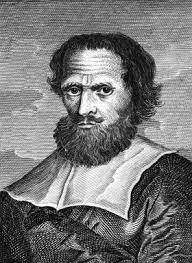
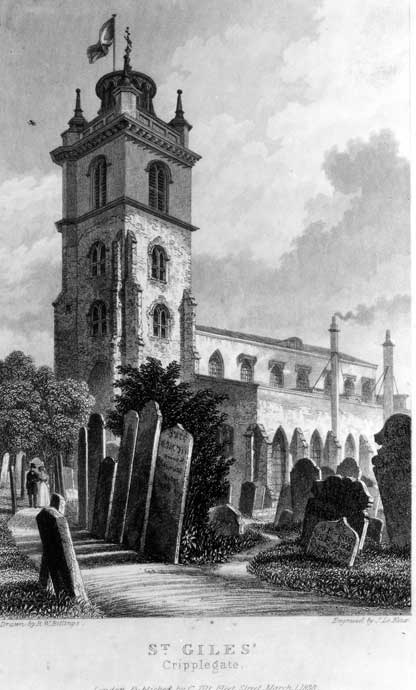
Berowne’s ideas also follow the argument of Robert Crowley – the Rector of St. Giles, Cripplegate – who had a huge influence on Shakespeare.

Sir Thomas Lucy, who had harassed Shakespeare and his family at Stratford-upon-Avon because they were Catholics – worshipped at St. Giles when he was in London.

Shakespeare had sought him out as a protector when he fled to London – and Crowley had taken the eighteen year old under his wing.

Crowley hated all artifice in life – in language and in fashion. Crowley – a radical balladeer as well as a priest – hated elaborate clothes, make-up, wigs and hair-colouring in women

Let thine apparel be honest;

Be not decked past thy degree

Neither let thou thine head be dressed

Otherwise than beseemeth thee.

Let thine hair bear the same colour

That nature gave it to endure;

Lay it not out as doeth a whore

That would men’s fanatasies allure.

Paint not thy face in any wise

But make thy manners for to shine

And thou shalt please all such men’s eyes

As do to Godliness incline.

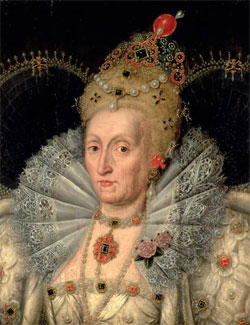
Also, by attacking make-up and wigs, Shakespeare is launching an indirect attack on Queen Elizabeth – who wore a bright red wig and made up her face with egg-white, white lead, borax and alum.

Shakespeare uses all these ideas in his Sonnets to Amelia. For him there is no division between art and life. Sonnet 22 was probably sent to Amelia by a messenger – or left for her to ‘find’ – in the way the Lords in Love’s Labour’s Lost send their sonnets to their mistresses

22. (127)

In the old age black was not counted fair,

Or if it were it bore not beauty’s name:

But now is black beauty’s successive heir

And Beauty slander’d with a bastard shame:

In previous times a black colouring was not considered attractive – and even if it was, it wasn’t described as beautiful. But now black is seen as their natural heir to beauty – and beauty does not inherit the title because it is a bastard. Shakespeare goes on to explain this statement.

For since each hand hath put on Nature’s power,

Fairing the foul with Art’s false borrow’d face,

Sweet beauty hath no name, no holy bower

But is profan’d, if not lives in disgrace.

Women have taken over from Nature – making ugly features seem attractive with make-up. So what was considered beautiful before – a white skin and red lips – has been desecrated and profaned by artificiality.

Therefore my Mistress’ eyes are Raven black,

Her eyes so suited, and they mourners seem,

At such who, not born fair, no beauty lack,

Sland’ring Creation with a false esteem.

Amelia’s eyes are black like a raven’s wing because they are in mourning at the behaviour of unattractive women who make themselves attractive with make-up and so betray nature by making men fancy them.

Yet so they mourn, becoming of their woe,

That every tongue says beauty should look so.

But Amelia’s eyes look so attractive in mourning that everyone agrees that BLACK IS BEAUTIFUL!!!

23. (132)

This sonnet was sent to Amelia – or read aloud to her. It addresses Amelia directly.

Clearly Shakespeare’s first wooing sonnet to Amelia has failed completely.  She treats him with contempt as she’s after young Harry.

Thine eyes I love, and they as pitying me,

Knowing thy heart torment me with disdain,

Have put on black, and loving mourners be,

Looking with pretty ruth upon my pain.

Shakespeare says he loves Amelia’s eyes who have dressed in black mourning because they pity Shakespeare, though her heart despises him.

And truly not the morning Sun of Heaven

Better becomes the grey cheeks of th’ East,

Nor that full Star that ushers in the Even

Doth half that glory to the sober West

As those two morning eyes become thy face:

Shakespeare plays on ‘mourning’ and ‘morning’. For him neither the morning sun, which brightens up the dull, dawn clouds or the evening star which adds glory to the staid light in the west at sunset are as beautiful as Amelia’s two black eyes seen in the morning.

O let it then as well beseem thy heart

To mourn for me since mourning doth thee grace,

And suit thy pity like in every part.

Shakespeare asks Amelia’s heart to pity him as her eyes do because mourning becomes her and every part of Amelia should pity Shakespeare equally.

Then will I swear beauty herself is black,

And all they foul that thy complexion lack.

If Amelia does so, Shakespeare promises he will declare that BLACK IS BEAUTIFUL – and all those women without black skins ugly.

24. (128)

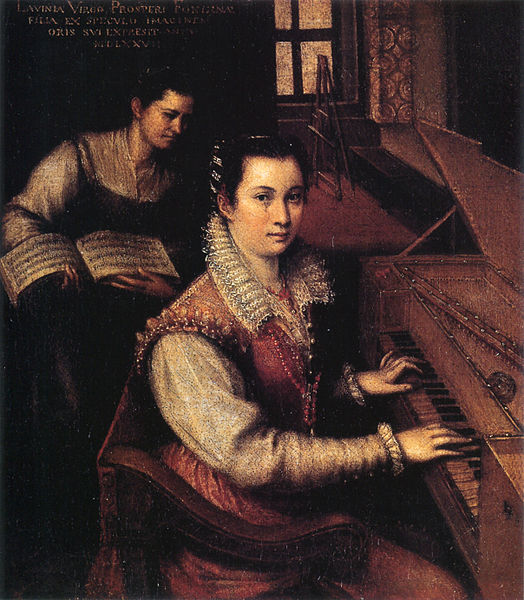
Amelia was a musician and singer – and played the clavichord.

Her whole family were the Queen’s Musicians – first brought over to England from Venice through the good offices of Thomas Wriothesley, 1st Earl of Southampton….

Photo by Ross Underwood.

……during the reign of Henry VIII.

In addition, Amelia had been brought up by aristocratic women when her mother had died – so her skills would have been developed.

How oft when thou my music, music play’st,

Upon that blessed wood whose motion sounds

With thy sweet fingers when thou gently swayst

The wiry concord that mine ear confounds,

Do I envy those Jacks that nimble leap

To kiss the tender inward of thy hand,

Whilst my poor lips which should that harvest reap,

At the wood’s boldness by thee blushing stand.

Shakespeare says that Amelia herself is like a piece of music and when she plays the clavichord itself and coaxes the wires into a harmony that tricks and engages Shakespeare’s ears in a delightful way, he envies the keys of the instrument which seem to jump up to kiss her hands while his lips, that should be kissing Amelia’s hands instead, are embarrassed by their sexy boldness.

To be so tickled, they would change their state

And situation with those dancing chips,

Ore whom thy fingers walk with gentle gait,

Making dead wood more blest than living lips.

If Shakespeare’s lips could be touched and fondled in the same way, he would willing turn them into keys which, though they are ‘dead wood’ are more blessed by Amelia as her fingers walk over them than Shakespeare’s living lips.

Since saucy Jacks so happy are in this,

Give them thy fingers, me thy lips to kiss.

Since the impertinent keys of the clavichord are happy enough with the situation, she should give her fingers to them to kiss and her lips to Shakespeare.

Lips would also suggest Amelia’s labia. Labia, after all, is Latin for ‘lips’.

To read ‘Love in a Time of Plague’ Part Twelve, click: HERE


Read Full Post »

It’s best to read ‘Attempted Seduction’ Part Nine first.

1591. The Royal Progress.

Queen Elizabeth visited Titchfield and Cowdray in the autumn of 1591 as part of her progress. In her retinue was the Bassano family – dark-skinned Sephardic musicians. These included the mixed-race Amelia. She was the beautiful young mistress of old Lord Hundson – a cousin of the Queen.


Henry Carey, Lord Hunsdon.

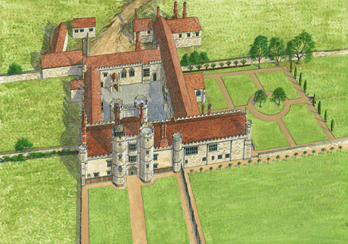
Elizabeth shot deer from standings at both Cowdray and Titchfield and this became one of the central events in the ‘romantic satire’ Love’s Labour’s Lost which Mary Southampton commissioned from Shakespeare in another attempt to turn son Harry straight.

Amelia stayed on at Titchfield after the Progress as the Plague was raging in London – and she had set her cap at young Lord Harry.

Shakespeare fell in love with her and cast her in the play as the dark-skinned wanton, Rosalind.

He cast himself as her lover, Lord Berowne – a play on Mary Southampton’s family name, Browne.

[1592: Shakespeare – in collaboration – writes Sir Thomas More, Edmund Ironside, Arden of Faversham, Love’s Labour’s Lost]

1592 AMATEUR THEATRICS

Love’s Labour’s Lost was given a private performance in the grounds of Place House in Titchfield by a cast of aristocratic amateurs – including women – and Shakespeare’s professional colleagues at Whitsun (14th May) 1592.

The aristocrats included Penelope Rich…..

….famous for her blonde hair and black eyes…

….hair which is mentioned in the play as being like ‘the heavens’.

….who played the Princess of France….

She had been the muse of Sir Philip Sidney in his sonnet sequence – Astrophil and Stella – and he had played upon her name ‘Rich’. Shakespeare does the same in the play – and then in his own Sonnets.

Shakespeare even lifted the form of the ‘Shakespearean Sonnet’ form from Sir Philip in his Arcadia.

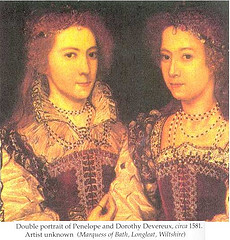
Penelope’s sister, Dorothy,was also cast as Maria in the play….

She had acted with her sister at Wilton.

Katharine was played by Frances Devereux, the Earl of Essex’s wife who had originally been married to Sir Philip Sidney. Frances, like Katherine in the play, had a sister who died.

Unfortunately the text of Love’s Labour’s Lost is corrupt at times, so we cannot tell which female character dresses in white. But Frances Devereux was often painted in white……

…..and white was the colour of her husband, Robert Devereux, the 2nd Earl of Essex and great friend of Harry Southampton…

These three women were inseparable – and Antonio Perez – a gay Spaniard who was part of the 2nd Earl of Essex’s entourage – called them:

Three sisters and goddesses.

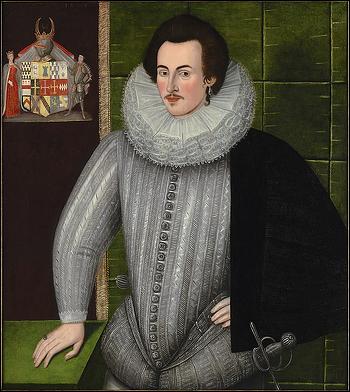
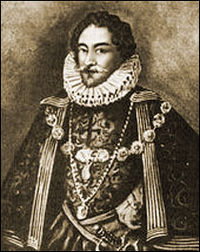
Penelope Rich’s lover, Charles Blount [pronounced ‘Blunt’]…..later Baron Mountjoy…


……played Lord Longaville…..

Fynes Morrison – a contemporary – said he was ‘of stature tall’ – and as well as ‘long’ in the name, the character is described by Maria as ‘tall’.

Morrison also said that Blount:

chose to be drawn with a trowel in his hand and this motto: Ad raedificandam antiquam domum – to build the Ancient House. For this noble and ancient Barony was decayed.

This imagery of re-building a house is used earlier in Sonnets 11 [Old 10] and 14 [Old 13] as an image for Harry having a son – and so ‘re-building’ his body.

Blount was a close friend of Southampton and Shakespeare was referring to this painting in his Sonnets.

He uses the word ‘Blunt’ in the play to describe Longaville….

..and the word ‘Blunt’ in the Sonnets.

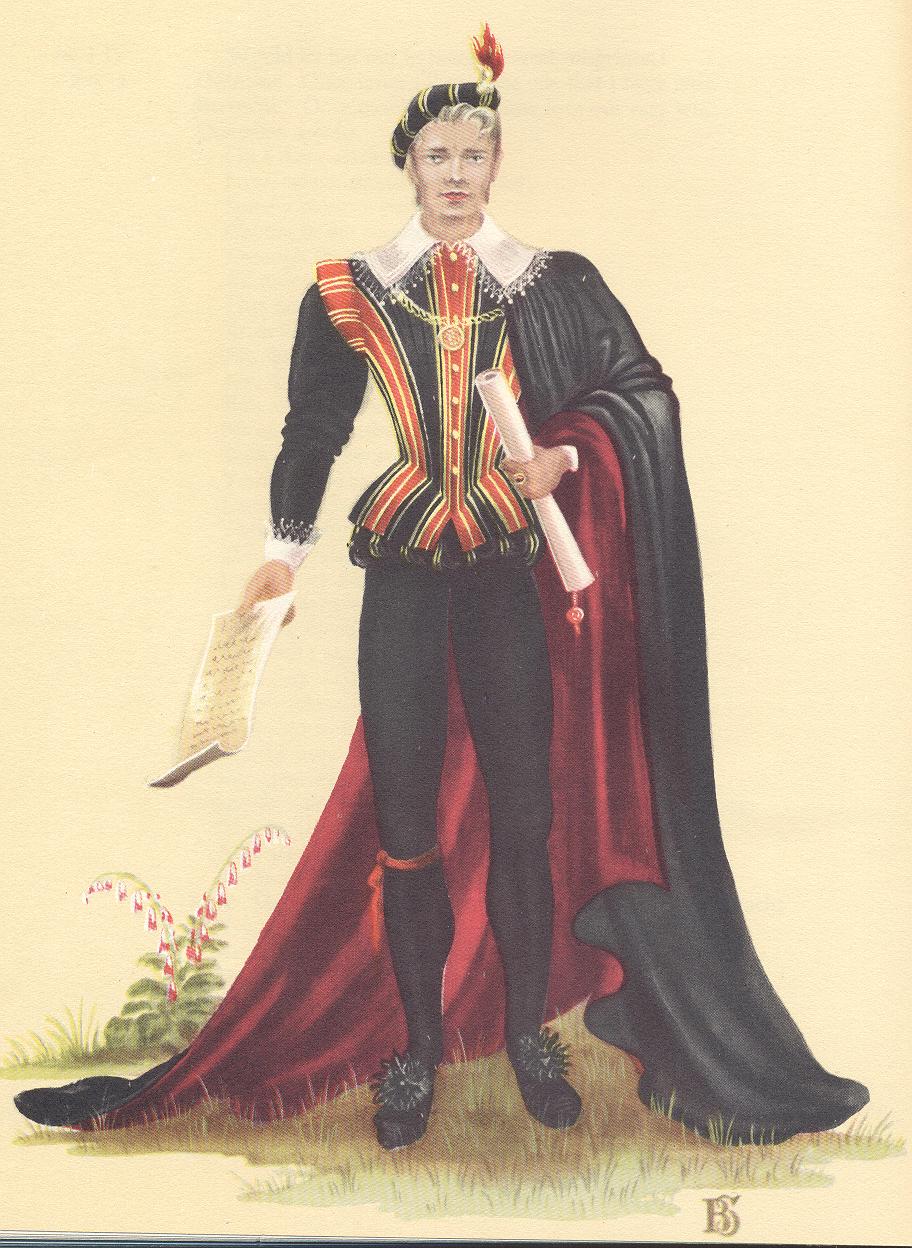
Roger Manners, 5th Earl of Rutland, Southampton’s friend, played Dumaine.

Dumaine quotes the word ‘manner’ of  himself in the play and as we shall see, Shakespeare uses ‘manners’ as a coded reference to to the Earl of Rutland in the Sonnets.

Dumaine is the youngest of the wooers – so much so that he doesn’t yet have a beard. In 1592, the Earl of Rutland was sixteen.

Harry himself ……

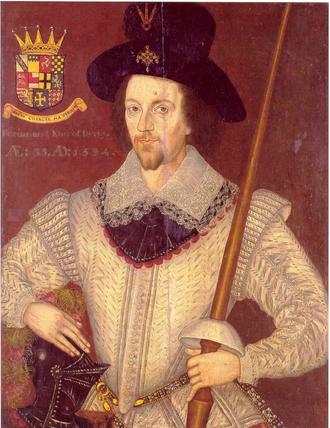
….played Ferdinando, King of Navarre…..

….a tribute to Ferdinando, Lord Strange, with whose company Shakespeare had begun his acting career and who was a friend of the Southamptons….

…..and Henri, King of Navarre, with whom the Earl of Essex had just fought the Siege of Rouen.


The tiny, beardless Nashe played the part of Moth, ‘the well-educated infant’ in the show who is pageboy to the tight-fisted Spaniard, Don Armado….

– a satire on Sir Walter Raleigh….

……who was the enemy of Southampton and Essex.

Armado, though a Spaniard, breaks into broad Devonshire in the course of the play.

[Note: The version of Love’s Labour’s Lost that has come down to us is a re-write for Elizabeth’s Court in 1599. Raleigh was back in favour then – so the Braggart is turned into a satire on Perez whom Elizabeth despised.]

THE ‘BATH’ SONNETS

20. (153) 21. (154)

These two sonnets, the final sonnets in the original published order, are not autobiographical at all. They were intended for the character of Armado .

When he falls in love with the wench, Jaquenetta, he declares:

Assist me, some extemporal god of rhyme,
for I am sure I shall turn sonnet. Devise, wit;
write, pen; for I am for whole volumes in folio!

During the preparation for the production, word came that Raleigh had impregnated Bess Throckmorton – so the plot had to be changed. (Originally Armado was going to catch venereal disease from Jaquenetta and be rejected by her.)

These are two variations on the sonnet Armado never delivered….

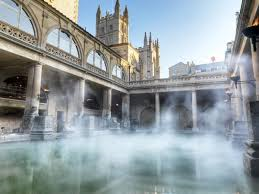
It describes the origins of the famous thermal waters of Bath…..

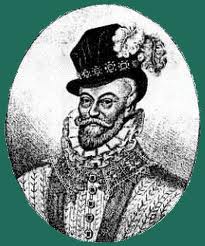
…….a favourite haunt of Raleigh and his crony the ‘Wizard Earl’ – Henry Percy, Ninth Earl of Northumberland……

Northumberland was in Bath in June and October, 1590 – and for three weeks in April, 1591, with a retinue of 25, including Raleigh….

Bath was famous for its cure of venereal disease and was only hours away from Raleigh’s home, Sherborne.

To this day, the waters rise up already heated by geothermal means. To the Celts and Romans this was a phenomenon of mystery – and involved the intervention of a God or Goddess…

Sulis to the Celts……..

….and Minerva to the Romans.


Shakespeare – in the character of Armado – offers his own explanation.

20. (153)

Cupid laid by his brand and fell a sleep:

A maid of Dyan’s this advantage found,

And his love-kindling fire did quickly steep

In a cold valley-fountain of that ground:

Cupid, putting down his fire-brand which causes people to fall in love, fell asleep – and a nymph in attendance to Diana – Goddess of the chase and chastity – found it and plunged it into a cold fountain.

Which borrow’d from this holy fire of love,

A dateless lively heat still to indure,

And grew a seething bath which yet men prove

Against strange maladies a sovereign cure:

The waters took on seething heat from this holy fire which lasts till this day as a cure for exotic illnesses (1) Love (2) Venereal disease.

But at my mistress’ eye Love’s brand new fired,

The boy for trial needs would touch my breast;

I sick withal the help of bath desired,

And thither hied, a sad distemper’d guest.

But at my mistress’s (1) eyes (2) pudenda, the dowsed brand sprung to life again – and to try out its potency Cupid plunged it into my breast and it made me (1) Sick with love (2) Sick with venereal disease.

I needed to go to Bath for its waters (1) To relieve the heat of my love (2) To find a cure for my venereal disease.

But found no cure; the bath for my help lies,

Where Cupid got new fire: my mistress’ eye.

But the waters of Bath did not provide relief. The relief to my love-sickness can only be found at its source – my mistress’s (1) Eye. (2) Pudend.

21. (154)

The little Love-God lying once a sleep,

Laid by his side his heart inflaming brand,

Whilst many Nymphs that vow’d chaste life to keep,

Came tripping by, but in her maiden hand,

The fairest votary took up that fire,

Which many Legions of true hearts had warm’d;

And so the General of hot desire,

Was sleeping by a Virgin hand disarm’d.

A repeat of the above story – except a troop of nymphs dedicated to chaste life troop by – the most beautiful of which picks up the torch which had caused many to fall in love. So the all-powerful Love God, Cupid, was dis-empowered by a virgin.

This brand she quenched in a cool Well by,

Which from love’s fire took heat perpetual,

Growing a bath and healthful remedy

For men diseas’d; but I my Mistress’ thrall,

Came there for cure, and this by that I prove:

Love’s fire heats water, water cools not love.

The nymph cools the brand in a well that again takes on an eternal heat which cures men (1) Of their love (2) Of their disease. But I was so under the power and control of my mistress that I found that the fire of love can heat water but water cannot cool the ardour of love.

‘Love’s fire heats water’ is a direct did at Sir Walter Raleigh. With his West Country accent, he pronounced ‘Walter’ as ‘Water’ – causing Queen Elizabeth to say:

I thirst for Water’.

When the sonnets were published in 1609, Raleigh was out of favour with King James and imprisoned in the Tower. He was again a safe target for Shakespeare to attack.to attack.

To read ‘Enter the Dark Lady’, Part Eleven, click:

Read Full Post »


It’s best to read ‘The Birthday Sonnets’ Part Eight first.

1590-1591

The rest of 1590 and 1591 was taken up with massive activity at Titchfield and Wilton. Queen Elizabeth had withdrawn Raphael Holinshed’s Chronicles – because she didn’t want anyone comparing her reign with others. The Countess of Southampton and the Countess of Pembroke – who both had good reason to dislike the Queen – commissioned Shakespeare to write the Wars of the Roses plays.

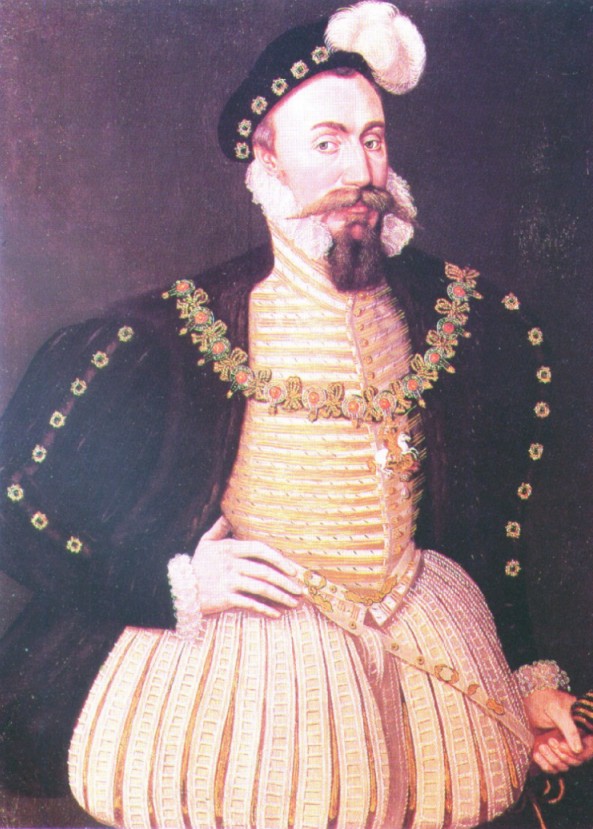
These were largely a satire on Elizabeth and the Tudors – and Elizabeth’s old lover, Robert Dudley the Earl of Leicester…..


…..who was the model for Richard III….

Shakespeare got his old enemies, Robert Greene…..

…..and Thomas Nashe…..

Thomas Nashe

down to Titchfield to help him…..

[1591: Plays written by Shakespeare: The Troublesome Reign of King John, The True Tragedy of Richard Duke of York, First Part of the Contention, Richard III and Henry VI Part One.]

1591: PLATONIC LOVE

Shakespeare’s next sonnet was a private one to Harry – also to be read by his mother, Mary, Second Countess of Southampton.

19. (20)

A Woman’s face with nature’s own hand painted,

Hast thou the Master Mistress of my passion,

A woman’s gentle heart but not acquainted

With shifting change as is false women’s fashion;

Shakespeare says that Harry’s face is like a woman’s – but with this difference: Harry does not use make-up. His features have been painted by Dame Nature herself.

He then describes Harry as being like both a man and a woman – controlling Shakespeare’s passion as both his master and his mistress. Harry has the soft-hearted nature of a woman – but not the fickle nature of a woman who often changes her lovers. Shakespeare uses ‘feminine’ endings for the end of each line of the Sonnet – ending on two syllables rather than one.

An eye more bright then theirs, less false in rolling:

Gilding the object where-upon it gazeth;

Harry’s eyes are brighter than a woman’s and, unlike a woman’s, do not look at every handsome man that passes by.

The beams from Harry’s eyes are like shafts of gold that gild the person he looks at. (At this time, people thought that beams came FROM the eye, rather than to it.)

A man in hew all Hews in his controlling,

Which steals men’s eyes and women’s souls amazeth.

Shakespeare, by spelling hue as ‘hew’ – and then italicising Hews and capitalising the ‘H’ – plays on Harry’s name and title. Hews is an anagram from Henry Wriothesley, Earl [of] Southampton. Every man in the room looks at Harry and he entrances the very souls of women.

And for a woman wert thou first created,

Till nature as she wrought thee fell a-doting,

And by addition me of thee defeated,

By adding one thing to my purpose nothing.

Shakespeare says that Dame Nature originally intended to make Harry a woman – but as she creted the female Harry, she fell in love with him – just as in Ovid – Shakespeare’s hero – Pygmalion, the sculptor, falls in love with the woman he is carving, Galatea…


But since she prickt thee out for women’s pleasure,

Mine be thy love and thy love’s use their treasure.

In order to fulfil her love, Dame Nature gave Harry a penis so he could give pleasure to a woman. Because this was Nature’s intention, Shakespeare wants his love for Harry to be Platonic rather than actively sexual.

Both Shakespeare and Harry were Catholics. The Jesuits actively encouraged homosexual platonic love – especially between young missionary priests. As long as the love was not physical, it was holy.

John Ingram was one of these young missionary priests. On 21st August, 1589, he wrote to his confessor, Father Joseph Cresswell, when he learnt of the death of his ‘intimate friend’ Humphrey Wolsley:

Yet when the news came of his exchange of life with death, I was so overcome and prostrated with grief, that I passed the whole night without sleep. For as often as I tried to fall asleep, so often did I recall to mind Humphrey’s incredible kindness to me and his many good services, so often did I see before me the man to whom I used to turn, in whose company I found peace, in whose sweet intercourse I lay aside all care and trouble. He, he it was who would talk so often and so earnestly about virtue and goodness, about quelling disorderly passions and extirpating vices before they became deeply rooted or further disseminated. From his company, help and advice, I might, had I tried, have gathered richer and more abundant thought. Such, dearest father was our intimacy, such the bonds of our friendship, which, I trust, your paternity heartily approves of, as I am sure that God does.

From this Sonnet it is clear that Harry – who as we learn from later Sonnets – was attracted to men of a class lower than himself – has made a play for Shakespeare. We also learn from Sonnet 104 (Old Order) that Shakespeare was sexually attracted to Harry the very first time he set eyes on him – April, 1590.

However, he had been employed by the Countess of Southampton – who was also attracted to lower class men – to convince her gay son to get married – so a homosexual affair between Shakespeare and Harry would have been counter-productive to say the least. In this Sonnet, which was also intended for Mary Southampton’s eyes, Shakespeare gently rebuffs him.

Harry, who we later learn engaged in cross-dressing, was born into a heavily bi-sexual, aristocratic culture. His hero, Sir Philip Sidney, then dead….


……had written the romance Arcadia which features Prince Musidorus with his:

….fair auburn hair (which he ware in great length, and gave at that time a delightful show with being stirred up and down with the breath of a gentle wind…his face now beginning to have some tokens of a beard….’

And Prince Pyrocles who is…

…..of a pure complexion, and of such cheerful favour as might seem either a woman’s face on a boy or an excellent boy’s face on a woman.

Prince Pyrocles falls in love with Pamela – the daughter of King Basilius – whom John Aubrey tells us – was based on Dorothy Devereux. Her sister in the story – Philoclea – was based on Penelope Rich – who was to become Shakespeare’s leading lady in private performance!

Pyrocles dresses up as a woman – Zelmane – to gain entry into the court .

He looks so beautiful in drag that Prince Musidorus fancies him – and King Basilius falls in love with him!

There is a tradition that the Pembroke family – and Lady Penelope – would act out scenes from Arcadia – and at Wilton there are Arcadian Panels in one of the drawing rooms….

To read ‘The Bath Sonnets’, Part 10, click: HERE
Read Full Post »

It’s best to read ‘The Birthday Sonnets’ Part Seven first.

15. (14)

Not from the stars do I my judgement pluck,

And yet methinks I have Astronomy,

But not to tell of good, or evil luck,

Of plagues, of dearths, or seasons’ quality.

Shakespeare does not consult the stars to come to decisions – but at the same time he is a Master Astrologer. However he does not use this skill to predict the future for people.

Nor can I fortune to brief minutes tell,

Pointing to each his thunder, rain and wind,

Or say with Princes if it shall go well

By aught predict that I in heaven find.

Nor can he predict from the heavens what is going to be the fate of individuals – or even royalty, who might consult him in the way Queen Elizabeth consulted the Magus John Dee at Mortlake.

But from thine eyes my knowledge I derive,

And constant stars in them I read such art

As truth and beauty shall together thrive

If from thy self, to store thou wouldst convert:

No. Shakespeare claims that his knowledge of the future is derived from Harry’s eyes and this knowledge tells him that if Harry were to have a child, truth and beauty would flourish together.

Or else of thee this I prognosticate,

Thy end is Truth’s and Beauty’s doom and date.

If Harry, however, decides not to have a son truth and beauty will no longer reside together. Shakespeare is claiming that Harry is unique in that he is both beautiful AND truthful in a way that no-one else alive is.

16. (15)

When I consider every thing that grows

Holds in perfection but a little moment,

That this huge stage presenteth nought but shows

Whereon the Stars in secret influence comment.

Everything is changing in life and perfection only lasts a second. The world is like a theatre which presents shows on which the stars secretly comment – like an audience watching a play.

When I perceive that men as plants increase,

Cheered and checkt even by the self-same sky:

Vaunt in their youthful sap, at height decrease,

And wear their brave state out of memory.

Men are subject to the same influences as plants are: like them, they grow vigorously but at the zenith of their growth they start to decline and become merely a memory of their former grandeur.

Then the conceit of this inconstant stay

Sets you most rich in youth before my sight,

Where wasteful time debateth with decay

To change your day of youth to sullied night,

Knowledge of this transience makes you even more valuable to me – knowing that time and the natural process of decay are teaming up to kill you.

And all in war with Time for love of you,

As he takes from you, I ingraft you new.

Shakespeare is in a war with Time. As Time reduces Harry, Shakespeare increases him with his verse. It is like grafting on a new plant to an older one.

Shakespeare is starting a  new theme. That his poetry can make Harry immortal.

17. (16)

But wherefore do not you a mightier way

Make war upon this bloody tyrant time?

And fortify your self in your decay

With means more blessed then my barren rhyme?

Shakespeare invites Harry to make war on Time in a more powerful way than Shakespeare’s verse – which is barren of ideas as a woman can be barren.

Now stand you on the top of happy hours,

And many maiden gardens yet unset,

With virtuous wish would bear your living flowers,

Much liker than your painted counterfeit:

Harry is at a supreme moment of happiness in his life and many women are like gardens waiting to be filled with the flowers of Harry’s children – which would represent you more truthfully than a painting or a poem can do…..

So should the lines of life that life repair

Which this (Time’s pencil or my pupil pen)

Neither in inward worth nor outward fair,

Can make you live your self in eyes of men.

Only life itself can repair the lines that will appear on your face: drawings are still subject to time and I am only beginning to learn my craft as a writer. Neither art nor poetry can capture your outward beauty and inner worth so that men can see it.

To give away your self, keeps your self still,

And you must live drawn by your own sweet skill.

The paradox is that by giving yourself away to a woman, you get to keep yourself. And you can only live by making a drawing of yourself with a son.

The Countess of Pembroke – thirty miles away from Titchfield – was said to keep a ‘school’ for poets.

Mary Southampton – by commissioning this series of seventeen sonnets from Shakespeare for her son’s seventeenth birthday – was also keeping her own school at Place House in Titchfield.

18. (17)

Who will believe my verse in time to come

If it were fill’d with your most high deserts?

Though yet heaven knows it is but as a tomb

Which hides your life, and shows not half your parts:

Even if Shakespeare had the skill as a writer to describe Harry’s qualities no one in the future would believe him. As it is, his verse rather resembles a tomb that hides a body than displays it accurately.

If I could write the beauty of your eyes,

And in fresh numbers number all your graces,

The age to come would say ‘This Poet lies;

Such heavenly touches ne’er toucht earthly faces.’

Even if Shakespeare had the skill to describes the beauty of Harry’s eyes and the beauty of his behaviour, people would say he was lying because such qualities can only be found in heaven – not on earth.

So should my papers (yellowed with their age)

Be scorn’d, like old men of less truth than tongue,

And your true rights be term’d a Poet’s rage,

And stretched metre of an Antique song.

Shakespeare’s poems will turn yellow with age and be mocked as old men, who lie about the past, are mocked. The truth about Harry would be dismissed as a poet’s madness and the exaggeration of some old ballad.

But were some child of yours alive that time,

You should live twice: in it and in my rhyme.

But if Harry were to have a son he would live twice over: once in his son, and once in Shakespeare’s verse.

Shakespeare, in the Birthday Sequence, holds out the idea that his verse will make Harry immortal, withdraws the idea as presumptuous, then  re-inforces it in the very last couplet.

This dynamic in the relationship between Shakespeare and Harry is of vital importance. Harry has the wealth and the looks: Shakespeare has the talent.

To read ‘The Attempted Seduction’ Part Nine, click: HERE
Read Full Post »

It’s best to read ‘The Birthday Sonnets’ Part Six first.

11. (10)

For shame deny that thou bear’st love to an

Who for thy self art so unprovident

Grant if thou wilt, thou art belov’d of many,

But that thou none lovest is most evident:

For thou art so possest with murdrous hate,

That gainst thy self thou stickst not to conspire,

Seeking that beauteous roof to ruinate

Which to repair should be thy chief desire:

Shakespeare continues the argument of the previous Sonnet – that though Harry is beloved of many, he loves no-one in return because he is hell-bent on his own destruction. His duty is to repair his house, i.e., himself – by having a son – not destroy it.

O change thy thought, that I may change my mind,

Shall hate be fairer lodg’d than gentle love?

Be as thy presence is, gracious and kind,

Or to thy self at least kind hearted prove.

Shakespeare asks Harry to change his mind about having a son. It is wrong that self-hatred should exist in someone who looks so beautiful. Other, less attractive people are filled with love – including Shakespeare himself, who loves Harry. Harry should be kind to other people  – as his nature suggest he is – or at least he should be kind to himself.

Make thee an other self for love of me,

That beauty still may live in thine or thee.

‘An other self’ is code for a baby boy, that Shakespeare picks up later in the Sonnets. Shakespeare now talks openly of his love for Harry – and this love supplies a reason for Harry to have a son – so that his beauty will live on in himself and his child to please Shakespeare.

12. (11)


As fast as thou shalt wane so fast thou grow’st

In one of thine, from that which thou departest,

And that fresh blood which youngly thou bestow’st,

Thou mayst call thine, when thou from youth convertest.

Shakespeare argues that by having a son Harry will wax just as quickly as he wanes – that as he grows older and weaker, his son will grow older and stronger – ands a part of Harry will live on in his son. And by having a son when he is a young man he can claim this young man as himself as he grows older.

Herein lives wisdom, beauty, and increase,

Without this folly, age, and cold decay:

If all were minded so, the times should cease

And threescore year would make the world away:

Shakespeare here makes an oblique attack on Queen Elizabeth – who was nearing 60 in 1590 – ‘three score years’ and by staying, technically, at least, a virgin was facing a future filled with ‘folly, age and cold decay’. If everyone behaved like her, there would be no human race left in sixty years.

Let those whom nature hath not made for store,

Harsh, featureless, and rude, barrenly perish,

Look whom she best endow’d, she gave the more;

Which bounteous gift thou shouldst in bounty cherish.

Shakespeare argues that unattractive people like the Queen shouldn’t procreate – but because Nature has given so much to Harry, it is his duty to reproduce.

She carv’d thee for her seal, and meant thereby,

Thou shouldst print more, not let that copy die.

Shakespeare claims that Nature created Harry to be her seal =- with which she signed letters – her sign and motto, as Harry is the finest creature she has made. But a seal is there to produce copies – as Harry should do.

13. (12)

When I do count the clock that tells the time,

And see the brave day sunk in hideous night;

When I behold the violet past prime,

And sable curls all silver’d ore with white:

When lofty trees I see barren of leaves,

Which erst from heat did canopy the herd,

And Summer’s green all girded up in sheaves

Borne on the bier with white and bristly beard:

The ticking of a clock, the transformation of day into night, a fading violet, trees bereft of leaves that once gave shade to cattle and the green corn transformed into sheathes with white beards like old men…..

Then of thy beauty do I question make

That thou among the wastes of time must go,

Since sweets and beauties do them-selves forsake,

And die as fast as they see others grow,

…..all these make Shakespeare question the very nature of Harry’s beauty as it will be subject to time and decay. All beautiful things depart from their original natures and fade as quickly as they see other beautiful things come into being.

And nothing gainst Time’s scythe can make defence

Save breed to brave him, when he takes thee hence.

Shakespeare concludes that there is nothing we can do defeat time and death except have a son which allows us to mock time and death as we die.

14. (13)

O that you were your self, but love you are

No longer yours, then you your self here live.

Against this coming end you should prepare,

And your sweet semblance to some other give.

Shakespeare wishes that Harry’s identity could be complete and permanent – but he knows that his existence is dependent on his being alive on earth. Harry should prepare for this coming extinction and give his beauty to someone else.

So should that beauty which you hold in lease

Find no determination, then you were

Your self again, after your self’s decease,

When your sweet issue your sweet form should bear.

In that case Harry’s beauty – which is leased to him could transform into a lease that has no end date. Because when he dies his son would look like him and so be him.

Who lets so fair a house fall to decay,

Which husbandry in honour might uphold,

Against the stormy gusts of winter’s day

And barren rage of death’s eternal cold?

Who owns a beautiful house and lets it fall into decay without preserving it against winter and decay?

O none but unthrifts, dear my love you know,

You had a Father, let your Son say so.

Only spendthrifts – but you, who are my loved one, know this already. You also know that you had a father, Henry, 2nd Earl of Southampton, who died when you were eight years old. Have a son, so he can boast of the same thing.

To read ‘The Birthday Sonnets Part Eight, click: HERE

Read Full Post »

It’s best to read ‘The Birthday Sonnets’  Part Five first.

Sonnet 9 continues the sequence of seventeen sonnets for Henry Wriothesley, the Third Earl of Southampton’s seventeenth birthday.

9. (8)

Music to hear, why hear’st thou music sadly,

Sweets with sweets war not, joy delights in joy:

Why lov’st thou that which thou receiv’st not gladly,

Or else receiv’st with pleasure thine annoy?

Shakespeare confronts a paradox. Harry has a beautiful, singing voice – but listening to music itself irritates him. How can he love singing and yet hate music itself?

If the true concord of well tuned sounds,

By unions married do offend thine ear,

They do but sweetly chide thee, who confounds

In singleness the parts that thou should’st bear:

Shakespeare believes he has the answer why Harry is unable to listen to music with pleasure. A beautifully tuned instrument resembles marriage – and this disturbs Harry. He wants to live singly in the same way he sings by himself and not with others.

Mark how one string sweet husband to another,

Strikes each in each by mutual ordering;

Resembling sire, and child, and happy mother,

Who all in one, one pleasing note do sing:

Whose speechless song being many, seeming one,

Sings this to thee: ‘Thou single wilt prove none.’

For Shakespeare a well-tuned instrument – with its resonating strings – resembles husband, wife and son singing and living together in harmony. He draws on the Southampton family motto – Ung par tout – All for One or A|l in One – to make his point. Although they all sing separately, the make up one rich sound. Harry will never be able to know this harmony in life if he insists on remaining unmarried.

10. (9)

Is it for fear to wet a widow’s eye,

That thou consum’st thy self in single life?

Ah; if thou issueless shalt hap to die,

The world will wail thee like a makeless wife,

Shakespeare speculates it might be fear of creating a sorrowing widow that stops Harry from marrying. But if Harry doesn’t have children then the whole world will become his mourning widow. Also there is a sexual play on ‘eye’ which can mean the pudenda – and wetting it is a coded reference to ejaculation. Is Harry frightened of sex with women?

The world will be thy widow and still weep,

That thou no form of thee hast left behind,

When every private widow well may keep,

By children’s eyes, her husband’s shape in mind:

The whole world will be upset because Harry will have left no image of himself when he dies. Shakespeare brings the comparison home to the Southampton family itself when he talks about ‘private widows’ remembering their dead husbands through their children. Mary, 2nd Countess of Southampton, is a widow whose husband is dead. Harry enables her to recall her husband’s shape.

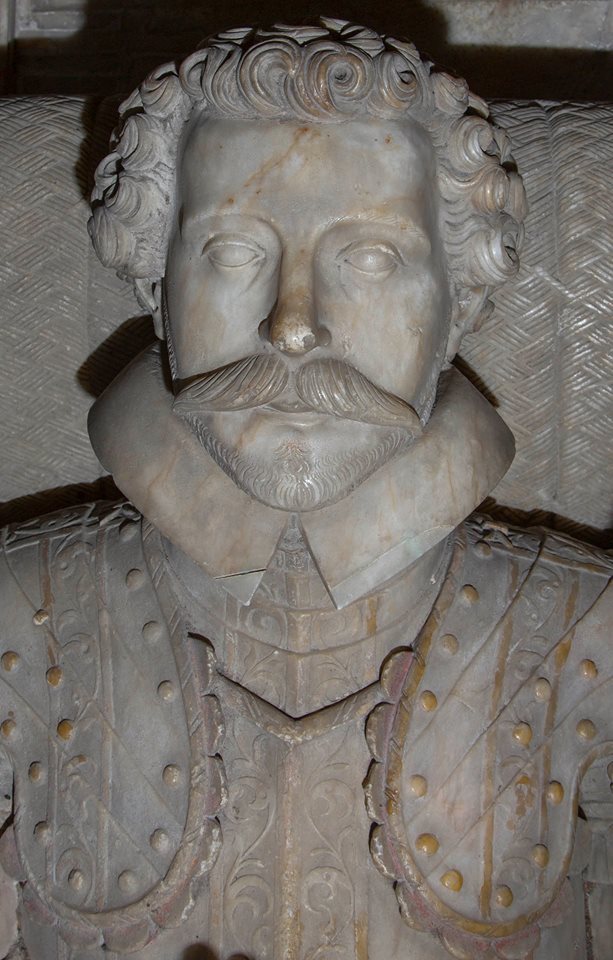
The 2nd Earl and the Countess did not get on because he thought she had been unfaithful to him. But we know from the effigy of him on the Southampton Tomb in St. Peter’s, Titchfield, that he was a very handsome man.

Photo of Second Earl of Southampton by Ross Underwood.

Shakespeare by using ‘eyes’ and ‘shape’ also suggests that Mary can recall the penis of her dead husband through her son.

Look what an unthrift in the world doth spend

Shifts but his place, for still the world injoys it,

But beauty’s waste hath in the world an end,

And kept unus’d the user so destroys it:

No love toward others in that bosom sits

That on himself such murdrous shame commits.

Shakespeare makes the contrast between a spendthrift and a beautiful young man who masturbates.  The wealth of the spendthrift is simply re-distributed – but semen once spent is lost for ever. And even if there is no ejaculation, the semen is destroyed by NOT being used. Shakespeare accuses Harry of not loving other people because of his insistence on solitary masturbation – which Shakespeare terms ‘murderous shame.’

To read ‘The Birthday Sonnets’, Part Seven, click: HERE
 

Read Full Post »

It’s best to read ‘The Birthday Sonnets’ – Part Four – first.

8. (7)

Lo in the Orient when the gracious light,

Lifts up his burning head, each under eye

Doth homage to his new appearing sight,

Serving with looks his sacred majesty,

In this Sonnet, Shakespeare compares the rising and setting sun to the life of a man who has no children. At the beginning of his life – when he is handsome and strong – people gaze at him. But when he gets older, people no longer want to look at him.

But there is another, coded message. The ‘burning head’ also represents the erect penis in the act of masturbation and ‘each under eye’ the testicles that are drawn up when the penis is erect – as though they are attendants on a king. The facial area in Shakespeare could also represent the genital area.

And having climb’d the steep up heavenly hill,

Resembling strong youth in his middle age,

Yet mortal looks adore his beauty still,

Attending on his golden pilgrimage:

Here the ‘heavenly hill’ is the literal ‘hill of heaven’ – but it also suggest the ‘mons veneris’ – the ‘mound of Venus’ – the pubic bone above the penis. The ‘mortal looks’ which attend the Sun’s ‘golden pilgrimage’ – the golden journey the golden Sun makes – are literally the eyes of the onlookers – but they also represent the testicles, still elevated by the risen penis.

But when from high-most pitch with weary car,

Like feeble age he reeleth from the day,

The eyes (fore duteous) now converted are

From his low tract and look an other way:

The ‘weary car’ means ‘weary carriage’. In Greek classical mythology, the Sun rode in a chariot, pulled by fiery steeds.

So Shakespeare is saying that when the Sun has reached its zenith and starts to set, people are no longer interested. They are no longer interested in a man who is growing old and feeble.

But it also suggest the testicles which are no longer drawn up by the penis when the penis, having ejected semen, is no longer erect.

So thou, thy self out-going in thy noon:

Unlook’d on, diest unless thou get a son.

Literally, this means that a man who is completing his cycle of life will die unregarded unless he has produced a son who will inherit his strength and good-looks. But as Katharine Duncan Jones points out in the Arden edition of The Sonnets, ‘noon’ also symbolised erection for the Elizabethans, when both hands on the dial of a clock were pointing upwards.

‘Diest’ could also mean for Shakespeare – as it meant for the Metaphysical Poets – ‘to achieve orgasm’. So ‘unlook’d on’ can also suggest the act of solitary masturbation where a partner is not looking at the activity.

Stewart Trotter – the Code’s Chief Agent – submitted this interpretation of the Sonnet for his Cambridge Finals in 1971.

Stewart’s Cambridge College.


His Director of Studies – no names, no pack-drill – was so shocked he told him not to submit his essay.  But he did – and this is now the standard interpretation of the Sonnet.

To read ‘The Birthday Sonnets’, Part 6, click HERE


Read Full Post »

It’s best to read Part Three  before Part Four.

5. (4)

Unthrifty loveliness, why dost thou spend,

Upon thy self thy beauty’s legacy?

Nature’s bequest gives nothing but doth lend,

And being frank she lends to those are free:

Beauty is presented to Harry as a legacy he is obliged to pass on not spend on himself. But again, money for the Elizabethans had a sexual connation as well. ‘Spending upon thy self’ also suggests seminal emission in masturbation. Nature only lends things to us – she never gives them to us. And because she has an open, generous nature gives things to those who are generous and free as well.

Then beauteous niggard, why dost thou abuse,

The bounteous largess given thee to give?

Profitless usurer, why dost thou use

So great a sum of sums yet can’st not live?

‘Beauteous niggard’ = ‘handsome miser’. The ‘bounteous largesse given thee to give’ is the generous gift that Nature has given to Harry. But it is also a compliment on the size of his penis.  Shakespeare claims Harry is ‘usurer’ is (a money lender – like Shakespeare’s father was). But Harry is a money-lender who doesn’t make any money. The reason is that he is expending masses amounts of semen in masturbation – but doesn’t produce any life with it.

For having traffic with thy self alone,

Thou of thy self thy sweet self dost deceive,

Then how when nature calls thee to be gone,

What acceptable Audit can’st thou leave?

‘The traffic with thyself alone’ is a euphemism for solitary masturbation. The ‘sweet self’ means the sweet baby boy that Harry could produce and which Harry is cheating himself of. When Nature decrees that Harry must die – what ‘audit’ will he have left behind that would be acceptable to Nature? The first syllable of ‘acceptable should be emphasized.

Thy unus’d beauty must be tomb’d with thee,

Which used lives th’ executor to be.

Harry’s beauty will die with him – unless he has a son who can act as the executor of his will and the executor of his beauty.

‘Used’ needs to be two syllables to fill the line.

6. (5)

Those hours that with gentle work did frame

The lovely gaze where every eye doth dwell,

Will play the tyrants to the very same,

And that unfair which fairly doth excel:

Time has produced Harry’s lovely eyes which everyone gazes at. But that same time will wreck havoc with those same eyes like a tyrant and make unbeautiful which is so excellingly beautiful now.

For never resting time leads Summer on

To hideous winter and confounds him there,

Sap checkt with frost, and lusty leaves quite gone,

Beauty ore-snow’d and bareness every where.

Time will do exactly the same thing to Harry as it does to Nature itself. It leads summer on to winter and destroys him. It stops the flow of sap (Harry’s sexual energies) and makes the leaves fall from the trees (Hair fall from the head). ll the beautiful plants will be covered with snow (white heads and beards) and gardens will be bare of plants (heads will become bald.)

Then were not summer’s distillation left

A liquid prisoner pent in walls of glass,

Beauty’s effect with beauty were bereft,

Nor it nor no remembrance what it was.

If the beautiful blooms of summer were not distilled into perfume and captured in glass bottles, the result of beauty would be lost along with beauty itself – and no-one would remember it.

But flowers distill’d, though they with winter meet,

Leese but their show, their substance still lives sweet.

‘Leese’ = ‘lose’. But flowers turned into perfume, though they meet with Winter, lose simply their outward show.  Their inner essence lives on.

So, if Harry impregnates a woman, his own essence would live on after he has died.

Elizabethan dichroic glass bottle for ‘casting’ perfume.


7. (6)

Then let not winter’s ragged hand deface

In thee thy summer, ere thou be distill’d:

Make sweet some vial; treasure thou some place

With beauty’s treasure ere it be self kill’d.

Winter makes things ragged:  this is called a ‘transferred epithet.’ Shakespeare warns Harry not to fall into the hands of death before he has impregnated a woman. He should make ‘sweet some vial’ – a woman’s womb – and should honour this womb with his semen before he wastes and kills his sperm through masturbation.

That use is not forbidden usury

Which happies those that pay the willing loan:

That’s for thy self to breed an other thee,

Or ten times happier be it ten for one,

The usury laws in 1590 had not settled down.  Money lending had been officially illegal – but Elizabeth was forced to allow them so business could continue – but insisted that a lender did not charge more than 10% of the money for the loan. (Shakespeare’s father charged much more!)

So this ‘use’ of money/semen is not illegal: he lends his money/semen to a woman as he gets another self back in the form of a baby boy – or ten babies boys.

Ten times thy self were happier then thou art,

If ten of thine ten times refigur’d thee,

Then what could death do if thou should’st depart,

Leaving thee living in posterity?

If he were to breed ten boys and they in turn bred ten sons each he would have a hundred sons. This is a way to confound death because there would be a hundred images of himself still living.

Be not self-will’d for thou art much too fair,

To be death’s conquest and make worms thine heir.

Shakespeare tells Shakespeare not to be self-will’d’ because ‘will’ was also used for the genitals male AND female. Shakespeare saying that Harry is far too beautiful to waste it on masturbation. Death would then be able to destroy him and make him the air to worms.

It also means ‘make worms thy hair’ – another reference to Harry’s flocking locks….


To read Part Five, click HERE!

Read Full Post »

It’s best, first, to read ‘Stratford, Touring, London and Titchfield Part One. 

Here are the opening three poems of the seventeen poems written by William Shakespeare to celebrate the seventeen birthday of Henry Wriothesely, Third Earl of Southampton and Baron of Titchfield on 6th October, 1590

The first number attached to each sonnet shows the Sonnet’s position in the new ordering and the second number its original numbering by Shakespeare and his publisher.

2. (1)

From fairest creatures we desire increase,

That thereby beauty’s Rose might never die,

But as the riper should by time decease,

His tender heir might bear his memory:

The Elizabethans were happy for a word to be stressed in any number of ways in poetry. ‘Increase’ in this context should have the second syllable emphasised – as marked.

The seventeen year old Harry Southampton is being addressed directly in the Sonnet. He is ‘the fair creature’ and we want beautiful people to reproduce – that way they will become immortal.

The italics and capitalisation on Rose are Shakespeare’s own. He is stating that Harry is a rose. The rose symbol represents the town of Southampton – and Harry was Third Earl of Southampton.

His family name was Wriothesley.  It hard started off as Writh – but as the family became more grandiose it had grown to Wriothesley.

Then when part of the family became aristocratic, different ways of pronouncing the name came into play. The lower down branches pronounced the word ‘Risley’ – and the name is signed that way by some of the family.

For the aristocrats it was ‘Ryosely’ – to sound like a rose.  This is how it is recorded in the Titchfield Parish Register.

Shakespeare is saying that the ‘riper’ rose – the older one, will with time cease to be: but his softer, younger heir will remind people of the older father.

Shakespeare has a beautiful internal rhyme with ‘heir’ and ‘bear’.

‘Tender heir’ also suggests ‘tender hair’. Harry was proud of his locks of hair which hung down his shoulders.

But thou contracted to thine own bright eyes,

Feed’st thy light’s flame with self substantial fuel,

Making a famine where abundance lies,

Thy self thy foe, to thy sweet self too cruel:

‘Bright eyes’ is a literal reference to Harry’s eyes: but for Shakespeare and the Elizabethans, the vocabulary of the face could also suggest the genital area. So the ‘eyes’ could also represent the ‘testicles’.

In this sequence of seventeen poems, Shakespeare suggests time and time again that Harry is too addicted to teenage masturbation.

The ‘self-substantial fuel’ with which Harry feed his ‘light’s flame’ – his passion is the semen he ejects.

By not sharing his sexual energies with a woman, Harry is starving the world – and being cruel to himself. He is engaging too energetically in self-abuse and denying himself a son.

Thou that art now the world’s fresh ornament,

And only herald to the gaudy spring,

Within thine own bud buriest thy content,

And tender churl mak’st waste in niggarding:

Harry is ‘the world’s fresh ornament’ because he is so attractive and by proclaiming him the ‘only herald to the gaudy [rejoicing] spring’ Shakespeare is complimenting Harry’s ancestors who were heralds and ensigns.

‘The bud’ where Harry ‘buries’ his content’ is the tip of the penis which gives him so much pleasure when he masturbates. So, paradoxically, he is wasteful and niggardly at the same time. He wastes his semen by not sharing it with others.

Pity the world, or else this glutton be,

To eat the world’s due, by the grave and thee.

Shakespeare asks Harry to take pity on the rest of the world by fathering a son – or he, along with his death, will be greedy and rob the world of what it is entitled to.

Remember: Lord Burghley wanted Harry to marry his grand-daughter, Elizabeth Vere and was threatening the Southampton family with an enormous £5,000 fine.

3. (2)

When forty Winters shall besiege thy brow,

And dig deep trenches in thy beauty’s field,

Thy youth’s proud livery so gaz’d on now,

Will be a tatter’d weed of small worth held:

Harry Southampton was seventeen when Shakespeare wrote these words to him. He is talking about a time when he is forty years older – 57. This was the age of Queen Elizabeth in 1590 – so it an oblique attack on her.  She was hated by the Southampton family for her persecution of Catholics.

Shakespeare has stopped writing about Spring and is writing about Winter. He compares the lines that will appear on Harry’s face to the deep trenches in a field. His youthful body he compares to the bright livery a Lord and his attendants would wear – and says it will turn into an old, tattered coat [weed].

Then being askt, where all thy beauty lies,

Where all the treasure of thy lusty days;

To say within thine own deep sunken eyes,

Were an all-eating shame, and thriftless praise.

By using the word ‘treasure’ Shakespeare introduces another sexual theme.  Money and semen are often equated in the Sonnet sequence – and the ‘deep-sunken eyes’ has be literally eyes – but it can also suggest shrivelled testicles.

How much more praise deserv’d thy beauty’s use,

If thou couldst answer ‘This fair child of mine

Shall sum my count, and make my old excuse’,

Proving his beauty by succession thine.

Shakespeare is saying that if, in old age, when asked where all his beauty has gone, Harry could point to a son, all would be explained. He would show Harry’s true worth – and excuse his old age.

This were to be new made when thou art old,

And see thy blood warm when thou feel’st it cold.

It would miraculously endow Harry with another youth. Although his sexual ardour would be diminished by old age he would experience it vicariously through his son.

4. (3)

Look in thy glass and tell the face thou viewest,

Now is the time that face should form an other,

Whose fresh repair if now thou not renewest,

Thou do’st beguile the world, unbless some mother.

The glass here means ‘looking glass’. Shakespeare is inviting Harry to look at his ‘face’ in the mirror. The face here can be literally his face – but it can also mean the genital area – that’s why Harry’s face has the ability to form ‘an other’. ‘Fresh repair’ means getting on with the job while Harry is still young – to make himself stay young. The consequence of not doing so is to cheat the world and take a blessing away from a woman which is rightly here’s.

Shakespeare uses ‘face’ sexually also in ‘King Lear’: ‘Behold yon simpering dame/Whose face between her forks presageth snow.’ Forks=legs.

[This reference to a looking glass is also an oblique attack on Queen Elizabeth as well. She was said to have no ‘true’ looking glasses around her as she did not want to be aware of her own aging. Her Ladies-in-Waiting were said to take advantage of this by painting her nose red.]

For where is she so fair whose un-ear’d womb

Disdains the tillage of thy husbandry?

Or who is he so fond will be the tomb

Of his self love to stop posterity?

Shakespeare compares sexual intercourse here with ploughing a field – so an ‘unear’d womb’ is one without ears of corn i.e. one that is virgin. There is no woman so beautiful who would not relish young Harry as her lover – and who would be so stupid as to be the reason his family line stops with his death.

Thou art thy mother’s glass and she in thee

Calls back the lovely April of her prime,

So thou through windows of thine age shalt see,

Despite of wrinkles this thy golden time.

This a compliment to the beautiful Mary Countess Mary Southampton who in 1590 was still in her thirties.

Shakespeare is saying that Mary can see her younger self – ‘the lovely April of her prime’ – reflected in the mirror of her son. If Harry were to have a child, he could so the same. The ‘windows of age’ that Shakespeare refers to represent that added vision and knowledge that maturity will bring – even though it brings wrinkles as well.

But if thou live remembred not to be,

Die single and thine Image dies with thee.

But if you live wishing NOT to be remembered and die a bachelor then your beauty and how you look will die with you.

‘Die single’ also has a sexual meaning. ‘To die’ in Shakespeare – as in the metaphysical poets like John Donne – can mean ‘to experience an orgasm. So to ‘die single’ is also an image of solitary masturbation.

To read ‘The Birthday Sonnets’ Part Four, click: HERE!


Read Full Post »

« Newer Posts - Older Posts »