(It’s best to read The Introduction and Part 1. first.)
EXHIBIT (3)
Harry Southampton’s Letter.
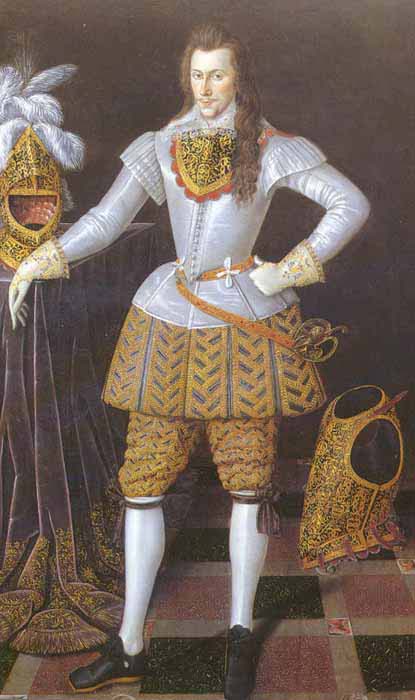
The Earl of Southampton preparing to joust.
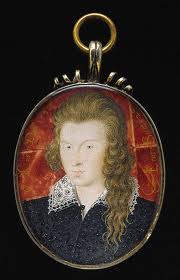
A letter exists written by Henry Wriothesley, third Earl of Southampton, to Robert Devereux, second Earl of Essex from Dieppe.
It is dated 2March.
The full text reads:
Though I have nothing to write about worth your reading, yet can I not let pass this messenger without a letter, be it only to continue the profession of service which I have heretofore verbally made unto your Lordship, which howsoever in itself it is of small value, my hope is, seeing it wholly proceed from a true respect born to your own worth, and from one who hath no better present to make you than the offer of himself to be disposed of by your commandment, your Lordship will be pleased in good part to accept it, and ever afford me your good opinion and favour, of which I shall be exceedingly proud, endeavouring with myself always with the best means to deserve it. As I shall have opportunity to send into England I will be bold to trouble your Lordship with my letter, in the mean time wishing your fortune may even prove answerable to the greatness of your own mind, I take my leave &c…
Southampton did not record the year.
Historians have given two possible dates, 1591 and 1598.
The first date (1591) has now been dismissed because the eighteen year old aristocratic Southampton would never have been allowed by the Privy Council to travel to France at a time of war.
However, the second date (1598) is equally unlikely. Southampton writes about his ‘profession of service’ to Essex having been ‘verbally made unto your Lordship’ and consequently ‘of small value’.
By 1598 Southampton had fought gallantly for Essex on the Islands Campaign and so his loyalty had been already proved by action rather than words.
The Earl of Essex was keen to form a spy network round the world so he could be first with the news, and so first with the power, at Elizabeth’s Court where he had many enemies.
When Harry Southampton writes –
As I shall have opportunity to send into England I will be bold to trouble your lordship with my letter.
– this is a coded way of saying that he will send back regular spy reports to Essex.
On 25February, 1593, Essex was made a member of the Privy Council with the power to grant passports.
So the date of 2March, 1593, fits the contents of the Third Earl of Southampton’s Letter perfectly.
EXHIBIT (4) Thomas Nashe’s The Unfortunate Traveller.
On 27th June, 1593, on his return to England, Nashe entered The Unfortunate Traveller on the Stationer’s Register.
The prototype of the picaresque novel, it chronicles Jack Wilton’s adventures in Europe with his master the Earl of Surrey – code for Nashe and Southampton.
Nashe dedicates the book to Henry Wriothesley, third Earl of Southampton (a dedication he was later forced to withdraw) as ‘a lover and cherisher’ ‘as well of the lovers of poets [Amelia Bassano/Lanier] as of poets themselves’ [Shakespeare].
The Earl changes places with Jack ‘to take more liberty of behaviour’ in Italy, the land of ‘whoring’ and ‘sodomitry’. This is exactly the same plot device Shakespeare was to use in his re-write of The Taming of a Shrew: Lucentio, studying at the University of Padua, changes place with his adoring servant Tranio.
Given Harry Southampton’s taste for lower class men, this is what really happened. Southampton pretended to be his own servant so he could have more fun.
Many of Nashe’s details suggest direct observation. Jack/Nashe describes how his long hair, light–coloured clothes and dagger with unblunted tip were all forbidden in Rome.
He writes:
The name of the place I remember not, but it is as one goes to St. Paul’s Church not far from the Jews’ piazza.
Nashe, describing a beautiful garden in Rome, refers to the music of the spheres which we cannot hear because of ‘the grossness of our senses’…an idea to re-surface in The Merchant of Venice.
EXHIBIT (5)
Shakespeare and the Obelisk at Rome.
Brass eternal slave to mortal rage…
In Sonnet 123 Shakespeare writes:
‘No! Time, thou shalt not boast that I do change;
Thy pyramids built up with newer might,
To me are nothing novel, nothing strange;
They are but dressings of a former sight’
On 15th March 1604, King James processed through the City of London. Shakespeare – as a Groom of the Chamber – was given 4 and a half yards of scarlet material to march in livery.
Lining the route were tall constructions of wood and plaster – the tallest of which was ninety foot high. Ben Jonson describes a huge rainbow in the Strand supported by ‘two magnificent pyramids of 70 foot in height, on which were drawn his Majesty’s several pedigrees of Eng and Scot.’
What Jonson calls a pyramid we would now call an obelisk.

Triumphal arch with pyramids constructed above the Cheapside Conduit in the City of London.
In 1586 Pope Sixtus V re-sited an Egyptian obelisk in front of St. Peter’s in Rome.
It was the ‘former sight’ of this Obelisk that Shakespeare describes in Sonnet 123.
Eighty-three foot tall, this Obelisk had a profound importance for Catholics. It had been plundered from Egypt by Caligula and erected in the Circus, where, in the reign of Nero, St. Peter was said to have been crucified upside down.
According to Catholic doctrine, this Obelisk was the last thing the Saint saw before he died.
This brush with sanctity was thought to have given the Obelisk miraculous powers: it was one of only two left standing in Rome.
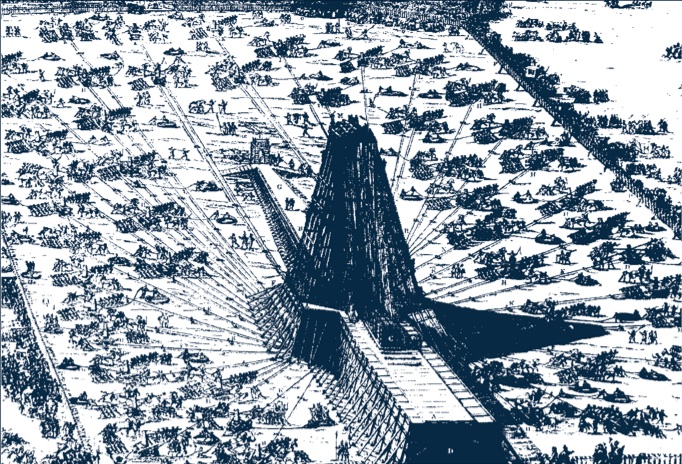
The Pope wanted to move the Obelisk – now a holy relic – to a position in front of the Basilica of St. Peter. The commission for moving the monument – which Michelangelo passed over as too terrifying – was hotly contested by the most brilliant of Rome’s engineers. The job, surprisingly, went to the youngest bidder, Domenico Fontana, who devised a scheme that would take six months and involve hundreds of men and horses…
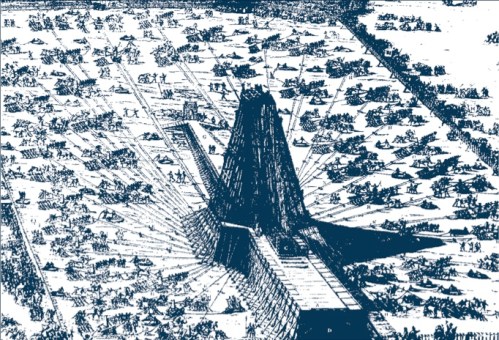
First, the Obelisk had to be taken down – then the bronze orb, rumoured to contain the ashes of Julius Caesar, removed from its summit.
This famous event was celebrated by Shakespeare in Sonnet 64. It begins by evoking in code the topography of Rome (Shakespeare could not openly admit he had been there):
‘When I have seen by time’s fell hand defaced
The rich, proud cost of outworn buried age’
It continues:
‘When sometime lofty towers I see down razed,
And brass eternal slave to mortal rage.’
The ‘lofty tower’ was the Obelisk and the ‘brass eternal’ the gilt orb on its summit.
‘Mortal rage’ is a Roman Catholic reference to the Protestant ‘Sack of Rome’ which occurred in 1527. The Lanquenets – Mercenary Soldiers of Charles V – killed 147 of the Swiss Guard (who were defending Pope Clement VII) on the steps of St. Peter’s.
‘Blasphemous’ shots were fired at the orb on top of the Obelisk (sacred to Catholics) and a lead bullet was imbedded in the metal.
Shakespeare would have seen this famous orb on his trip to Rome: it is on show, as a Catholic relic, to this day.
Sonnet 125 picks up the theme of James’s Coronation Obelisks. Shakespeare warns Southampton no more to trust in temporal power than to believe that the plaster board Obelisks lay ‘great bases for eternity’ the way the ‘sanctified’ original did. The ‘great base for eternity’ also suggests St. Peter, the ‘rock’ upon which Christ built his ‘eternal’ Catholic Church.
In the Sonnet previous to this (124) Shakespeare has declared his love ‘all alone stands hugely politic/That it nor grows with heat, nor drowns with showers’
Shakespeare loved to intertwine the religious and the erotic. ‘Hugely politic’ suggests the phallic as well as the sacred nature of the Obelisk.
Elsewhere in the Sonnets, Shakespeare talks of his homosexuality as ‘dear religious love’ and offers his passion as an ‘oblation’ to Southampton.
In As You Like It Rosalind says of Orlando, who, like Harry Southampton, had ‘chestnut’ coloured hair:
His kissing is full of sanctity as the touch of holy bread.
Shakespeare, like many of his contemporaries, seemed to thrive on danger. He would have adored standing in front of the Pagan-Christian Obelisk with Harry Southampton, his forbidden love, in a forbidden city, following a forbidden faith.
To endorse his love he even has the audacity, in the final couplet of the Sonnet, to summon up for ‘witness’ ‘the fools of time’ Catholic Martyrs like St. Peter himself, who ‘die for goodness, who have lived for crime’.
That is, martyrs whose only crime was to be alive and to be Catholic.
Like homosexual men, condemned to death in Elizabeth’s time, just for being what they were.

Caligula's Obelisk in 1875
(It’s best to read Part 3. next.)
Read Full Post »