This article is dedicated to Kevin Fraser of the Titchfield Festival Theatre and the members of the Titchfield History Society for their brilliant work on the Titchfield Parish Register.
Prof. Jonathan Bate writes of The Strange Case of Mr. Apis Lapis :
It’s a terrific article and very persuasive that Beeston [of Posbrook Farm, Titchfield] is Apis Lapis. All very interesting….
The Shakespeare Code would like to thank Prof. Bate for his interest and support. He is a Commander of the British Empire, a Fellow of the British Academy and the Royal Society of Literature, Professor of Shakespeare and Renaissance Studies at the University of Warwick and a Governor and Board Member of the Royal Shakespeare Company.
A synopsis of the argument of this article can be found on: Why Falstaff is Fat.
Before reading it, it would be best to read Shakespeare, Love and Religion – a three part overview of the life and work of Shakespeare posted earlier.
Please click: Here.
The Proposition.
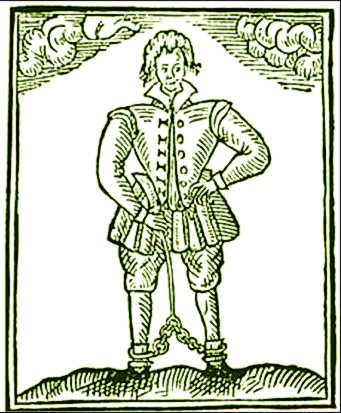
Thomas Nashe has left us a puzzle. He dedicated his pamphlet Strange Newes of the Intercepting certaine letters, and a convoy of verse, as they were going privilie to victuall the Low Countries (late 1592 or early 1593) to Master William Apis Lapis. Scholars of Nashe interpret this as a Latin code for William Bee (apis) and Stone (lapis); but who this William Beeston(e) was has never been discovered. He cannot be the actor/impresario William Beeston, who gave John Aubrey his information on William Shakespeare, as he was not born till 1610/11. This later William Beeston was the son of another actor/impresario, Christopher Beeston, who, for a time, was a member of the Lord Chamberlain’s Men. Using letters, wills and business documents (some never published before) and, of course, Nashe’s own prose, this article will put forward a candidate for Apis Lapis, show how he was linked to Christopher Beeston and suggest that Shakespeare used him as the inspiration for one of his most popular characters.
Mr. William Apis Lapis
What can we learn about Mr. Apis Lapis (William Beeston) from Thomas Nashe himself? He begins his pamphlet Strange Newes by addressing its dedicatee directly:
To the most copious Carminist of our time, and famous persecutor of Priscian, his very friend Master Apis Lapis: Tho. Nashe wisheth new strings to his old tawny purse and all honourable increase of acquaintance in the cellar.
We are into problems immediately: the word ‘Carminist’ does not appear in the Oxford English Dictionary. Leaving that difficulty for later, others present themselves. It is clear that Apis Lapis was poor at Latin grammar: the ‘Priscian’, whom he ‘persecutes’, was the author of a sixth century Latin primer still used in Elizabethan ‘grammar’ schools. What, however, does Nashe mean when he wishes ‘new strings’ to Apis Lapis’s ‘old tawny purse’?
The Oxford Dictionary of National Biography describes Apis Lapis, in two separate articles, as an ‘early benefactor’ and ‘a generous friend’; but this is contradicted later when Nashe claims that Apis Lapis would rather ‘spend jests than money’. Nashe does not even bother to ask Apis Lapis for the usual payment for his dedication: he knows the only spare cash Apis Lapis ever has he will squander on ‘the dirt of wisdom, called alchemy’. Nashe wishes him ‘new strings’ to his purse not because he is ‘generous’ or a ‘benefactor’ but because he is mean. He has worn out his old strings by pulling them tight.
When Nashe describes Apis Lapis as ‘a famous pottle-pot Patron’ he is using the word ‘patron’ to mean ‘a supporter, upholder or advocate’, the way his old enemy (and main butt of the Strange Newes pamphlet) Dr. Gabriel Harvey used it when he wrote, in 1573, ‘I was a great and continual patron of paradoxis’. Apis Lapis is ‘promoting’ wine, not buying rounds of it: a pottle-pot held an astounding four pints of the liquid.
Why Apis Lapis should be promoting wine at all is explained by Nashe’s hope for ‘all honourable increase of acquaintance in the cellar’. ‘Drawers’ offered favoured guests, like Prince Hal in The First Part of King Henry IV, ‘the courtesy of the cellar’ to drink in more intimate surroundings. Apis Lapis, this article will argue, is promoting wine because he sells it.
When Nashe describes Apis Lapis as ‘an infinite Maecenas to learned men’ who ‘have tasted the cool streams of [his] liberality’, Apis Lapis is a Maecenas in reverse: one who gets paid for providing ‘cool streams’ of wine to his clients, but behaves as though he is doing them a favour. This ‘topsy-turvy’ mindset is made clear in later editions of the pamphlet where Nashe writes, ‘there is not a morsel of meat they [the ‘learned men’] can carve you, [Apis Lapis] but you will eat for their sakes, [my italics] and accept very gratefully’.
Irony, not to say sarcasm, comes so naturally to Nashe that we must guard against taking him literally. When he describes Apis Lapis as ‘gentle’ and addresses him as ‘your worship’ it does not necessarily mean that Beeston was a gentleman. His family may well have been gentry in the past, but Apis Lapis has fallen on hard times.
He has, we learn, a strong sex-drive which has brought forth ‘fruits’ (illegitimate children) ‘chronicled in the Archdeacon’s court’. This becomes, in Nashe’s mock encomium, his ‘hospitality’; likewise, his ‘keeping three maids together in [his] house a long time’ becomes ‘a charitable deed’.
Nashe claims he is not accusing Apis Lapis of ‘any immoderation either in eating or drinking’; but immediately adds that his ‘government and carriage’ is ‘every way Canonical’. ‘Canonical’ could mean ‘appointed by canon [church] law’, which entailed keeping regular times for prayer and fasting; but it could also mean ‘of a cathedral chapter or member of it’. Cathedral Canons have never been noted for their abstinence and given Nashe’s worship of Chaucer (the ‘Homer’ of England) he probably had a particular Canon in mind, the one who turns up late for the pilgrimage in The Canterbury Tales. An alchemist like Apis Lapis, he is ‘sluttish’ and ‘threadbare’, ‘sweats’ like a ‘stillatorie’ [distillery] ‘stinks’ like a ‘goat’ and cons money from the gullible.
Later in the pamphlet, Nashe, ‘conjuring’ Apis Lapis, by ‘all that his visage holdeth most precious’, names (along with ‘the soul’ of the poet John Davies) ‘The Blue Boar in the Spittle’. Reginald B. McKerrow, the distinguished editor of Nashe, admits: ‘I do not understand this’; but surely Nashe is referring to ‘The Blue Boar’ mentioned by John Stow, a ‘Cook’s house’ (restaurant) in Spittle Lane, conveniently near the Vintner’s Hall and Wharf. So, while ostensibly praising Apis Lapis for his moderation, Nashe is actually accusing him of excess of every kind.
Nashe, though, is genuinely fond of his ‘very friend’, Apis Lapis, the enemy of ‘small [weak] beer and grammar rules’ with his ‘shreds of Latin’ and his ‘wonted Chaucerism’ a word invented by Nashe to celebrate Apis Lapis’s relish for ‘high’ literature and ‘low’ life (Nashe equates the immortality of Chaucer’s verse with the immortality of brothels in Southwark). He admires Apis Lapis’s ‘pleasant witty humour which no care or cross can make unconversable’ and, signing himself off as ‘thine entirely’, he exhorts him to ‘love poetry’ and ‘hate pedantism.’ It is Apis Lapis’s deep engagement with verse (he could quote Chaucer and Terence by heart and studied poetry in manuscript) that has prompted scholars to define ‘Carminist’ as ‘poesy-maker’ (from the Latin ‘carmen, carminis’, a poem or song). McKerrow, however, says he is ‘by no means sure this is the sense intended’.
Nashe had a complex, playful habit of mind which Harvey condemns as ‘foolerism’, a ‘fantastical emulation…to presume to forge a misshapen rabblement of absurd and ridiculous words’. Nashe packs multiple meanings into ‘canonical’ and ‘Chaucerism’: so why not ‘Carminist’ as well?
The word could also derive from the medieval Latin ‘carminus’, ‘a beautiful red or crimson pigment derived from cochineal’. So ‘Carminist’ might also suggest:
(1) An alchemist. Reddening, or, as Chaucer terms it (in the Canon’s Yeoman’s Tale) ‘rubifying’, was the final part of the alchemical firing process which aimed to turn silver material into gold. Nashe, drawing on ‘Sol’ and ‘Luna’ imagery from the same Chaucer Tale, describes this activity as ‘ex Luna in Solem’, (‘out of the Moon and into the Sun’). He compares it, disparagingly, to the transformation of silver herrings ‘by foggy smoke’ into red kippers.
(2) A heavy drinker. Prince Hal, in his conversation with tapsters in the Eastcheap cellar, learns that the cant phrase for ‘drinking deep’ is ‘dyeing scarlet’. So ‘Carminist’ could also be a way of describing how Apis Lapis acquired his ‘pure sanguine complexion’.
At the end of the dedication in Strange Newes, Nashe refers to Apis Lapis’s ‘surpassing carminical art of memory’. Again, the ‘carminus’ root could hold the key to this phrase. One of the prime sources of the Renaissance ‘art of memory’ was Ad Herennium, a treatise on rhetoric, attributed at the time to Cicero. It invites us to set up images in our mind that are ‘disfigured’ by being ‘stained with blood or soiled with mud or smeared with red paint [my italics] so that its form is more striking.’ Nashe argues that the only way to make this system work is to have a good memory in the first place.
A last possible root of ‘Carminist’ might be the English verb ‘to carminate’ (taken from the Italian ‘carminare’) which means ‘to dissolve ventosities’ (‘wind in the gut’ or ‘flatulence’). We know that Nashe had this bodily function in mind when he wrote Strange Newes: he describes how ‘a doctor [Harvey] and his fart…have kept a foul stinking stir in Paul’s churchyard’. So when Nashe describes Apis Lapis as ‘the most copious Carminist of our time’ the compliment was, to say the least, ambivalent.
The Great God Bacchus
In Strange Newes Nashe personifies Rhenish wine (sweet, white wine, imported from the Rhineland) as a ‘learned writer’ who has written a ‘comment upon red-noses’ and whose followers are ‘scholars’. Nashe employs the same conceit in an entertainment he wrote just before Strange Newes, Summers Last Will and Testament. Will Summers orders the actors to ‘bring now a black Jack [leather jug] and a rundlet [fifteen gallon cask] of Rhenish wine, disputing of the antiquity of red noses’. Summer’s line anticipates the entrance, on an ass ‘trapped in ivy’, of ‘the God barrel-belly’, Bacchus, who, between songs and ‘shreds of Latin’ (including Terence) delivers a ‘promotion’ of wine worthy of Apis Lapis himself:
So I tell thee, give a soldier wine before he goes to battle, it grinds out all gaps, it makes him forget all scars and wounds, and fight in the thickest of his enemies, as though he were but at foils amongst his fellows. Give a scholar wine, going to his book, or being about to invent, it sets a new point on his wit, it glazeth it, it scours it, it gives him acumen.
The physical build of Bacchus, ‘like a round church’ with ‘tuns of wine’ in his ‘paunch’, is also similar to the gourmandising Apis Lapis. The odds are that the part of Bacchus, ‘the Baron of double beer’ as Nashe calls him, was written for Apis Lapis and that he played it.
The circumstances of the performance of Summers Last Will and Testament are a mystery. There is a reference in the text to the Thames nearly running dry, which happened early in September 1592, so the entertainment must have been given after that date. There is also mention of ‘this low-built house’ in Croydon (which most scholars take to be the Archbishop of Canterbury’s summer palace) and a ‘lord’ before whom the piece was played (the Archbishop himself, for whom Nashe had worked as a pamphleteer during the late 1580’s.).
There are also direct addresses to Queen Elizabeth as a member of the audience. We know that she visited Oxford between the 22 and 28 September, when the ‘comely’ Henry Wriothesley, third Earl of Southampton, ‘a lord of lofty line’, paraded before her. We also know that she returned to Hampton Court on 10October and that Archbishop Whitgift attended Privy Council meetings there on 11 and 12 of October. So the performance must have been given between the end of September and 9 October 1592; but no record of the Queen’s visit to Croydon at this time has ever been found.
She did, however, visit West Horsley, ten miles away. Lord Montague, the third Earl of Southampton’s maternal grandfather, having suffered a long and lingering illness, was dying there. Queen Elizabeth, who, in William Camden’s words (translated from the Latin), ‘had experience of his fidelity’ and ‘held him most dear (though an earnest Roman Catholic)…visited him…a little before his death’. Lord Montague died on 19 October 1592. The Southampton family would have wanted to entertain the Queen, but it would have been wrong to do so in the house of a dying relative. The Archbishop of Canterbury could well have offered his summer palace for the event instead. Nashe’s interlude has its humorous elements, but the final tone is one of elegiac acceptance of the passing of the summer, completely appropriate for the occasion.
If Apis Lapis did play Bacchus, he was likely to have been part of the Southampton entourage, an old family friend even, known for his love of Rhenish wine. He might even have supplied it to the Southampton family.
The Lord of Misrule
Apis Lapis makes another transmuted appearance in the works of Nashe, this time as the Lord of Misrule in The Unfortunate Traveller, a ‘prototype’ historical novel written a year later (1593). Nashe describes the Lord of Misrule in exactly the same phrase he used for Bacchus, a ‘Baron of double beer’. Like Apis Lapis, the Lord of Misrule is also ‘a miser and snudge’ (skinflint) who sells cheese and cider to Henry VIII’s army. Nashe, in the character of Jack Wilton, states:
there’s great virtue belongs (I can tell you) to a cup of cider… if it had no other patron but this peer of quart pots [the Lord of Misrule] to authorise it, it were sufficient.
Nashe uses ‘patron’ here in the same way he used it of Apis Lapis in Strange Newes. He again satirises Apis Lapis’s social ambitions by calling the Lord of Misrule:
this great lord, this worthy lord, this noble lord’ who ‘thought no scorn…to have his great velvet breeches larded with the droppings of this dainty liquor…an old servitor, a cavalier of an ancient house, as might appear by the arms of his ancestors drawn verily in chalk on the side of his tent door.
Apis Lapis clearly yearned for a coat of arms. The way to acquire one (along with the necessary cash and influence) was to claim, as William Shakespeare’s father did, an illustrious ancestry. The King, though, has no illusions about the Lord of Misrule. He ‘terms’ him (however ‘pleasantly’) a ‘cider-merchant’.
Nashe, as Wilton, in the privacy of a back room (the equivalent of a tavern cellar) expresses the ‘entire affection’ he feels for the Lord of Misrule, not only because of his ‘high lineage’ but because of the ‘tender care and provident respect he had of poor soldiers’ to whom he sells cheese and cider, often in tiny portions, as ‘a rare example of magnificence and honourable courtesy’. Thus the greed of the Lord of Misrule is presented as charity, as Apis Lapis’s was in Strange Newes.
Wilton, as the story develops, tricks the Lord into providing free cider for himself and the whole army by saying he had been accused of treachery. The cowardly ‘snudge’ falls on his knees, wrings his hands and weeps ‘out all the cider he had drunk in a week before’. Giving Wilton his ‘greasy purse with that single money that was in it’, he then falls into a terrified ‘trance’ from which Wilton can only revive him by pretending to be a customer who wants to pay his bill….
Titchfield
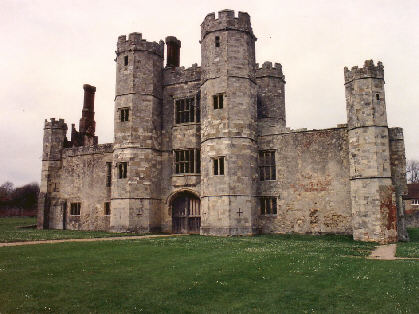
The ‘real life’ Apis Lapis, this article will argue, was from the town of Titchfield in Hampshire: so we need to examine Nashe’s own links with the area. Several members of a Nashe family feature in the Titchfield Parish Register but it is more likely that Nashe’s association with the town was through the third Earl of Southampton, also styled ‘the Baron of Titchfield’, after his favourite country seat.
Nashe openly dedicated The Unfortunate Traveller to Southampton, but all other possible references to him are in code. He writes a pornographic poem for a ‘Lord S.’ referring to him as ‘the fairest bud the red rose ever bore’. In Pierce Pennilesse (1592) he speaks of ‘Jove’s eagle-born Ganymede, thrice noble Amyntas’. In Strange Newes he describes himself as living in ‘a house of credit as well governed as a college, where there be more rare qualified men and selected good scholars than in any nobleman’s house that I know in England’.
All this fits the teenage, recklessly generous and sexually ambiguous third Earl of Southampton, down to the ‘red rose’, both the emblem of the town of Southampton and a reference to the grandiose way the Wriothesley family seems to have pronounced its name. (It appears variously as Wryosley, Riosely and even Royothizley in the TPR). The ‘house of credit’ could be Place House at Titchfield where John Florio was compiling his Italian-English dictionary, A Worlde of Wordes (1598), which he dedicated (amongst others) to the third Earl of Southampton, in whose ‘pay and patronage’ he had lived ‘for some years’.
This information is too generalised, though, to link Nashe positively with Titchfield; indeed, some scholars have taken ‘Lord S.’ to be Ferdinando Stanley, Lord Strange. However, in his The Terrors of the Night pamphlet (1594) Nashe starts to give more positive clues as to where he is.
Night Terrors
He states that in February 1593 he was ‘in the country some threescore mile from London’. (Titchfield, as the crow flies, is about seventy miles from the City). ‘A gentleman’ there ‘of good worship and credit falling sick, the very second day of his lying down he pretended [claimed] to have miraculous waking visions…A wise, grave sensible man he was ever reputed, and so approved himself in all his actions in his lifetime. This which I deliver, (with many preparative protestations) to a great Man of this Land he [the gentleman] confidently avouched.’
Nashe refers to the third Earl of Southampton as ‘a great man’ in the introduction to The Unfortunate Traveller. In Pierce Pennilesse he describes how (in 1592) ‘the fear of infection’ is detaining him ‘with my Lord in the country’. The plague was raging even more in London at the beginning of 1593, so the third Earl could well have been in Titchfield when he heard the story from the gentleman and asked Nashe to record it.
Nashe continues:
First, the house where this gentleman dwelt stood in a low marish ground, almost as rotten a climate as the Low Countries; where their misty air is as thick as mould butter, and the dew lies like frothy barme on the ground.
Titchfield, in 1593, was on the ‘marish’ (marshy) shores of a tidal river which linked the sea, three miles away, with the town. Nashe, though, was using the word ‘marish’ with its Latin root also in mind (mare, maris: the sea) as does the anonymous author of Every Woman in her Humour (1609): (‘That moving, marish element that swells and swages as it please the moon’). Thick sea mist still rises in the heart of Titchfield from the canal that replaced the river.
Nashe continues:
It was noted besides to have been an unlucky house to all his predecessors, situate in a quarter not altogether exempted from witches.
‘Exempted’ could mean ‘separate’ or ‘cut off’, as in a line of verse written in 1598: ‘In brave love and fortune’s art, /There is not anything less sure /Than such a free exempted heart’. ‘Quarter’ could mean ‘region, district, place, [or] locality’. Nashe seems to be saying that the area he is talking about was subject to occasional attacks of witchcraft from the outside. Henry Chettle, in his pamphlet Kind-Hartes Dreame, written around December 1592, describes one such attack that had recently occurred in Hampshire.
The Witch of Upham.
A ‘walking mort’ [female or harlot] had been wandering around the county, telling fortunes, healing the sick and claiming that she had inherited her powers from her gipsy mother and her ‘juggler’ [wizard] father. We know, from another pamphlet written in February1595, and official notes made at her trial in London a month earlier, that her name was Judith Philips. She had left her first husband to go travelling round the west of England with ‘divers persons naming themselves Egyptians’ [gipsies].
For ‘a certain space’ [of time] she operated ‘in the village of Upsborne in Hampshire, in distance seven miles or thereabouts from Winchester’. If ‘Upsbourne’, as has been suggested, is the modern ‘Upham’ (which is indeed seven miles from Winchester) then Judith’s ‘lewd pranks’ were enacted only a few miles away from Titchfield itself.Chettle describes how Judith duped a simple farmer and his wife of their money by promising (through her friendship with the Queen of the Fairies) to lead them to buried treasure. Part of the magical process involved hanging up their best sheet linen in a chamber and placing seven gold coins beneath seven candles. Judith put a saddle and bridle on the farmer, rode him seven times round the chamber, then, having made ‘an ass’ of him, she made off with the goods.
Nashe would have known the story well: Chettle mentions him by name in the same pamphlet.
Nashe might even have told him the story.
Heaven and Hell
The topography of Titchfield, then a busy port, seems to have influenced the nature of the gentleman’s visions. He saw fishing nets, fish-hooks, treasure chests, drunken sailors and seductive ‘bonarobaes’ (prostitutes), one of whom was about to put her foot into his bed when ‘a messenger from a Knight of great honour thereabouts…sent him a most precious extract quintessence to drink’.
We know that at Christmas in 1593 and ‘a great while after’ Nashe was staying with the Carey family at Carisbrooke Castle on the Isle of Wight, five miles away from Titchfield across the Solent. Nashe wrote the final version of The Terrors of the Night there ‘to satisfy some of my solitary friends’ and dedicated it to Elizabeth Carey, ‘sole daughter and heir to the thrice noble and renowned Sir George Carey, Knight, Marshall, &c.’
Sir George Carey was fascinated by Paracelsian medicine and supported its practitioners. He even had his own supply of ‘spirit of sack’ (processed sweet white wine) and it could well have been this ‘water’ which he sent to Titchfield. It brought temporary relief to the gentleman but ‘within four hours after, having not fully settled his estate in order, he grew to trifling dotage, and raving died within two days following.’ If we could find the gentleman himself, the Titchfield connection would be established; but we must bear in mind Nashe’s snobbery. Later in the pamphlet he confesses that he has ‘welt and garde’ [embellished] his narrative ‘with allusive exornations [decorations] and comparisons’ because he is ‘loathe to tire’ his readers with a ‘coarse, home-spun tale, that should dull them worse than Holland cheese’.
He has plainly raised the ‘home-spun’ class of the ‘gentleman’ who experienced the visions on the pretext of giving the Truth ‘a leathern patched cloak to keep her from the cold’. What he really means is that people will only believe in the visions if they come from someone ‘upper-class’. We can see the same process of ‘gentrification’ at work in the story of Judith Philips. In Chettle’s 1592 version she dupes ‘an honest simple farmer’. In the 1595 pamphlet the farmer has jumped a class or two to become ‘a wealthy churl’.
Naming names
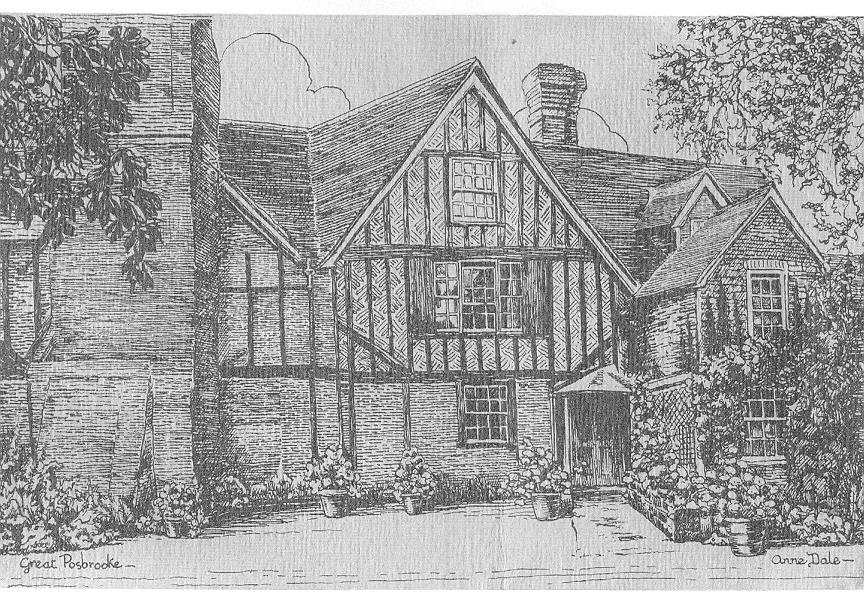
Thomas Ballard was a ‘husbandman’ of Posbrook, a mile or so outside Titchfield, on the marshy edges of the river, but a husbandman sufficiently well off to have newly fashionable glass in his windows. He also had enough of an estate to bother to leave a will, something only a fifth of Englishmen did at the time. His was witnessed on ‘the last day of February’ in 1593 and he was buried in St. Peter’s churchyard on 1 March. This suggests that his will, unsigned and unmarked, was completed for him posthumously while his grave was being dug.
Wills followed a strict formula. Ballard’s father’s, for example, written thirteen years before, begins:
In the name of God, Amen. The twentieth day of January in the 21st year of the reign of our sovereign lady Queen Elizabeth. I, Peter Ballard of Posbrook, husbandman, in the parish of Titchfield, being sick in body but of good and perfect memory do constitute and make this my last will and testament in manner and form following. First, I give and bequeath my soul into the hands of Almighty God and to his son Jesus Christ through whose death and passion I hope to be saved and my body to be buried in the church of Titchfield.
He then gets straight down to the dispersal of his estate. His son Thomas’s will is completely different. There is no sign whatsoever of ‘that usual clause (of perfect mind and memory) so duly observed in every testament’: in fact, after its opening, the will starts to ramble alarmingly:
In the name of the living God, I Thomas Ballard of Posbrook in the county of Southampton, husbandman, do make and ordain this my last will and testament in form and manner as followeth: I commit or commend my soul to my most merciful and loving father, through and by the power and virtue of that precious suffering in the soul of my redeemer and Saviour, Jesus Christ. To the earth I commit my body from whence I received it, and I faithfully believe that as my saving health did once suffer and at that time did end and finish all his unspeakable torments in and on his most precious body for my body and all his elect, he being perfect man, did it for my body fully and wholly and be judge, perfect God, equal with the father was, is and ever shall be able to dispatch all things for my salvation; also I unfeignedly believe that by the virtue of his resurrection and ascension, my body shall be raised up and gain immortal [sic] and receive this my soul and at his most glorious and famous second coming I shall hear that joyful voice of heaven and be partake of it: ‘Come ye blessed of my father’ and so forth.
The ‘so forth’ at the end of the paragraph suggests the witnesses had stopped taking notes. Ballard had lapsed into ‘idle dotage’.
Apis Lapis Revealed
In stark contrast is a will by another Posbrook man, of Posbrook Farm, written forty five years later. Written in his own, firm, characterful hand, it is signed by ‘Wm. Beeston’, the William Beeston this article nominates as Apis Lapis. He names two ‘worthy friends’ to oversee the will, Arthur Bromfield and Thomas Risley, both of whom throw extraordinary light on Beeston’s character and identity.
Arthur Bromfield was Beeston’s father-in-law, but he seems to have been of the same age as Beeston: he disappears from the records after 1641, three years after Beeston’s death in 1638. He was intimately linked with the Southampton family in a bizarre way.
On 6October 1594 the third Earl held a party at Titchfield to celebrate his coming of age. Two of his guests, Sir Charles and Sir Henry Danvers, arrived a day early for a very good reason: they were fleeing from a murder they had committed in Wiltshire. Sir Henry’s saddle was covered in blood, so the brothers were sheltered for the night at Whitely Lodge, two miles away from Place House. They then crossed Southampton Water to Calshot Castle, but having learnt that the authorities were on their trail, made their way back, after midnight, to Place House itself. One of the third Earl’s loyal ‘gentlemen’ then facilitated their escape, on horse-back, to France.
That servant was Arthur Bromfield. Six weeks later the third Earl gave him (for £10 a year and four capons) the site and manor of Charke and the farm of Lee Brytton ‘for good and faithful service done’.
Around this time Beeston (assuming that the Posbrook Beeston was Apis Lapis) was trading in Rhenish wine. Its importation and distribution, however, was an historic monopoly of the Hanseatic traders (‘the merchants of Almaine’ as John Stow calls them) ho controlled the Steelyard, a walled community with its own docks, church and counting house. The Steelyard had a famous winehouse where, Nashe says ‘men when they are idle and know not what to do’ went to drink Rhenish wine.
When Nashe, in Strange Newes, claims that the ‘gravity’ of Beeston’s famous ‘round cap’ and ‘dudgeon dagger’ will ‘make [him] called upon shortly to be Alderman of the Steelyard’ he is, as usual, being ironic. ‘Alehouse daggers’, worn at the back, go, in Nashe’s mind, with ‘greasy doublets’ and ‘stockings out at heels’ rather than fine silk and fur-trimmed gowns. Nashe, however, does seem to imply that there was an official link between Beeston and the Hanseatic traders.
When Apis Lapis learns that the law courts are to be moved to Hertfordshire because of the plague, he wonders where the Steelyard will go and falls into another ‘great study’ and ‘deep meditation’ (i.e. drunken stupor). At ‘a tavern in London’ he slips into another of his famous ‘trances’, this time accompanied by snoring. The tavern responds by mourning ‘all in black…because the grandame of good fellowship was like to depart from amongst them.’
Why was Beeston about to leave?
Monopolies
In 1589 Queen Elizabeth had given the lucrative ‘farm’ on all imported white wines (other than Rhenish) to her favourite, Robert Devereux, 2nd Earl of Essex, the Earl of Southampton’s intimate friend. She kept, however, a percentage of the tax for herself. The Hanseatic traders, aware of their anomalous position, would want to curry favour with the English establishment. Why not give the charismatic Beeston a licence to supply Rhenish wine, at a favourable rate, to the Essex and Southampton entourages? The wine certainly plays a starring part in the Southampton family entertainment, Summers Last Will and Testament.
The Southampton city residence was in Holborn, a stone’s throw from Gray’s Inn, an exclusive lawyers’ club of which the third Earl had recently been made a member. Why not extend Beeston’s licence to cover Southampton’s lawyer colleagues as well? Beeston, in term time, could take barrels of Rhenish wine, on donkey-back from the Stillyard, (as we see a man doing on the so-called ‘Ralph Agas’ map of Elizabethan London) to supply the barristers’ taverns in the City. When the lawyers moved to Hertfordshire, Beeston, under the terms of his licence, would have had to move with them.
The God of Wine’s ass in Summers Last Will and Testament is described as ‘trapped in ivy’: perhaps this was Beeston’s own trademark. Assuming the role of Bacchus/Silenus he could have ridden his donkeys through the streets of the City, singing to announce his arrival then ‘disputing’, with ‘shreds of Latin’, the merits of Rhenish wine to amuse his legal clientele. The ‘Silenus’ (in Nashe’s 1589 Preface to R. Greene’s ‘Menaphon’) who sells wine while ‘nodding on his ass trapped with ivy’ and who makes ‘the pausing intermedium twixt every nap’ with a ‘moist nose-cloth’ sounds very much like Apis Lapis.
It was not only the civil lawyers, though, whom Beeston entertained: he was ‘amongst grave doctors and men of judgement in both laws [civil and ecclesiastical] every day.’ The most important ecclesiastical court in England was in the City, the Court of Arches at St. Mary-le-Bow. This place holds the key to another ‘Nasheism’.
Nashe asks Beeston to ‘safe-conduct’ his pamphlet through ‘the enemy’s country’. Harvey at the time was practising law at the Court of Arches. He was ‘the enemy’ and ‘the country’ was St. Mary-le-Bow. ‘Safe-conduct’ is a code: Nashe wants Beeston to sell his pamphlet, with its scurrilous attack on Harvey, to Harvey’s own colleagues.
But he wants to go further than that. He asks Apis Lapis to ‘cherish’ his ‘surpassing carminical art of memory with full cups’, ‘scour’ Chaucer ‘against the day of battle’ and let ‘Terence’ come in ‘with a snuff of a sentence’ so that ‘we’ll strike it as dead as a door nail’. What he means is:
‘Let’s get blind drunk, turn up at Mary-le-Bow and shout insults, in Middle English and Latin, at Harvey himself’.
Death and Transformation
Queen Elizabeth closed the Steelyard at the beginning of 1598 in retaliation for the Holy Roman Empire’s trade ban on English merchants. The following year, as is well known, she sent the Earl of Essex to fight Tyrone in Ireland. Essex defied her by appointing the Earl of Southampton the General of Horse, then further defied her by returning with him, unbidden, to England.
In October, 1600, Elizabeth snatched away Essex’s farm on sweet wines, financially destroying him and his followers. Then, when, in early 1601, Essex and Southampton rebelled against her (to seize power from the Cecil faction at Court and ensure the succession of James VI of Scotland) she cut off Essex’s head, attainted Southampton and locked him in the Tower for life.
On her death in 1603, however, everything turned round. King James released Wriothesley from prison, restored his land and titles and saved him from ruin by granting to him the same farm on ‘sweet wines’ that had been Elizabeth’s gift to Essex. From 1604 to 1611 Bromfield was one of the men entrusted with the vital task of collecting this tax in London and Middlesex. He had clearly stayed loyal to his lord during the rebellion and imprisonment, as, by implication, did his ‘worthy friend’ Beeston. Both men probably took part in the rebellion itself.
During this period, Bromfield got married and by the end of his tax-collecting period had fathered four children, all baptised at Titchfield. From 1611 he also changed from being described as a ‘gentleman’ in documents to an ‘esquire’, so he must have been earning at least £500 a year, [£250,000] the minimum requirement for a coat of arms. Between 1612 and 1617, Bromfield fathered five more children.
Then, in 1618, perhaps not surprisingly, his wife Lucy died.
Enter Thomas Risley
Thomas Risley, the other executor of Beeston’s will, was from the non-aristocratic branch of the Wriothsely family, hence the spelling of his name. (On his death, though, the Titchfield Parish clerk upgraded it to ‘Riosley’). From 1608 he worked for the third Earl of Southampton both in London and Titchfield, often in alliance with Bromfield (whose name appears on nine of the third Earl’s extant documents). From 1624, though, he spent most of his time in Titchfield as the result of a family catastrophe.
That year the third Earl of Southampton, politically inept but a brave and gallant soldier, had taken his nineteen year old son and heir, James, to Holland to help the Dutch fight the Spanish. James died ‘of the pestilence’ at Roosendaal on 5 November and his grieving father took his body to Bergen-op-Zoom where he fell ill himself. A member of his entourage wrote this deeply moving letter to the third Earl of Essex, also on the campaign:
I humbly beseech your Lordship that the sad occasion of my writing may excuse my boldness and rudeness therein. Since my Lord of Southampton’s departure from Roosendaal his Lordship both in his own apprehension and opinion of them about him and judgement of the physicians grew much better than he last was when he parted from your lord: till this afternoon at 4 a clock, which immediately upon a glister [enema] given him by Dr. Turner he fell heavy and sleepy and slept some four hours though with much disquiet and troubled passions. After his awaking he fell extremely ill and could not speak to any of us. I presently caused another doctor to be sent for to join with Dr. Turner and upon consultacon [sic: an ‘i’ was later added over the top of the word] held betwixt them, the both are exceeding doubtful of him. As I held it my duty to let your lordship know of it with all the speed I could possibly [sic] so I humbly beseech your Lordship if you will be pleased to come over and see him: my heart breaks to tell your Lordship that if you make not haste I fear you shall never see him alive again. These thoughts silence me, I beseech your Lordship accept my duty and pardon me for I am your lordship’s humble servant ever to be commanded.’
The letter, lodged in the British Library, is signed ‘W. Beeston’. The third Earl died that night (10 November) and a second letter from Beeston to the third Earl of Essex followed from Bergen a fortnight later:
Our people returned yesternight from the Hague with a full dispatch of all things, according as we could desire, saving they were so long about it which by their relation was not in their power soever to effect, which I humbly beseech you may be the ground of my so long silence and stay and excuse for the same. I made bold to acquaint your Lordship how our affairs stood and that till we heard from the Hague we could not well remove from thence. Now that they are comed [sic] and all things ready that I can device [sic] necessary according to the instructions I have received for the bringing of the bodies to the ship, I humbly refer the accomplishing of the ceremonies to your Lordship’s own fittest time of coming hither. For now we attend only that and the first opportunity of the wind to set as quite out of the country. I beseech your Lord, accept the humble duty and pardon the boldness of him who in all humility waits your Lordship’s demands, and will live and die
Your honour’s humblest and most devoted servant
W. Beeston.’
These touching, if ungrammatical, letters are written, to my eyes, in the same hand as the Beeston who wrote his will at Posbrook, the same ‘Apis Lapis’, ‘Bacchus’ and ‘Lord of Misrule’ who loved poetry, wine and life, who possessed a gift for friendship across the board and who was trusted enough by the Southampton family to be the guardian of their dead.
Beeston the Mentor
Thomas Wriothesley, said to be ‘of infirm body’, was only sixteen when he became the fourth Earl of Southampton. His father had left no will, so, on 2 June 1625, power to administer ‘his property and goods’ was granted to his mother (the widowed Countess Elizabeth) and to ‘Arthur Bromfield of Titchfield’ and ‘Thomas Wriothesley of Cheltwood co. Bucks, Armiger’.
Beeston himself drew closer to the family than ever. The Countess ‘commanded’ him to write, in his idiosyncratic English, to his ‘much honoured friend’, the Master of St. John’s College, Cambridge:
Sir, After so long speech of my Lord of Southampton’s coming to St. John’s, my lady his mother is now resolved to send him to you presently, and to that purpose hath commanded me to send you the enclosed from my Lord Maltravers, [who was offering to give up his college rooms to Thomas] entreating your favour for those lodgings for her son, and according as her Ladyship hears from you, she is minded immediately to send his stuff, and to have them make ready. To no place can he come with more affection, either of her Ladyships, or his own, desiring to succeed his noble father and brother as in other things so in that kind respect they did both bear <unto> [added afterwards] and find again <ever> [added afterwards] from that worthy society. I shall not need further to trouble you at this present when I have remembered their loves and my very affectionate service unto you, only I beseech you, bestow me as near his Lordship as you may, they will take it for a favour and you shall still increase my obligation ever to remain,
Your worship’s ever to be commanded
W. Beeston.
Horsley,
September.20. 1625
Beeston signs his letter, still lodged at St. John’s, with an added flourish. Well he might: the Countess, by this ‘command’ had made him the virtual guardian of her son. Beeston, in turn, was prepared to move to Cambridge, even to lodge in the college itself, to be as near as possible to his delicate, young lord.
University, however, was not for the fourth Earl. Within a year he had left St. John’s and left England itself for France, not to return for seven years. In his absence his mother fulfilled one of the wishes of his dead father, to give his library of books to his old college. The Master was particularly grateful for her ‘care that they [the books] should come free to us, without any the least charge’. This, however, is contradicted by a note in the College Expenses in 1626 of a payment of 17/6d [nearly £500] ‘for entertaining the Countess of Southampton’s man, and unloading the books’. At every level, this ‘man’ sounds like Beeston.
Beeston continued to protect Thomas’s interests while he was abroad. In 1629 alone Beeston’s name appeared on four of the fourth Earl’s documents, along with Risley and Bromfield. (It was to appear on another eight of them before Beeston died).
Around this time Beeston became wealthy enough to marry Bromfield’s first-born child, Elizabeth. She gave him a daughter, named after herself, followed two years later by a son, Henry. A daughter Mary followed in 1632 then Frances in 1633. Beeston’s baby children were generally given the respectful title of ‘Mistress’ or ‘Mr.’ in the Parish Register and in the Wriothesley Papers Beeston is, at this period, always described as a ‘gentleman’. His ‘worthy friends’, however, Risley and Bromley, were ‘esquires’.
In May 1633, the fourth Earl was recalled from France to attend King Charles on a visit to Scotland. He then fled back to France in March 1634, after losing heavily at the Newmarket Races. He showed his complete trust in Beeston by authorising him (along with Thomas Risley, ‘esquire’) to sell 21,00 trees out of Titchfield Great Park to pay his debts, ratifying ‘all they shall do in the premises as if he were personally present’. Beeston, though, remained ‘a gentleman’
Later that year the fourth Earl returned to Titchfield with his French bride who began to bear him children. Lucy was also born to the Beestons in 1635 and, then, in 1636, ‘Mr. William Beeston of Mr. William Beeston’ was baptised.
In March of that year Beeston had edged closer towards his crest. The fourth Earl, though under huge financial pressure from the King, rented the magnificent Abshot Farm to Beeston for £10, as his father, the third Earl, had rented Chark Farm as a reward to Bromfield. Although the Earl’s document still describes Beeston as ‘a gentleman’, we can see where Beeston’s armorial seal, now missing, might have been fixed.
By the 7 April 1637, however, Beeston had definitely achieved his wish: a document names him as ‘esquire’ and has three equally spaced seals, bearing the coats of arms of the fourth Earl, Risley and Beeston. What sort of design had been chosen for Beeston’s crest? A ‘bend’ with six bees, playing, as Nashe had done, on his surname.
His little children, all born in the Stuart reign, would have been so proud. Henry grew up to be Master of Winchester College and Warden of New College, Oxford and William became a rich merchant and a Governor of Jamaica.
What had happened, though, to his older, illegitimate children from the reign of Elizabeth?
Natural Children.
We know (from Strange Newes) that in 1592 Beeston had at least two children who were ‘of an age to speak for themselves’, perhaps 11 or 12 years old. If he had fathered them as a teenager, as Shakespeare had fathered his first child, he would have been in his sixties when he married Elizabeth Bromfield (who was only 23) and his seventies when he died. If he had fathered them in his twenties, he could have been in his seventies when he married and eighties when he died. Why did he marry so late?
The first clue lies in the exact date of William Beeston’s will, 9 October 1638. This was five days after the actor/impresario Christopher Beeston had written his. Either this is an astonishing coincidence or there was, as some scholars have suspected, a link between Christopher Beeston and Mr. Apis Lapis. A further clue is that Christopher Beeston had an alias, Hutchinson. This would have helped him in his shadier activities: but it could also suggest that he was illegitimate.
When Nashe says that Apis Lapis’s children were ‘of an age to speak for themselves’ it could also refer to their becoming boy actors. A ‘Kitt’ who played ‘a soldier’ and ‘a captain’ for a mixture of the Admiral’s and Lord Strange’s Men in Richard Tarleton’s play The Seven Deadly Sins (around 1590-1) has often been named the young Christopher Beeston.
We know for certain that Christopher became an apprentice actor to Augustine Phillips: Phillips refers to him in his will as his ‘servant’. From what we know of Beeston’s love for English verse, and his own enjoyment of theatricals himself, he would have relished his son Kit’s choice of career; he might even have used his network of friends to get him the job. Christopher later joined the Lord Chamberlain’s Men and acted with Shakespeare in 1598 in Every Man in his Humour. In August 1602, however, he was forced to leave the company and join Worcester’s Men. A pregnant woman was accusing him of rape.
In a bid for respectability, Christopher married Jane Sands, a Roman Catholic, on 10 September. Christopher himself had probably been brought up by his natural father as a recusant: the Southampton family, at the time, had ardently followed the ‘Old Faith’.
On 5 November, Christopher was at Bridewell Court accused by Margaret White, the widow of a clothmaker, of ‘forcibly’ having sex with her on Midsummer Night. Christopher, very much the son of his father, had claimed to the woman that he had slept with ‘a hundred wenches’. In court he denied the charge, but eight days later he had to appear before the magistrates again. This time he brought players (probably from his new company) who ‘did very vehemently demean themselves and much abused the place’. No charge was finally brought, though Christopher was ‘greatly suspected’.
For William Beeston, this must have been a low point in his life. In 1602 his erstwhile ‘Lord’, Henry Wriothesley, was lying penniless and near to death in the Tower of London: now his bastard son was being charged with rape. He would have no more wanted to be associated with him than the Lord Chamberlain’s Men did.
Christopher’s wife, Jane, then gave birth to a son in 1604. Significantly Christopher did not name the boy after his father, but after Augustine Phillips. Phillips, obligingly, left Christopher thirty shillings in his will when he died the following year.
Between 1604 and 1610 Christopher and Jane had two more sons, but neither of them was named William. Then, around1610/11, Christopher and Jane had a change of heart. Jane produced another boy, and the couple named him ‘William’. They probably had an eye on Apis Lapis Beeston’s money.
Christopher was constantly in debt and, by the end of 1617, he had offended King James by running a brothel. His wife had also been tried for recusancy, an embarrassment, now, to Apis Lapis Beeston as the Southampton family had renounced its Catholicism at the accession of King James.
As he got older, Apis Lapis Beeston must have felt there was a danger, when he died, of Christopher (who probably grew up at Posbrook Farm) making a bid for his estate. What better way of stopping this than by marrying a young bride? Her father was his close friend, they might produce children and she would be left with a good dowry to marry again (as indeed proved the case). Also, by marrying Bromfield’s oldest daughter, he would enable her five younger sisters to take husbands themselves.
In 1638, Christopher fell ill, probably of the plague. He had, according to his will, ‘many great debts’ and was ‘engaged for great sums of money’. He was desperately worried about his son’s financial survival and kept changing his mind about how to provide for him. Knowing he was near death, it is highly likely he begged his father to protect his natural grandson. Apis Lapis Beeston now had his own legitimate family and so refused.
Christopher responded by writing a will in which he disowned his natural father completely: he signed himself ‘Christopher Hutchinson’ and referred to his son as ‘William Hutchinson’. Apis Lapis Beeston fell sick straight after seeing Christopher, probably infected by him. He wrote his own will, supplanting all earlier ones, which begins, characteristically, with a ‘shred of Latin’:
In Dei Nomine Amen. I William Beeston of Titchfield in County of South. [ampton]. Being well in mind but weak in body do make and ordain this my last will and Testament in manner and form following.’
Then he launches his final assault on English grammar:
First I bequeath my soul into the hands of my great and glorious Creator trusting to be saved by the alone merits of his only son my blessed Lord and Saviour Jesus Christ.
For ‘alone’ read ‘sole’. He commits his body to St. Peter’s churchyard, then writes: ‘Item: I bequeath to every child that God hath sent me five shillings [£125] a piece for their portions’. Beeston in 1638 seems every bit as mean as he was in 1592.
But he had a plan: by using the phrase, ‘every child that God hath sent me’ Apis Lapis Beeston includes his illegitimate children. By handing them a legacy, however small, it prevented them from making a bigger claim on his estate. He goes on to will all he possesses to his wife, who was pregnant at the time, and permits her to dispose any part of his legacy ‘upon her children as she shall find them dutiful to her and well-disposed’. He leaves 20 shillings [£500] to the poor and 40 shillings [£1,000] ‘in token of my love and thanks’ to Risley and Bromfield to buy memorial rings, ‘beseeching them to advise and assist my well-beloved wife in all her troubles and affairs’. He then seals his will with his coat of arms.
Christopher ‘Hutchinson’ Beeston died shortly after dictating his own will and was buried at St. Giles in the Fields, in London, on 15 October 1638. Apis Lapis Beeston died a couple of months later and was buried at St. Peter’s, Titchfield, on the 3 December.
But not before his baby daughter, Anne, was baptised a week earlier in the same, beautiful church.
Beeston’s Legacy
We are lucky enough to have the inventory of all Apis Lapis Beeston’s goods and chattels at Posbrook Farm. As well as the expected livestock and crops of a gentleman farmer, he had a buttery with a press and a brewhouse with vats and barrels. He had a store of cheese in his loft to the value of £2.10 [over £1,000] and two cheese presses. Evidently he was still making cider and cheese at the time of his death.
Most interesting of all, the farm contained a library with books to the value of £10 [£5,000], a testament to Apis Lapis Beeston’s love of poetry and, perhaps, of alchemy. The fourth Earl of Southampton might also have made him a present of some of the volumes intended for St. John’s: it was a full ten years after the widowed Countess first made the offer that the ‘whole’ of the third Earl’s library finally made it to his alma mater.
We know that Apis Lapis Beeston possessed a copy of Chaucer: it is also possible that he had a copy of Shakespeare’s First Folio, published in 1623. He would have known Shakespeare well through his patron, the third Earl of Southampton: he might even have served him Rhenish wine in the City. He was, after all, described by Nashe as a ‘pottle-pot patron to old poets’ and, though Shakespeare was not even thirty when Strange Newes was written, he was to be satirised as ‘W.S.’, ‘the old player’ in Willobie his Avisa, two years later. Hard-living men aged quickly under Elizabeth.
Even if Apis Lapis Beeston had not read Shakespeare’s plays, he would have seen them seen them on the stage. Indeed, when he writes to the third Earl of Essex ‘my heart breaks’ and ‘these thoughts silence me’ his grief evokes the ending of Hamlet.
Apis Lapis Beeston, of all people, would have attended the wildly popular Falstaff plays. If, in some tavern wordplay game, he had been asked to describe the ‘fat knight’, he might have used the equivalents of words like:
Affectionate, agreeable, ambitious, anarchic, arrogant, articulate, blissful, boastful, brutal, bullying, cheating, criminal, crooked, corrupt, cowardly, cruel, cynical, dangerous, delusional, devilish, devious, devoted, drunken, enchanting, extraordinary, facetious, familiar, fearful, fertile, free, glorious, gluttonous, greasy, greedy, haughty, hedonistic, heartless, licentious, impudent, imperturbable, impatient, intellectual, intelligent, inventive, irascible, knavish, lazy, lecherous, lewd, literate, lying, loving, loyal, lucky, ludicrous, lustful, lying, malignant, manipulative, maudlin, mean, merry, mirthful, obsequious, opportunistic, petty, playful, poetic, potent, presumptuous, priapic, proud, remorseful, repellent, ruthless, seamy, selfish, self-important, self-satisfied, snobbish, supercilious, thieving, vainglorious, vicious, violent, wicked and witty’.
Every one of these adjectives could apply to Apis Lapis Beeston himself. He shares with Falstaff a love of food and wine, a hatred of weak beer, a habit of breaking wind, a propensity to snore, a claim to ancestral grandeur and a wild, social ambition. Falstaff yearned to become a High Court judge, an earl or even a duke: Apis Lapis Beeston to possess a coat of arms.
Above all, both men have the capacity to love younger men. They both possess a huge ‘heart’ that can be ‘killed’ by them in turn: in Falstaff’s case, by the rejection of Prince Hal, in Apis Lapis Beeston’s, by the death of the third Earl of Southampton.
Falstaff, in The Second Part of King Henry IV asserts directly to the audience that:
the skill in the weapon is nothing without sack, [white wine] for that sets it a-work, and learning a mere hoard of gold kept by a devil, till sack commences it and sets it in act and use…. If I had a thousand sons, the first human principle I would teach them should be to foreswear thin potations, and to addict themselves to sack’.
This ‘promotion’ of white wine is identical to Bacchus’s in Summers Last Will and Testament. The great Shakespearean scholar, J. Dover Wilson, tables 26 other similarities between Shakespeare and Nashe in King Henry IV Parts One and Two, describing the phenomenon as ‘an unsolved, perhaps insoluble, puzzle.’
Titchfield, again, might provide an answer
Why Falstaff is Fat.
Robert Greene, England’s first ‘celebrity’ author, died penniless, in the garret of a cobbler’s house in London, in September 1592. His Groats-worth of witte, ‘found’ among his papers and published posthumously, contains the famous attack on Shakespeare:
‘There is an upstart crow, beautified with our feathers, that with his Tiger’s heart wrapped in a Player’s hide, supposes he is as well able to bombast out a blank verse as the best of you: and being an absolute ‘Johnannes factotum’, is in his own conceit the only Shake-scene in a country.’
Shakespeare, suspecting Nashe was the real author, caused such a fuss that Chettle, the publisher, had to print not only an apology to him, but a eulogy as well:
[Shakespeare’s] no less civil than he excellent in th My self have seen his demeanour e qualities he professes: besides, divers of worship have reported his uprightness of dealing which argues his honesty, and his facetious grace in writing, which approves his art.’
Shakespeare had powerful friends (the ‘divers of worship’) who were probably the Southampton family. After the defeat of the Armada, actors and writers became unfashionable, for a time, because of their unmanliness; some of them, like Thomas Kyd and possibly Christopher Marlowe, sought refuge in the great households as tutors. The zealously Catholic third Earl of Southampton had graduated from Cambridge in 1589 and spent the summer of 1590 at Titchfield. Shakespeare, from a deeply Catholic background himself, might well, as Dover Wilson suggests, have been employed, by Mary, Countess of Southampton, as tutor to her son.
Later on in Groats-worth of witte, a character called ‘Roberto’ (Greene at this point of the story) is bewailing his lot. A gentleman ‘behind a bush’ hears him and offers to either ‘procure [him] profit or bring [him] pleasure’ because ‘pity it is that men of learning should live in lack’. He adds, ‘Men of my profession get by scholars their whole living…I am a player’.
Roberto, startled that a mere actor should be able to wear such expensive clothes, says:
I took you rather for a Gentleman of great living, for if by outward habit men should be censured, I tell you, you would be taken for a substantial man.’
‘So am I where I dwell (quoth the player) reputed able at my proper cost to build a Windmill’.
The identity of ‘the Player’ is hinted at: a windmill features heavily in The Fair Em, a play about a beautiful, young aristocratic woman posing as a miller’s daughter. It has an ‘eavesdropping’ scene similar to Love’s Labour’s Lost and Charles II’s librarian catalogued it under ‘Shakespeare, Vol. 1’.
The actor admits that times, when he was a travelling player, were hard: but now he has ‘playing apparel’ worth £200 [£100,000]. This wealth suggests that the Player was being protected by a rich family. The third Earl was yet to come of age, but Countess Mary was already supporting John Florio.
Roberto asks how the Player means to use him and the Player replies:
Why, sir, in making plays…for which ye shall be well paid, if you will take the pains. Roberto, perceiving no remedy, thought best in respect of his present necessity, to try his wit and went with him willingly: who lodged him at the Town’s end in a house of retail
Might not the town, where the Player lives, be Titchfield and might not ‘the house of retail’ (in contrast to the Earl of Southampton’s ‘house of credit’) be Posbrook Farm?
Beeston, as we know from Strange Newes and the inventory of his goods, had a ‘maids’’ bedroom (as well as ‘lodging garrets’) for ‘the pleasure’ offered to Roberto along with ‘the profit’.
Although Dover Wilson later retracted many of his ideas, in the 1952 Cambridge University edition of Shakespeare’s plays he went so far as to apportion different sections of the three Henry VI plays to Nashe, Greene and George Peele, a writer down on his luck, who, in Groats-worth of witte, was also warned against ‘the upstart crow’. Hungry for success, Shakespeare could have hidden his scholarly collaborators away at the farm to work on the trilogy. Nashe, after all, declares, in the second edition of Strange Newes, that Apis Lapis kept ‘three decayed students’ ‘attending on’ him ‘for a long time’. It is easy to see, with alcohol and maids on tap, how ‘Roberto’, in ‘bad company’ could fall ‘from one vice to another.’
He had returned to London and death by 1592, but Nashe probably stayed on at Titchfield, hoping for more work. We know that he collaborated with Marlowe (on The Tragedie of Dido, Queene of Carthage) and Jonson (on The Ile of Dogges) so why not on further plays with Shakespeare? The two men could have ‘developed’ the character of Falstaff together, based on Apis Lapis Beeston himself and Nashe’s earlier ‘sketches’. True, Apis Lapis would only have been in his late 30’s or early 40’s at the time: but large men, even now, can look much older than their years and, like Falstaff himself, who claims to be in the ‘vaward’ [vanguard] of his ‘youth’, Apis Lapis Beeston could well have been born ‘with a white head and something of a round belly’. Perhaps Nashe and Shakespeare’s ‘promotion of wine’ speeches, in their separate entertainments, are so similar because both were taken verbatim from Beeston’s own donkey-top ‘sales pitch’.
And was Falstaff fat because Beeston was fat? There seems to be no other reason. Neither the historical Falstaff nor the historical Oldcastle (the character’s original name) was ever charged with obesity. Beeston’s natural grandson, William ‘Hutchinson’ Beeston, told John Aubrey that ‘Ben Jonson and he [Shakespeare] did gather the humours of men daily wherever they came’. He also told Aubrey that Shakespeare ‘understood Latin pretty well, for he had been in his younger years a schoolmaster in the country’.
To this day a small schoolhouse, dating from the reign of Henry VI, stands opposite the gates of Place House in Titchfield. It is my belief that William Shakespeare taught young Christopher Beeston there, that Christopher told his son, William Beeston, about it.
And that William Beeston told John Aubrey.
Please note: a version of this article with endnotes attached is available to readers on request. S.T.
Read Full Post »







 The Shakespeare Code