Feeds:
Posts
Comments

Archive for the ‘Uncategorized’ Category

Brothers and Sister of the Code are invited to peruse the BIOGRAPHY section which has been photographically enhanced and extended to include:

1. A cracking shot of Linda Lusardi,

2. Sex-changes at Cambridge University,

3. UFO’s in Papua, New Guinea,

4.  And the Family von Trapp!!!

PLEASE CLICK THE BIOGRAPHY BUTTON ABOVE.

Read Full Post »

(It is best to read Parts One and Two first.)

 On 7 February, 1601, on the eve of their Rebellion against Queen Elizabeth, the followers of the Earls of Essex and Southampton paid for a revival of William Shakespeare’s politically explosive The Life and Death of King Richard II at the Globe Theatre.

At the height of the Rebellion, the Earl of Southampton quoted from the play itself. He called Sir Walter Raleigh and Sir Robert Cecil –

caterpillars

 – exactly the word Bolingbroke uses in Richard II to describe his enemies, Bushy and Bagott.

Queen Elizabeth was well aware that the play was a satire on herself. Later on that year (1601) she said to the old scholar, William Lambarde:

I am Richard II, know ye not that?

Even Lambarde,  a gentle, unambitious antiquarian, described Shakespeare as ‘wicked’ and ‘unkind’.

William Lambarde, antiquarian and philanthropist.

Shakespeare, now hated by the Queen and those still  loyal to her, had to get out of town….

(The Code will cover this period in a later post ‘Shakespeare in Scotland and Oxford’)

On the death of Elizabeth, Shakespeare rushed back to London to greet his patron and lover, the Earl of Southampton, in the Tower. The Shakespeare Code believes Shakespeare saw the ‘wooing portrait’ in Southampton’s cell….
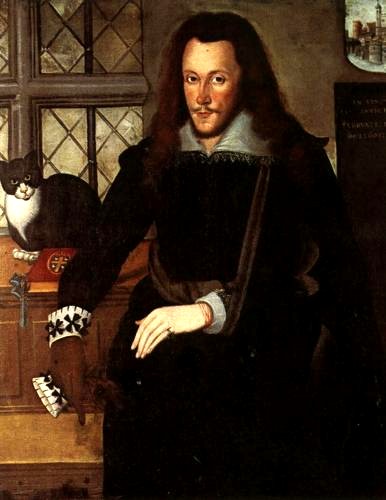
He dashed off two Sonnets to accompany the painting on its horse-back journey to King James in Scotland.  James was an openly bisexual man for whom Shakespeare had written and performed.

The two Sonnets are numbers 67 and 68 – the only Sonnets in which the Earl of Southampton is referred to in the third person!

The first Sonnet begins by begging James for Southampton’s release from prison:

Ah wherefore with infection should he live

And with his presence grace impiety,

That sin by him advantage should achieve,

And lace itself with his society?

The ‘infection’ Shakespeare writes about is:

  1. The disease that Southampton is recovering from.
  2. The unhygienic conditions of the Tower.
  3. The moral depravity of the other ‘impious’ prisoners in the Tower.

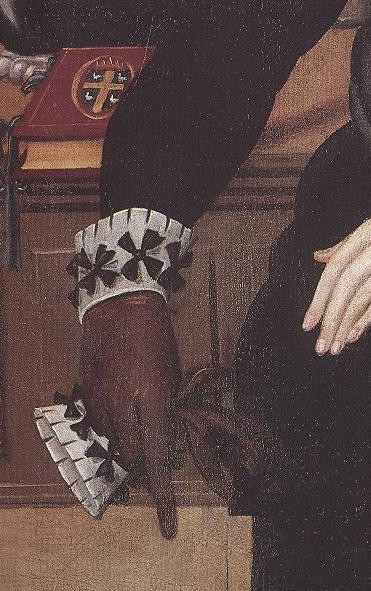
Southampton, by contrast to them, enjoys the ‘grace’ of God – that is why he is pictured with a Bible adorned with his family coat of arms. The cross on the crest, in this positioning, becomes a Christian cross as well.

The implication is that Southampton, in God’s eyes, is without sin and so should be released from his sentence. His Rebellion, to ensure James’s succession, was inspired by God.

Shakespeare describes the sin surrounding Southampton in the Tower as ‘lacing’ itself with his ‘society’. This draws attention to the black cross-lacing in Southampton’s gloves, which takes the form of a St. Andrew’s Cross, the symbol of Scotland.

The artist  has positioned the St. Andrew’s cross-lacing strategically close to the ‘George’s’ Cross on the cover of Southampton’s Bible.
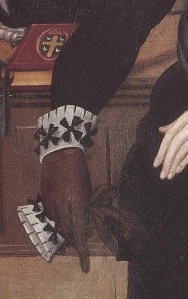
The St. George Cross and the St. Andrew Cross.

The unification of Scotland and England had been the ambition  of James’s Roman Catholic mother, Mary Queen of Scots.

It was now the ambition of James himself.
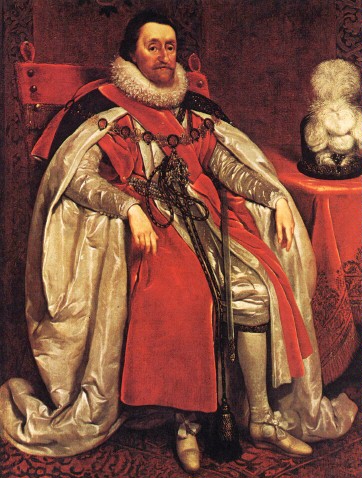
King James VI and I

Sonnet 67 continues:

Why should false painting imitate his cheek

And steal dead feeling of his living hue?

Why should poor beauty indirectly seek

Roses of shadow since his Rose is true?

‘False painting’ refers to:

  1. The use of cosmetics to make women (and some men!) more beautiful than they really are.
  2. The ‘wooing portrait’ of Southampton itself which can never hope to match Southampton’s true beauty.

The beauty of the painting can only be a ‘shadow rose’. Southampton is the ‘true rose’.

Shakespeare here is punning on the ‘Wriothesley’ family name. ‘Rosely’, as we know from the Titchfield Parish Register, was the grandiose way the aristocratic branch of the family pronounced its name (while the less aristocratic settled for ‘Risley’!)

The phrase His Rose is true means:

1. Southampton is morally trustworthy and loyal to James.

2. Southampton’s cheek has a natural blush. It is not produced artificially by cosmetics.

Sonnet 67 continues:

Why should he live, now nature bankrupt is,

Beggar’d of blood to blush through lively veins,

For she hath no exchequer now but his,

And, proud of many, lives upon his gains?

Nature is ‘beggar’d of blood’ – robbed of blood – for a very good, literal reason. Essex has been beheaded. Nature’s supply of blood (or, rather, ‘noble’ blood) has dried up.

But  ‘blood’ is often associated with ‘semen’ in Shakespeare’s mind. So is ‘money’.  (See the earlier posting The Shakespeare Code)

When Shakespeare describes Nature as ‘bankrupt’, he is suggesting She has no life-force. And when Shakespeare describes Southampton as Nature’s only remaining ‘exchequer’ he is suggesting, now Essex is dead, Southampton is the only source of Dame Nature’s vitality.

Southampton has made ‘gains’ by not expending  his semen.  (Well, not with women anyway. He has been locked up in prison! )

Shakespeare uses the same idea in the famous Sonnet 94 when he writes that chaste young men, by not engaging in sexual activities, ‘harbour nature’s riches from expense’. They preserve their semen which consequently becomes more powerful.

(This idea is very close to the Ancient Chinese idea that too much sexual activity depletes the body’s preserves of energy in the kidneys).

So Nature, which adores producing a multiplicity of forms, (‘proud of many’) has survived by living off Southampton’s stored, pent-up energy.

But how can Southampton himself survive if Nature is draining his own life-force?

The answer is that Nature has not utilised this energy: she has simply stored it away in the Tower as an example of what vibrant, bursting, beautiful ‘wealth’ had once existed a long time ago….

O him she stores, to show what wealth she had,

In days long since, before these last so bad…

The implication is that King James himself should snatch this prize (a healthy, virile, beautiful young man) from the clutches of Nature. He should release Southampton from the Tower…

In the second sonnet (68), Shakespeare refers again to the ‘wooing portrait’.  He compares Southampton’s unrouged cheek and natural, cascading hair to a map that points, again, to an earlier, simpler, more innocent age:

Thus is his cheek the map of days outworn,

When beauty lived and died as flowers do now,

Before these bastard signs of fair were borne,

Or durst inhabit on a living brow;

Before the golden tresses of the dead,

The right of sepulchres, were shorn away,

To live a second life on second head;

Ere beauty’s dead fleece made another gay.

‘The bastard signs of fair’ is a reference to the growing fashion, led by Queen Elizabeth, for wigs which were often made from hair taken from dead bodies. ‘The Bastard’ was the standard Roman Catholic insult for Elizabeth. Her mother, Anne Boleyn, in Rome’s eyes, had not been properly married to her father, King Henry VIII.
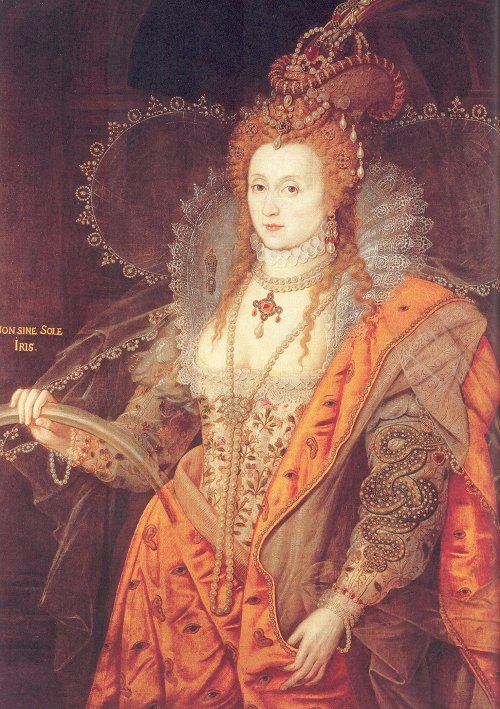
Elizabeth with wig.

Shakespeare now makes an audacious leap. Southampton’s naturalness has been compared to ‘days long since’ and ‘days outworn’ when beauty ‘lived and died’ as naturally as a flower. The scholarly King James would have thought of classical ‘pagan’ times and the myth of the ‘golden age’.

But Shakespeare suddenly challenges this assumption:

In him those holy antique hours are seen,

Without all ornament, itself and true,

Making no summer of another’s green,

Robbing no old to dress his beauty new

The ‘antique’ hours are ‘holy’ ones, so they cannot be pre-Christian.

THEY ARE PRE-REFORMATION!

Shakespeare presents Southampton as a glorious reminder of the ‘natural’ days of Roman Catholic England, before the artificial doctrines of John Calvin corrupted it and before men and women started to wear make-up and wigs.

At this time many believed that James was a Roman Catholic and James, who needed Catholic support for his succession to the throne of England, did nothing to discourage the assumption.

Shakespeare, like many others, hoped that James would restore the ‘Old Faith’ and lead England back to Rome.

Sonnet 69 concludes:

And him as for a map doth nature store

To show false art what beauty was of yore.

Again, Nature stores Southampton in the Tower – this time like a map, which James is invited to unroll….

The Earl of Southampton was released from the Tower on 9th April, 1603,  a few days after Shakespeare wrote these two SonnetsHe wrote another Sonnet (107) to celebrate the event:

Not mine own fears, nor the prophetic soul

Of the wide world, dreaming on things to come,

Can yet the lease of my true love control,

Supposed as forfeit to a confined doom.

Shakespeare now admits he was worried that Southampton was ‘doomed’ to die in the Tower – which nearly happened. But, thankfully, Elizabeth herself has died and all the doom-mongers have been proved wrong:

The mortal moon hath her eclipse endured,

And the sad augurs mock their own presage;

All the worries about the succession have proved groundless and James’s predilection for peace promises a time of certainty and security:

Uncertainties now crown themselves assured,

And peace proclaims olives of endless age.

With the love and favour of the new King, dropping on him like a sexy, soothing, ‘balm’, Southampton looks more beautiful than ever. And there’s something in it for Shakespeare.  By writing this Sonnet he will achieve a victory over death – a triumph denied those without his ability…

And now with drops of this most balmy time

My love looks fresh, and death to me subscribes,

Since ‘spite of him I’ll live in this poor rhyme,

While he insults o’er dull and speechless tribes.

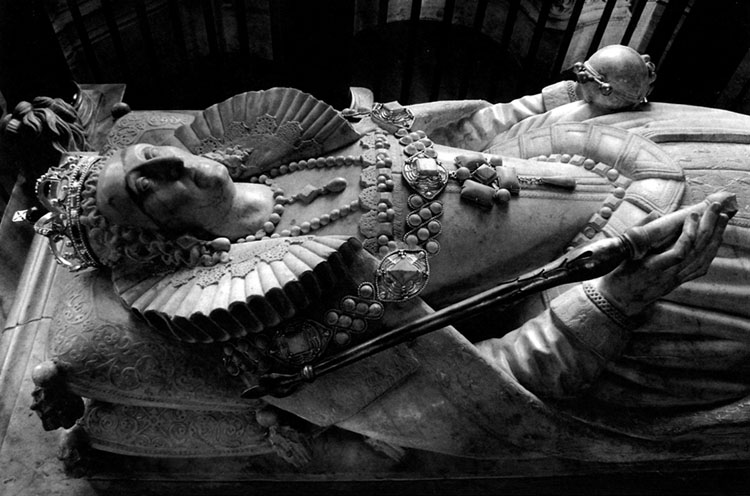
And there’s something in it for Southampton.  Shakespeare, by writing about him, will make him immortal as well. Unlike the talentless, tyrannical ‘Virgin Queen’ who will leave nothing behind her but a decaying tomb…

And thou in this shall find your monument,

When tyrants’ crests and tombs of brass are spent.

Tomb of Queen Elizabeth

On 16 May, 1603 King James granted Southampton a general pardon for his crimes. On 2 July he created him a Knight of the Garter.

But this euphoria was to be short-lived…

(It’s best to read Part Four now.)

Read Full Post »
Martin Jarvis, famous for (among much else) his radio broadcasts of Richmal Compton’s sublime William Stories, has been inducted into The Shakespeare Code’s  ROLL OF HONOUR.

His brilliant  production of Sir Terence Rattigan’s great play The Browning Version (starring Michael York) was  broadcast on the B.B.C.’s  Radio 4  at 2.30 p.m. Saturday, 11th June.

At the end of the broadcast, he gave a short talk describing how, in 1976, Sir Terence visited the King’s Head Theatre in Islington to see the revival of the play which re-established his reputation in the English speaking world.

The play was produced by the late, great Dan Crawford.

It was directed by The Shakespeare Code’s chief reporter,  Stewart Trotter, who was given the Hugh Beaumont Award for his production by the London Theatre Critics.


Simon Callow (whose name is also inscribed on The Code’s ROLL OF HONOUR) on hearing of this award immediately dubbed it:

A BINKIE!!!

Read Full Post »

Congratulations on the website, which is clearly garnering attention….I stare in awe from the outside, without much knowledge, but with admiration…

 The Shakespeare Code would like to thank Dr. Miéville for his kind comments, congratulate him, in turn, for the rave reviews his fiction is garnering and record how proud it was to canvas for him, and the Socialist Workers Party, in the 2001 British election.

Dr. Miéville’s  name has been inscribed in The Shakespeare Code’s

ROLL OF HONOUR

Read Full Post »

(It is best to read Part One first)

Not everybody likes cats.

There are, in fact, three names for ‘cat phobia’:

galeophobia, ailurophobia and elurophobia.

William Shakespeare had observed this phenomenon at first hand.

In The Merchant of Venice, Shylock, asked why he hates the merchant Antonio, replies:

Some men there are love not a gaping pig

Some that are mad if they behold a cat,

And others, when the bagpipe sings i’ the nose,

Cannot contain their urine: for affection,

Mistress of passion, sways it to the mood

Of what it likes or loathes…

Shylock can find no logical reason why he loathes Antonio, any more than there is a logical reason why some men will hate a ‘harmless, necessary cat’: it is simply:

 a lodg’d hate and a certain loathing.

The only character in William Shakespeare’s works who expresses an aversion to cats is Bertram, the Count of Rossillion, in All’s Well that End’s Well.  He falls under the malign influence of Paroles, a corrupt and selfish captain. When Bertram learns the full extent of his captain’s treachery, he exclaims:

I could endure anything before but a cat;  and now he’s a cat to me!

Then, as he discovers more and more about Paroles, Bertram adds:

He’s more and more a cat!

And again:

A pox on him, he’s a cat still!

The Shakespeare Code believes that Bertram, with his ‘arched brows, his hawking eye, his curls’ is a  ‘warts and all’  portrait of Henry Wriothesley, the third Earl of Southampton.

The Code’s reasons for this belief are:

  1. Both Bertram and Southampton are wards of court
  2. Both are sons of a widowed Roman Catholic Countess
  3. Both are ambitious to shine in the Wars
  4. Both end up as Captains of Horse, and
  5. Both treat their ‘lower class’ lovers appallingly.

In the great scene of the play, the Countess of Rossillion questions her adopted ‘daughter’ Helena (whose father, a poor, but skilled herbalist, has recently died) as to whether she is in love with her aristocratic son, Bertram.

After an attempt at prevarication, Helena confesses her love:

Then I confess,

Here on my knee, before high heaven and you,

That before you, and next to high heaven,

I love your son…

Helena later adds:

But if yourself,

Whose aged honour cites a virtuous youth,

Did ever in so true a flame of liking,

Wish chastely and love dearly, that your Dian

Was both herself and love – O then give pity….

The Countess of Southampton (Henry Wriothsley’s mother, Mary) had, in real life, fallen in love with ‘a common person’ when she was married to the second Earl. But, like the Countess of Rossillion in the play, she did not give way to her feelings. She remained as chaste as the goddess Diana.

Allegedly.

The Code believes that: 

1. Helena is William Shakespeare in drag.

2. The Countess of Rossillion in the play is the Countess of Southampton.

3. The Countess of Southampton, like the Countess of Rossillion, approved of the liaison between her son, (Henry) and a member of the (relatively!) lower classes (Shakespeare).

If Betram suffered from ‘galeophobia, ailurophobia and elurophobia’ then the Earl of Southampton must have suffered from them as well!

Southampton was an excitable, spoilt young man who was always getting into quarrels. His experience of being sentenced to death after the rebellion (then living through Essex’s botched execution) had a sobering effect on him.

For a time, at least.

He wrote to the Privy Council from the Tower about his ‘lowly and penitent heart’ and his ‘true penitent soul’ and his wish to ‘prostrate [himself] at Her Majesty’s princely feet’.

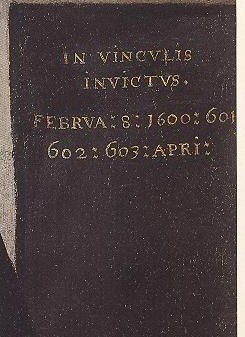
This is the ‘contrite’ image Southampton now wishes to project to  King James in the ‘wooing portrait’  he sends to him. The inscription, written above the dates of his incarceration, reads:

IN VINCULIS

INVICTUS.

This could mean a defiant ‘In chains, but unbeaten’ or ‘Bloodied, but unbowed’. However, the Latin ‘sed’ (‘but’) does not appear in the inscription.

The implication is that Southampton is unbeatable BECAUSE he is in chains.

‘The chains’, could of course, refer to literal imprisonment in the Tower and all the Earl has learnt from his disgrace.

Equally, ‘the chains’ could refer to the sling he has to wear in order to recover from his illness, from which he has also learnt.

But the most likely reading of  ‘in chains’  is that the Earl has

CHAINED HIS OWN PASSIONS!!!

The Tower has turned him into a Stoic.

Southampton is now so completely master of himself that he can even tolerate the presence of a cat, a creature that, like Bertram, he could not ‘endure’ before his imprisonment.

So the cat is, in reality, a symbol – a symbol of passion tamed.

It might have been based on a real ‘harmless, necessary cat’  kept in the Tower to chase off mice and rats: but it cannot be Southampton’s ‘favourite cat, Trixie’.

Southampton hated cats!

But why is the cat looking out of the picture? And what is the cat looking at?

Like the Earl of Southampton, the cat is looking out at the man for whom the portrait was painted – King James.

The cat is exercising the inalienable right of every cat (symbolic or otherwise) first recorded by Shakespeare’s friend, John Heywood, in 1562:

What! A cat may look on a King, ye know.

The cat is  black and white. The Earl is pictured in black and white.

The Code has established that the Earl of Southampton is in mourning for the dead hero, the Earl of Essex.

But black and white were also the ‘signature’ colours of the Earl of Essex, to show his loyalty to Queen Elizabeth….

The Earl of Essex in black and white

So the ‘black-and-white’ theme of the painting would also evoke, for James, the soul of his  ‘martyr’, the Earl of Essex.

Southampton is presenting himself as a ‘substitute Essex’,  a glorious remnant of the now glorious revolution against the wicked Queen Elizabeth.

Did the Third Earl of Southampton include a letter to King James along with his portrait?  His right hand, after all, was not in a sling.

This, The Code believes, was not Southampton’s style. He would dictate his letters (which his secretary would pen in a ‘secretary hand’:)  he would then sign them, with a flourish, ‘H. Southampton’.

The late, great maverick Shakespeare scholar (and war-time Bletchley code-breaker) Eric Sams discovered that a letter to Lord Burghley, and signed by Southampton, is written –

IN SHAKESPEARE’S HAND!

(a discovery confirmed by the American hand-writing expert, Charles Hamilton)

The Code has examined this letter in manuscript at the British Museum and believes Mr. Sams’s and Mr. Hamilton’s claims to be true.

[Lansdowne MS LXX.72. The letter is dated 27th June, 1592]

The Code also believes that Shakespeare wrote another letter for Southampton in his cell to accompany the portrait.

BUT THE LETTER WAS IN THE FORM OF TWO SONNETS!

The Numbers of the Sonnets will be revealed in:

‘The Earl of Southampton and Trixie the Cat. Part Three’.

(It’s best to read Part Three next.)


Read Full Post »

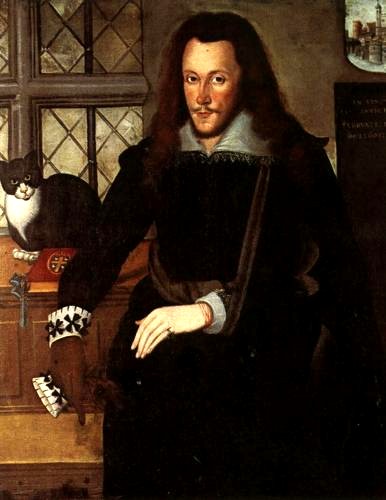
In Boughton House (the Northamptonshire home of the Duke of Buccleuch) there hangs a painting of Henry Wriothesley, the third Earl of Southampton, Shakespeare’s patron and lover.

He is shown as a prisoner in the Tower of London – accompanied by a black and white cat.

The Earl of Southampton’s presence in the Tower is easily explained.

On 8 February, 1601, along with his intimate friend, Sir Robert Devereux, the second Earl of Essex (and two hundred of their hot-headed followers) Southampton had rebelled against Queen Elizabeth.

The men wanted Elizabeth to name King James VI of Scotland as her successor. They feared that, if she did not, civil war would break out when she died.

The Queen, for her part, feared that, if she did name James as her successor, she would be assassinated.  She had, after all, executed King James’s mother, Mary Queen of Scots.

Another aim of the rebellion was to kill Sir Walter Raleigh and Sir Robert Cecil who had plotted against Essex while he was away from the Court, fighting in Ireland.

But the attempt (after divine service on a Sunday morning) to raise the citizens of London had fallen flat.  Everyone had prospered too well under Elizabeth.

Essex was beheaded and Southampton imprisoned in the Tower. Southampton had also been sentenced to death, but his mother and his wife had pleaded for mercy. Queen Elizabeth agreed to transmute the death sentence to life imprisonment.

She despised the long-haired, quarrelsome Southampton, but realised he was no real threat to her. Also, the beheading of Essex had proved very unpopular with her subjects. The London mob had tried to lynch Essex’s executioner who had taken three blows to sever his head.

The Cat in the Tower is more difficult to explain.

A legend has grown up, first reported in 1793 by Thomas Pennant in Some Account of London:

After he [the third Earl of Southampton] had been confined there [the Tower] a small time, he was surprised by a visit from his favourite cat, which had found its way to the Tower; and, as tradition says, reached its master by descending the chimney of his apartment. I have seen at Bulstrode, the summer residence of the late Duchess of Portland, an original portrait of this Earl, in the place of his confinement, in a black dress and cloak, with the faithful animal sitting by him.

Pennant, at least, has the good grace to add:

Perhaps this picture might have been the foundation of the tale.

Even the great Southampton scholar, C.C. Stopes (mother of Marie)  joins in the cat speculation by suggesting that Southampton’s wife brought the cat with her on a ‘prison visit’  to her husband  ‘to help to comfort, and to help calm the excitement of meeting again after such a long and anxious separation.’

In our time, Southampton’s ‘favourite cat’  has even acquired a name:

‘TRIXIE’

 To celebrate its 2,000th view, The Shakespeare Code has sworn to eliminate Trixie the Cat with EXTREME PREJUDICE.

The third Earl of Southampton, stripped (officially, at least) of his title and signing himself plain ‘H. Wriothesley’, was incarcerated on 8 February, 1601. He was ill from the start of his imprisonment and on 22 March the Privy Council allowed a doctor in to treat his ‘quartern ague’ which produced ‘swelling in his legs and other parts’.  

In August the following year (1602) the Lieutenant of the Tower transferred the ‘weak and very sickly’  Southampton to a more salubrious lodging, but warned the Privy Council that:

Without some exercise, and more air than is convenient for me to allow without knowledge from your honours of her Majesty’s pleasure, I do much doubt of his recovery.

Southampton’s mother, Mary, was allowed in to see him later that month, then, in October, his wife, Elizabeth.

In February of the following year (1603) the Jesuit Father Rivers noted that: ‘

The Earl of Southampton in the Tower is newly recovered of a dangerous disease…but in no hope of liberty.

Then, on 24 March, 1603, Queen Elizabeth died.

James became King of England as well as King of Scotland and everything turned round. The traitors of Elizabeth’s reign became the heroes of James’s.

When Southampton heard that Elizabeth had died, he threw his hat, for sheer joy, over the walls of the Tower. He expected King James would release him and pardon him.

He also hoped James would make him his lover.

However, many other handsome young aristocrats (including the Countess of Pembroke’s two sons) were vying for this  powerful position.

How could Southampton, imprisoned in the Tower, catch the King’s eye before his rivals?

He could commission a portrait and rush it to King James in Scotland!

The painting is heavily coded:

  1. The book on the window ledge (gilt-edged and most likely a Bible) has the Southampton family crest of four silver falcons embossed on the cover. This shows the painting was executed after Southampton’s title was restored by the House of Peers on 26  March,  1603.
  2. Southampton is dressed in black with a ring prominently displayed on his left finger. He is  in mourning (in a ‘suit of woe’) for his friend, the second Earl of Essex who, in James’s eyes at least, was a ‘martyr’.  The ring is a memorial tribute to Essex.
  3. A pane of glass in the window is smashed. This symbolises the violent, untimely death of the youthful Essex.
  4. Southampton’s arm is in a sling. This shows that Southampton is still recovering from his illness and so needs freedom and fresh air. It also allows Southampton (a) to show off the beauty of his long, elegant fingers and (b) offer his ‘submissive’ left hand to James as a lover.
  5. Red threads (holding tiny red gemstones) are wrapped round Southampton’s wrist. This indicates (a) that Southampton was recovering from a form of rheumatism (red thread round the wrist was an old folk-remedy) and (b) that Southampton was offering his love to James (red gems were all named ‘rubies’ at the time and symbolised passion).
  6. Southampton’s hair cascades, unadorned, round his shoulders. This shows (a) the unaffected truth and straightforwardness of his nature, (b) his hatless deference to the new King into whose presence the portrait would be taken and (c) his readiness to symbolically ‘wed’  James. Brides at this period wore their hair, plainly brushed, down to their shoulders for the wedding ceremony.

 [See the painting (also now at Boughton House) of the Earl of Southampton’s bride, Elizabeth Vernon, combing her shoulder-length hair in preparation for the wedding service which will make her a Countess]

7.  There is a painting (within the painting) of the Tower of London with four white swans swimming in its moat.  These swans represent the faithful lovers who will greet Southampton when he is released from the Tower.

8.  Beneath the painting of the Tower is the exact date of Southampton’s incarceration, ‘FEBRUA: 8 1600:’ (The New Year  at this time, started on 31 March). This date is followed by:  ‘601: 602: 603: APRI:’

There is no exact date after ‘APRI’ as there is after ‘FEBRUA’.  If the painting had been executed after the Earl of Southampton’s release, the exact date would have been included.

This painting, the Shakespeare Code believes, is an invitation to King James to fill in the exact date in April by ordering Southampton’s release from the Tower.

The painting was a rushed job, executed over six days and nights (26  March to 1 April) then sent, by horseback courier, to James at Holyrood House in Edinburgh.

King James, smitten with the painting of the Earl, responded on 5 April with a letter to the ‘Peers, Nobility and Council’  of England:

Although we are now resolved, as well in regard of the great and honest affection borne unto us by the Earl of Southampton as in respect of his good parts enabling him for the service of us, and the state, to extend our grace and favour towards him….we have thought meet to give you notice of our pleasure….which is only this : Because the place is unwholesome and dolorous to him to whose body and mind we would give present comfort, intending unto him much further grace and favour, we have written to the Lieutenant of the Tower to deliver him out of prison presently to go to any such place as he shall choose in or near our city of London, there to carry himself in such quiet and honest form as we know he will think meet in his own discretion, until the body of our state, now assembled, shall come unto us, at which time we are pleased he shall also come to our presence, for that as it is on us that his only hope dependeth, so we will reserve those works of further favours until the time he be-holdeth our own eyes, whereof as we know the comfort will be great unto him so it will be contentment to us to have opportunity to declare our estimation of him…

The painting had clearly worked at every possible level.

But what is ‘Trixie’ doing in the Tower?  And why is she staring out of the painting?

For the answer to this question, we must turn to….

The Swan of Avon….

William Shakespeare….

(it’s best to read Part Two now.)


Read Full Post »
The Shakespeare Code announced that on 28th April, 2011, the eve of the Royal Wedding) it received its –

TWO THOUSANDTH VIEW!!!

 The Codethanked all those eminent men and women who sent endorsements and encouragements to the site. In recognition, The Shakespeare Code recorded their names or titles on its coveted:

ROLL OF HONOUR

 They are, in chronological order:

Michael Hentges

Martin Green

Alan Samson

Lord Bragg of Wigton

Sir Nicholas Hytner

Jane Howell

Greg Doran

Maggie Ollerenshaw

Simon Callow

Prof. David Womersely (Thomas Wharton Professor of English at Oxford University)

Karen Gledhill

Prof. Jonathan Bate (Professor of Shakespeare and Renaissance Studies at Warwick University)

Dr. James Kelly (Senior Tutor at Queen’s College, Cambridge)

China Miéville

Martin Jarvis

The Shakespeare Code also thanked the hundreds of intellectually curious and open-minded  people from all over the world who have clicked onto the site, The Brothers and Sisters of The Code…


Read Full Post »


Professor Jonathan Bate writes of The Strange Case of Mr. Apis Lapis ( The Shakespeare Code, 17th February, 2011):

 It’s a terrific article and very persuasive that Beeston [of Posbrook Farm, Titchfield] is Apis Lapis… All very interesting….’

The Shakespeare Code would like to thank Prof. Bate for his interest and support. He is a Commander of the British Empire, a Fellow of the British Academy and the Royal Society of Literature, Professor of Shakespeare and Renaissance Studies at the University of Warwick and a Governor and Board Member of the Royal Shakespeare Company.

To read ‘The Strange Case of Mr. Apis Lapis’, click here.

To read Prof. Bate’s endorsement of The Code’s ‘Titchfield Theory’, click here.

Read Full Post »

(It’s best to read Parts One, Two, Three, Four and Five and ‘A Synopsis’ first)

Queen Elizabeth hated warfare. She thought it was a waste of money and a waste of life. She had no interest in attacking other countries and would only allow armies to be mobilised if England itself was attacked.

The Earls of Essex and Southampton hated peace. They thought it made men ‘hate one another’ because they ‘less need one another’. ‘It begot plenty, plenty pride, pride distain and disdain strife’. War, they believed, was ‘an agent of civilization’ and ‘the school of tolerance’.

So when Richard III, in his opening soliloquy, criticises the effeminacy of peacetime (when ‘grim-visaged war’ is reduced to capering ‘nimbly in a lady’s chamber’), many Elizabethans would have agreed with him. And not just the men.

War is ‘grim-visaged’ and so is King Richard himself. That’s why he feels at home on the field of battle. (He has already proved himself  a valiant warrior at Tewksbury before the play starts).

But peace, he thinks, makes him look like a monster. So he behaves like one. 

Shakespeare’s genius is to show, at the Battle of Bosworth Field, all Richard’s positive qualities flooding back: his courage, comradeship, defiance and wit. He cheers the hearts of his soldiers, is utterly professional in his preparations and in battle ‘enacts more wonders than a man’.

Indeed, if Richmond (later Henry VII, Queen Elizabeth’s grandfather) had not filled the battle field with look-alike ‘Richmonds’ (five of whom King Richard slays) the Battle could well have gone the other way.

Note: Shakespeare himself invents these sneaky ‘look-alikes’. Would he have done that if the intention of the play was to justify the Tudor claim to the throne?

The Death of Richard III - Olivier as the King

War even brings out a poetic sensibility in the hunch-backed King. On the eve of battle he urges the Duke of Norfolk to make sure he is safely guarded in his tent, then adds:

Stir with the lark tomorrow, gentle Norfolk

To which the Duke, with loyalty and affection, responds:

I warrant you, my lord…

Read Full Post »

(It’s best to read Parts One, Two, Three, Four and Five first)

‘Richard III’ Decoded  is a series of five short articles which argue that William Shakespeare’s The True Tragedy of Richard III was not a piece of pro-Tudor propaganda.

It was, in fact, a coded attack on Queen Elizabeth herself.

It was a satire on the life of Sir Robert Dudley, the Earl of Leicester, Queen Elizabeth’s lover and friend, who had died just a couple of years earlier (1588).

In 1584, the Jesuits had published Leicester’s Commonwealth, a savage attack on Leicester which Shakespeare draws on to create his portrait of the hunch-backed king.

The King Richard of Shakespeare’s play

1. Murders a husband to get his wife.

2. Murders his wife to get another wife.

3. Uses black magic (or seems to!) to get his way with women.

4. Assumes, in the midst of his atrocities, an air of religious piety.

The historical King Richard was never accused of these crimes: but the Earl of Leicester was.

The Shakespeare Code argues that the original, lavish production of Richard III was staged in the grounds of Place House in Titchfield.

It was here that Leicester, acting as agent-provocateur, had destroyed the Catholic cause in England. He had encouraged the Duke of Norfolk to marry Mary Queen of Scots and the Earl of Southampton’s family to rebel against Queen Elizabeth.

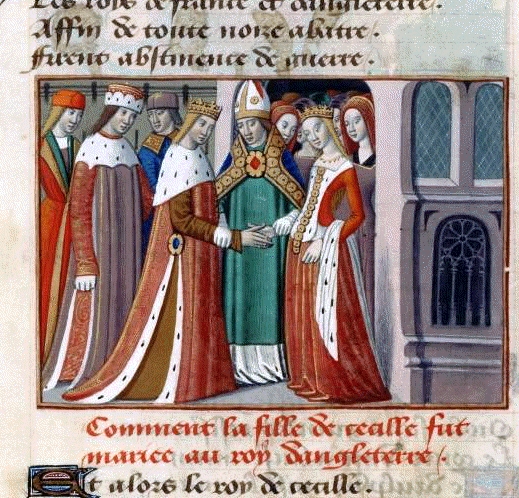
It was also at Place House (when it was an Abbey) that King Henry VI had married Margaret of Anjou.

Henry VI marries Margaret of Anjou in Titchfield

That is why Henry VI – as a corpse and a ghost – plays such a prominent part in Richard III. He was a local hero at Titchfield and had granted, in 1447,  the village a school and a fair. It was against the background of this fair that the play – with its horses, armour, tents and armies – was originally performed.

The fair at Titchfield is held to this day:

Titchfield Fair

The Shakespeare Code also argues that the pro-Tudor version of the Richard III story, performed by the Queen’s Men, was a government reply to Shakespeare’s subversive one.

It was the beginning of the hostility that was to grow between Queen Elizabeth and one of the most brilliant of her subjects, the Catholic homosexual, William Shakespeare.

(It’s best to read ‘Richard III’ and War next.)

Read Full Post »

« Newer Posts - Older Posts »