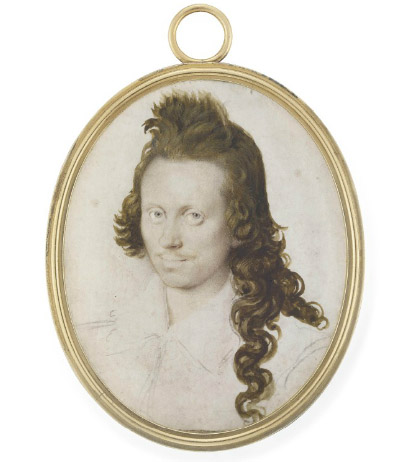
Dr Elizabeth Goldring – working with Professor Sir Jonathan Bate – has identified a Nicholas Hilliard miniature as being that of Henry Wriothesley, the Third Earl of Southampton. He is touching his heart in a gesture of love.

The miniature was painted on a playing card – and on the reverse side originally there was an Ace of Hearts. However this has been painted over and replaced with a black spear.
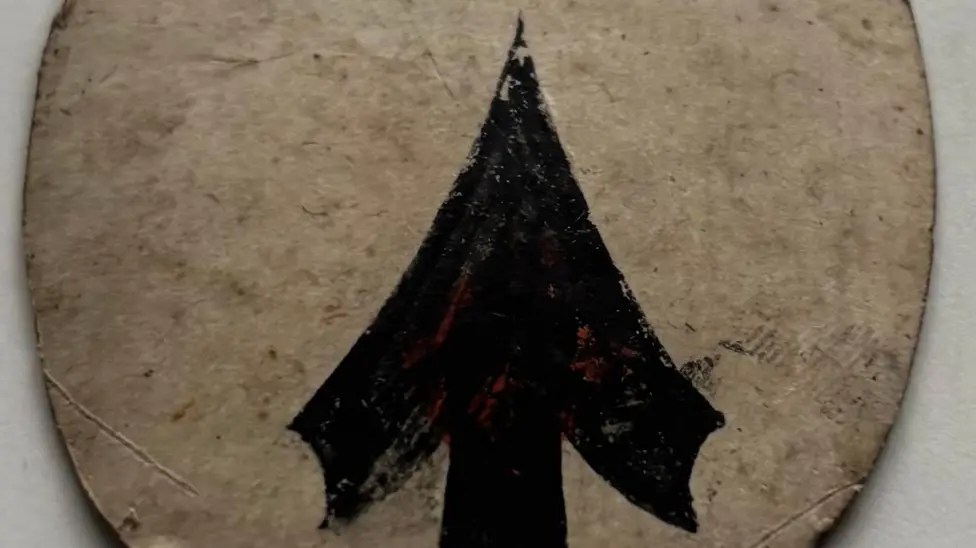
Dr. Goldring suggests that the spear was painted in by William Shakespeare – and was sent by Shakespeare to Southamton when their love affair came to an end. The spear formed part of Shakespeare’s family crest.
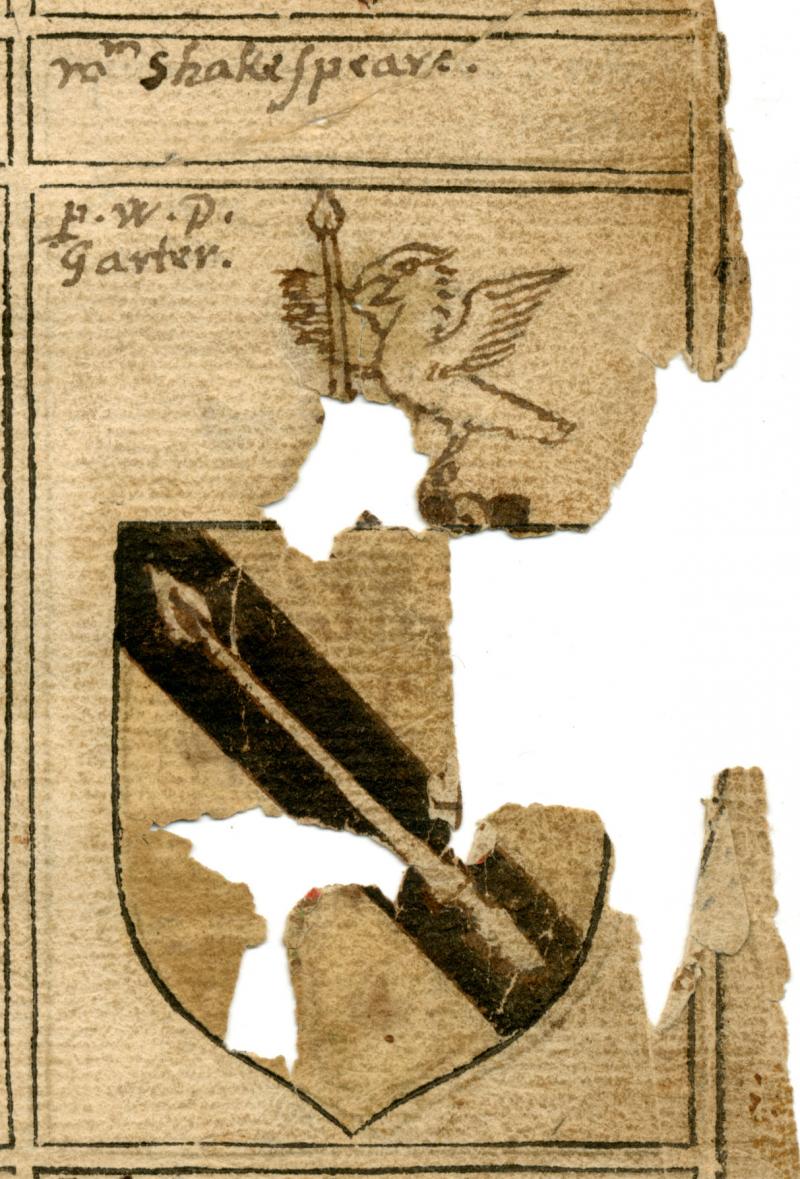
Dr. Goldring suggests that this rupture was in 1598 – when Southampton got married – but the Code believes that this break occured in 1605 – when Southampton’s wife, Elizabeth, produced a son for him – and that Shakespeare returned the miniature together with the ‘Poison Pen’ Sonnet 126
The Code re-ordered Shakespeare’s Sonnets in 2018 – and we suggested then that Shakespeare was given the miniature by Southampton when he was going off on tour in 1595. Sonnets 46 and 47 (103 and 104 in the Code’s order) deal with that gift.
In Sonnet 46 Shakespeare uses the word ‘heart’ 8 times – and in Sonnet 47 6 times. In both Sonnets the word ‘heart’ is used TWICE in the concluding lines!
In the light of Dr. Goldring’s discovery, the Code would now like to suggest that ‘heart’ carries a reference to the Ace of Heart’s card on which Southampton’s likeness is painted.
Here is part of the original Post – with original images – published seven years ago on 22nd October 2018 – but with the word ‘heart’ in the Sonnets italicised.
XXXXXXXXXX
There were riots in London in June, 1595. Martial law was imposed and the theatres were shut. Shakespeare was forced to tour with his new company to Ipswich and Cambridge…..
Harry gave Shakespeare a miniature of himself…..

……as a keepsake.
And Shakespeare resumed his affair with Harry. But after Harry’s earlier infidelity – and flirtation with Chapman, the relationship was never to be as ecstatic as it was before.
Sonnet 103. (46)
‘Mine eye and heart are at a mortal war,
How to divide the conquest of thy sight;
Mine eye, my heart thy picture’s sight would bar,
My heart, mine eye the freedom of that right.‘
[My eye and my heart are engaged in a deadly war about how to divide the spoils of the miniature of you which you gave me.
My eye wants to stop your heart from looking at you – and my heart your eye.]
‘My heart doth plead that thou in him dost lie,
(A closet never pierst with crystal eyes)
But the defendant doth that plea deny,
And says in him thy fair appearance lies.‘
[My heart pleads in evidence that you, Harry, reside in my heart, a private room never broken open by the eye with its cutting crystal edge: but the defendant, my eye, refutes that argument and says that you, Harry, reside more in your reflection in his eye.]
‘To ‘cide this title is impanelled,
A quest of thoughts, all tenants to the heart,
And by their verdict is determined
The clear eye’s moiety, and the dear heart’s part.‘
[To judge this case a jury of thoughts are summoned, all dependent on the heart – and their judgement will determine the case for the eye – full of clarity – and the case for the heart – full of devotion.]
‘As thus, mine eye’s due is thy outward part,
And my heart’s right, thy inward love of heart.‘
[My eyes case rests on your appearance: my heart’s case on your inner love.]
104. (47)
‘Betwixt mine eye and heart a league is took,
And each doth good turns now unto the other;
When that mine eye is famisht for a look,
Or heart in love with sighs himself doth smother,‘
[My eye and heart have come to an agreement – and now they are working as a team. When my eye is starved of your sight or my heart is suffocated with sighing for you.]
‘With my love’s picture then my eye doth feast,
And to the painted banquet bids my heart;
An other time mine eye is my heart’s guest,
And in his thoughts of love doth share a part.‘
[Then my eye feasts on the sight of your miniature and invites my heart to the banquet. At other times, my eye is the guest of my heart and shares my hearts thoughts of love for you.]
‘So either by thy picture or my love,
Thy self away, art present still with me,
For thou not farther than my thoughts canst move,
And I am still with them, and they with thee.‘
[So either by means of my miniature of you – or my love for you – you are with me even if you are absent from me: because you cannot move further away from me than my thoughts of you: I am with them and they are with you.]
‘Or if they sleep, thy picture in my sight
Awakes my heart, to heart’s and eye’s delight.‘
[And if I do stop thinking about you, your miniature acts as prompt to arouse my thoughts of you and my love for you.]
 The Shakespeare Code
Leave a comment