Brothers snd Sisters of The Shakespeare Code…
You will have heard of Church Mice – but did you know there were Church Cats as well?
Your Cat is happy to say she is one of them! I organise our wonderful team of Volunteers who welcome visitors to St. Mary le Strand Church – the Jewel in the Crown in the new pedestrian precinct at the east end of London’s fabulous Strand!
A couple of years ago a London tour guide was taking a party of visitors round our Church….

……..and made a joke that it was rarely open – just like its twin church, Santa Maria Maggiore, in Rome…..

Your Cat quipped back – ‘Well it’s open now – and under new management it very often is. And sometimes receives over 200 visitors a day.
Your Cat told the Code’s Chief Agent – Stewart Trotter – the story – but at the time we both accepted the current thinking – that Sir Christopher Wren had more of an influence on the design of the Church than any building in Rome.
Wren, it’s true, had helped James Gibbs, the Church’s architect, to get the commission and clearly forced through the Church’s steeple…..
Gibbs hated the idea as he wanted the building to resemble the Temple of Solomon in Jerusalem- but there were tons of Portland stone lying in the Strand intended for a huge column with Queen Anne on top. But she had died when the foundations were being dug – and four days later the whole scheme was abandoned.

The same thing happened when Gibbs designed St. Martin’s-in-the Fields: he wanted a round church with a flat roof – but again was lumbered with a steeple.
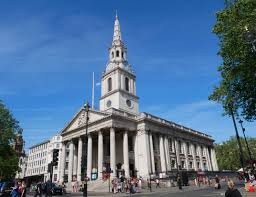
The ironic thing, of course, was this design went all over America – and made Gibbs famous.

But when Pope Francis died and was buried at Santa Maria Maggiore……

-……….our Chief Agent thought again. One of the chief advocates of the ‘Wren, not Rome, influenced Gibbs’ school was completely wrong about the vaults of St. Mary le Strand.. He believed they were built for burials when that’s the last thing the Commission for Building Fifty Churches wanted them to be used for – as readers of The Shakespeare Code will well know!
So our Chief Agent started to look up older architectural ‘authorities’. They suggested Il Gesu, Sat’Agnese in Agone and even Santa Maria della Pace might have influenced Gibbs – but nobody mentioned Santa Maria Maggiorre. This probably means it was an original idea of the guide.
But was it true?
As we said in our earlier posts, Gibbs had arrived in Rome around 1703 with the intention of training as a Roman Catholic priest at the Scots College – but became terrified of the Italian Jesuit head of the college. On top of that, he was required to take a vow that he would return to his native Scotland as a missionary priest – and face imprisonment or even death.
When James II had died in exile in 1701, Pope Clement XI……
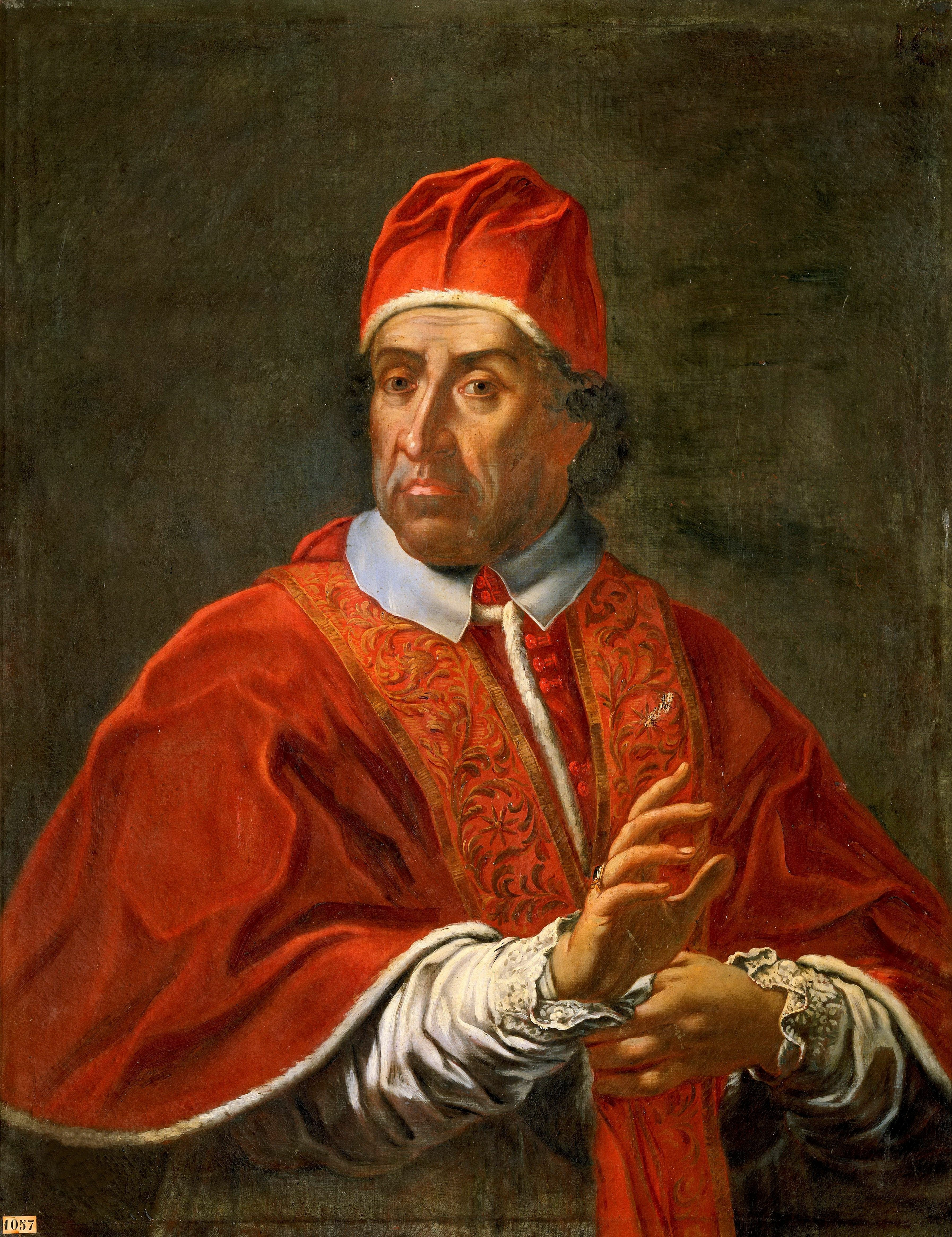
………proclaimed him a martyr and declared that his son, also called James, was the rightful King of England, Scotland and Ireland. He referred to him as King James III.

So when Gibbs travelled to Rome he knew it would be a haven for Jacobite Roman Catholics like himself. Masses for the Stuart family were openly celebrated in Santa Andrea degli Scozzesi (St. Andrew’s Church) next to the Scots College.
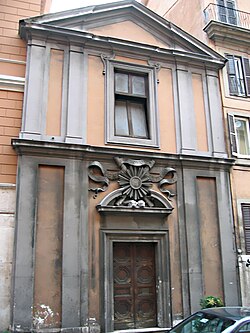
Gibbs decided to leave the college – but to stay in Rome, where he ‘kept good company’. He was a talented draughtsman and water-colourist and was lucky enough to catch the eye of Carlo Fontana….
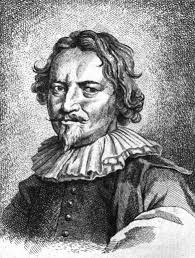
…….whom he described as ‘the best architect in Rome’ and who ‘took me into his own house’.
Gibbs became Fontana’s apprentice – and one of Fontana’s biggest commissions at the time was from Pope Clement XI – to re-design the gates at the portico of Santa Maria Maggiore.
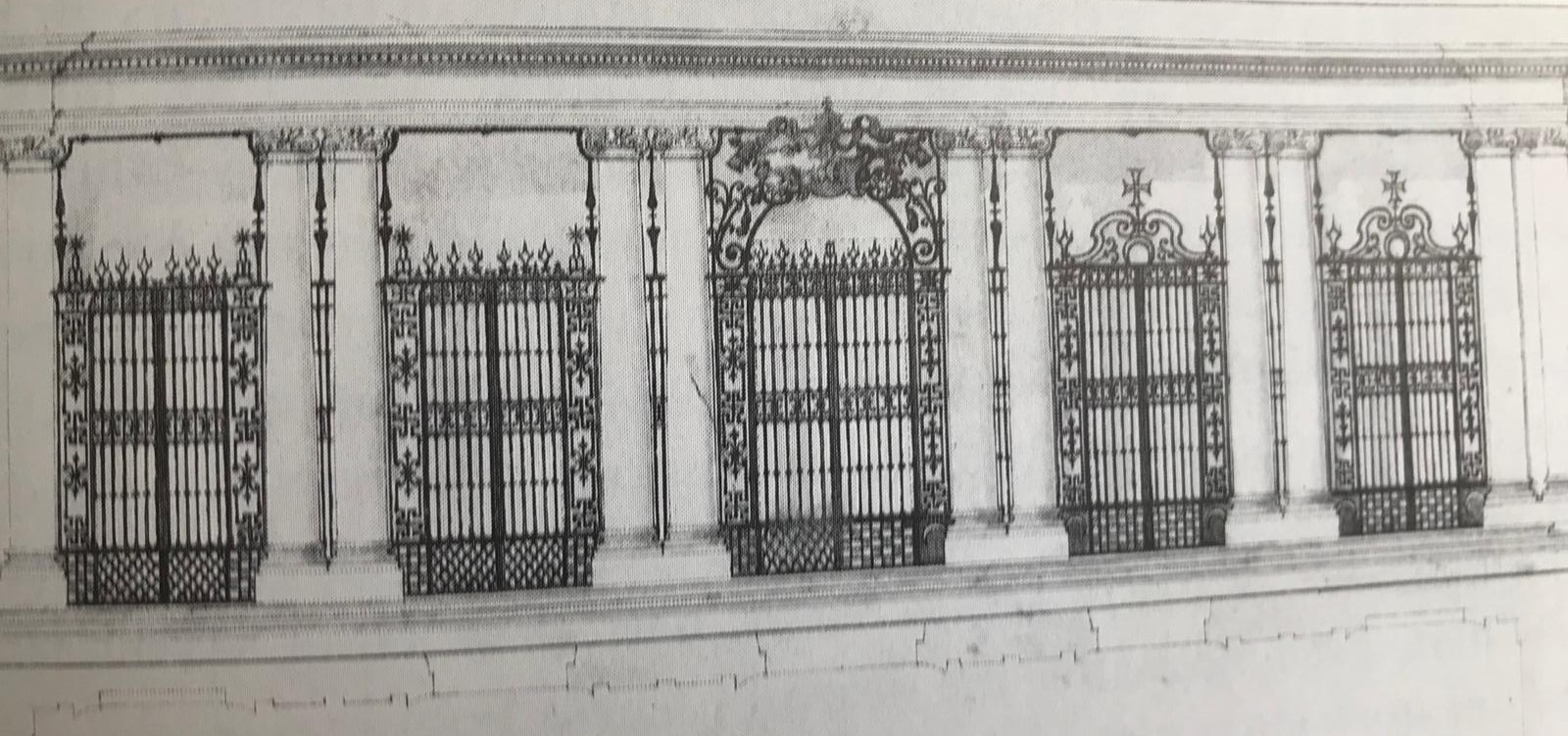
So Gibbs would have got to know that church intimately. He might even have had a hand in drawing the plans for the gates…
Santa Maria Maggiore has a coffered ceiling and upper windows…..

…….very similar to St. Mary le Strand…..

However, unlike London, Rome has many churches with coffered ceilings.
What was unique to Santa Maria Maggiore was its self-supporting, spiral staircase….

…….attributed to Gian Lorenzo Bernini….

…..and thought to be the only one in Rome.
Gibbs also gave St. Mary le Strand an identical spiral, self-supporting staircase……

….and could well have been inspired by Bernini.
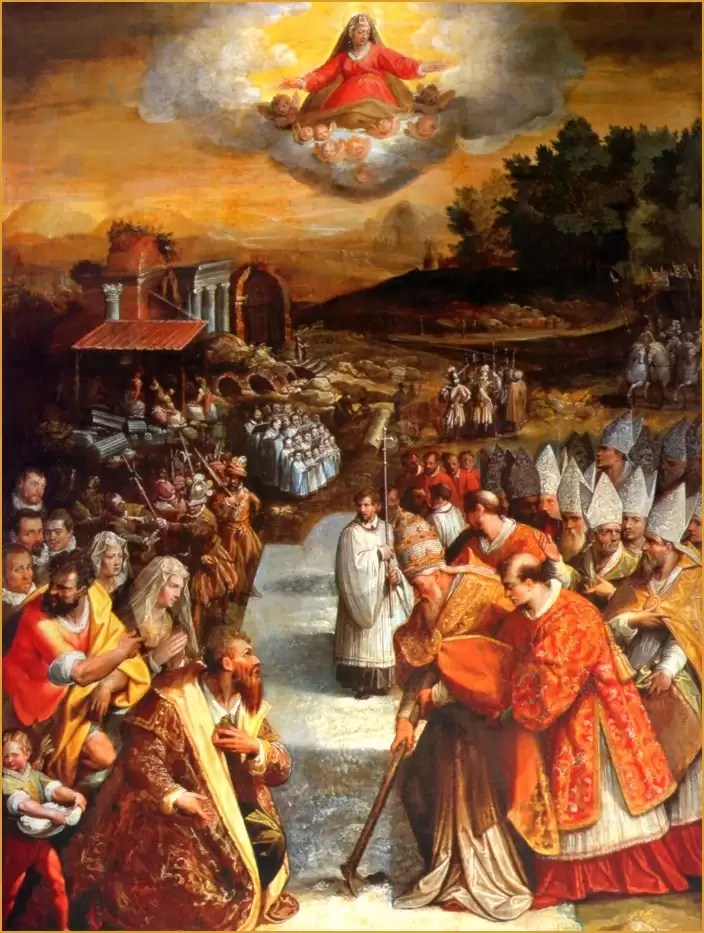
Both churches are dedicated to the Virgin Mary – and Santa Maria Maggiore was built on the site of an apparition of Mary and a subsequent miraculous fall of snow on the 4th and 5th of August in 352 A.D.
Gibbs – in his ceiling of St. Mary le Strand – references this snowfall with rosettes that look like snow flakes…
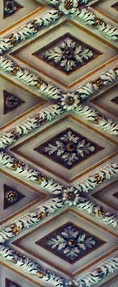
Compare these designs with John Nettis’s illustrations of snow flakes in 1755…
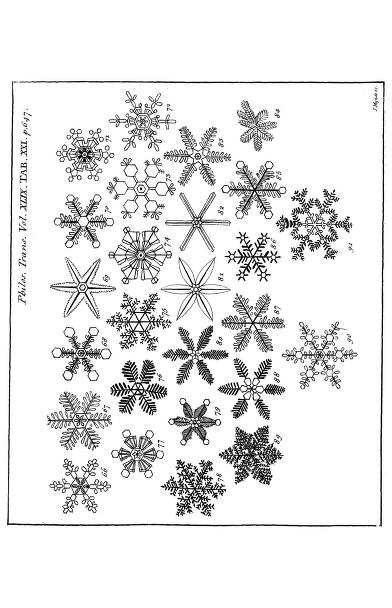
It is the custom at Santa Maria Maggiore to drop white petals from the ceiling on August 5th each year to resemble snow flakes.
And the play of light in Saint Mary le Strand might suggest a fall of snow….

Gibbs makes St Mary le Strand look as opulent and Roman Catholic as possible…….

….. even though there was Lutheran king on the throne when it was designed and built.
The Code argues that this was a defiant act of magic – willing the Old Pretender – and Roman Catholicism with him – back to Britain.
But there is another astounding similarity.
Both churches feature triangles and eyes in their design.
Santa Maria Maggiore has a triangle and an eye in what is now the Baptistry…..

And St. Mary le Strand has a triangle in the apse….
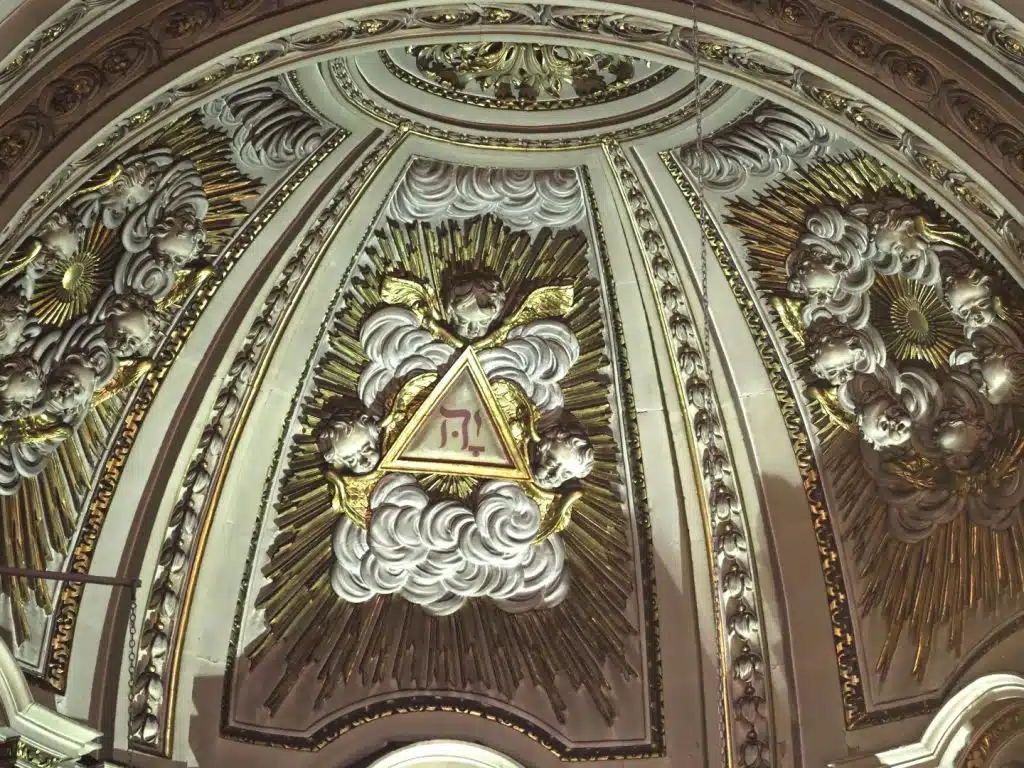
……with eyes next to it…..

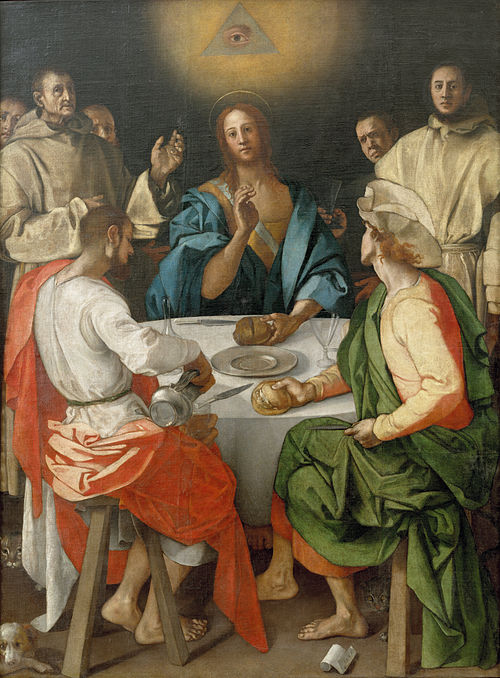
The Freemasons were to adopt the Eye of Providence symbol in the eighteenth century, but it was originally a Roman Catholic symbol. It was particularly favoured in the Counter Reformation as a replacement for the ‘vultus trifons’ – ‘the three-faced countenance’ of the Holy Trinity….

…….which Pope Urban VIII vetoed in 1628 because it looked too pagan. Jacopo Pontormo’s ‘Christ at Emmaus’ (1525) originally had a ‘vultus trifons’ – but someone painted an Eye of Providence over it sometime in the sixteenth or seventeenth century.
We don’t know when the Eye of Providence appeared in Santa Maria Maggiore – but it could have been in time of Clement XI. He saw it as his duty to restore buildings rather than build them – so spent a lot of time and care on re-decoration.
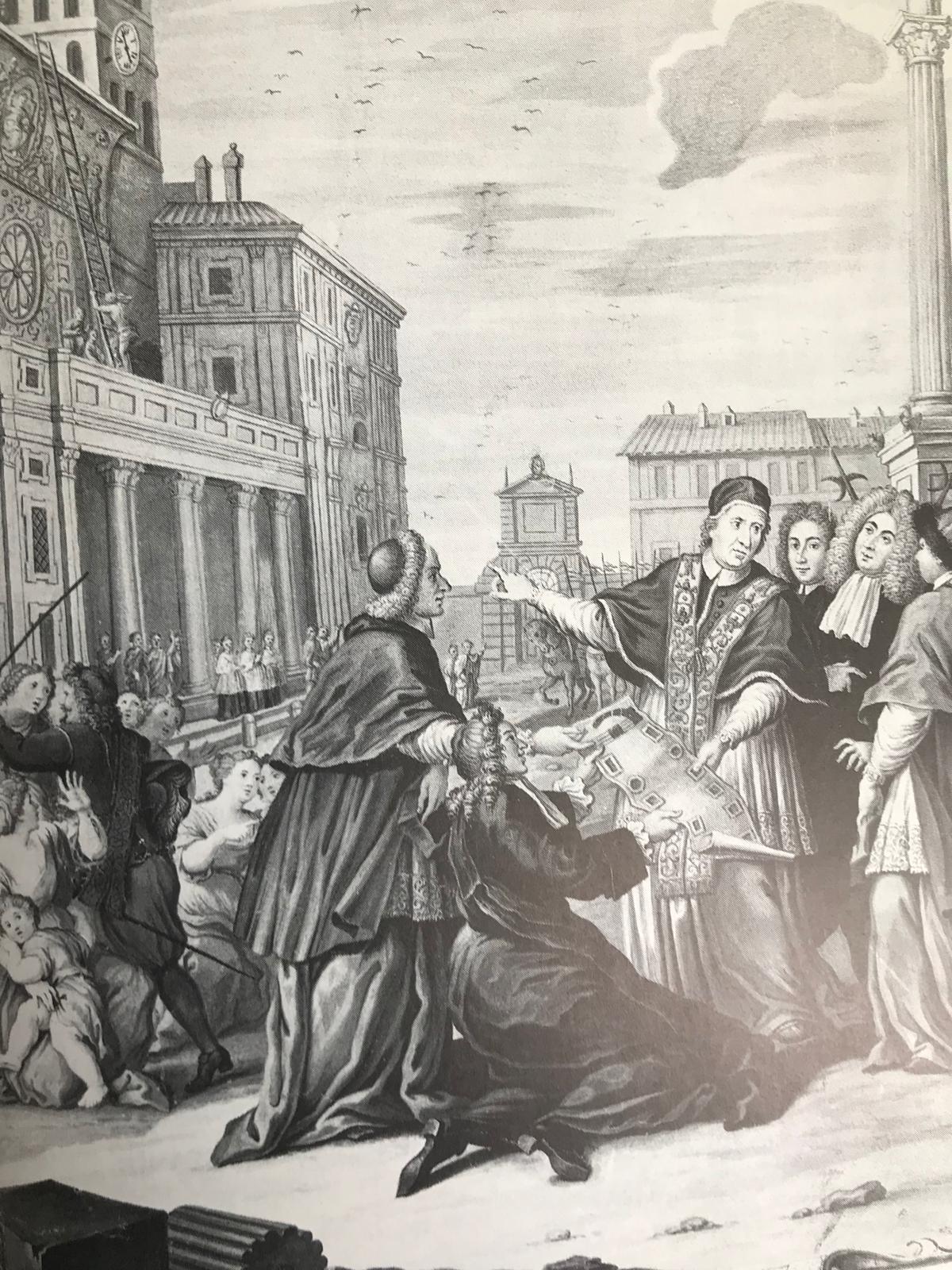
[Pope Clement XI inspecting the facade of Santa Maria Maggiore]
He was wooing Jacobites because he – like many of them – wanted a return to Britain of Roman Catholicism. He was later to give the Stuarts a palace in Rome and a Papal pension.
He could well have known that the triangle was the secret sign used by Jacobites…..

……..and the Eye of Providence could well have been his – and God’s – endorsement of the Stuart Royal family.
The symbol at Santa Maria Maggiore is surrounded by handsome cherubs – some with what might be Prince of Wales’s feathers – as in St. Mary le Strand……
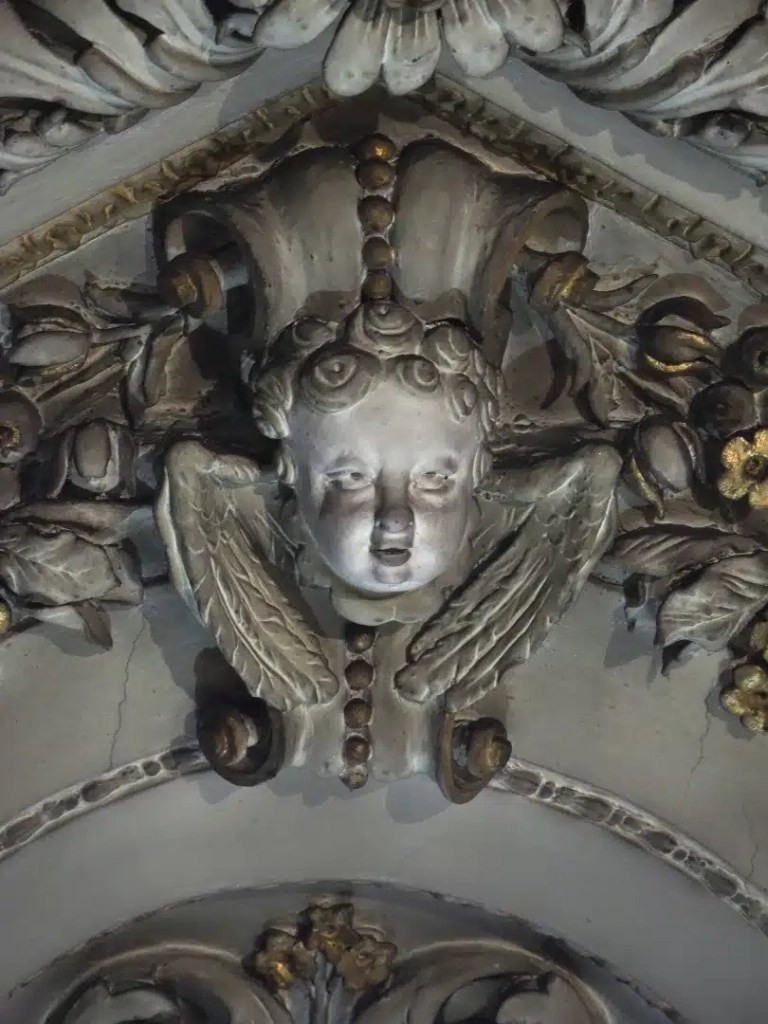
…. and Chiswick House.

Could the cherubs be the Stuart line stretching out till the end of time?
The cherubs round the ‘eye’ at St. Mary le Strand have grotesque faces…..
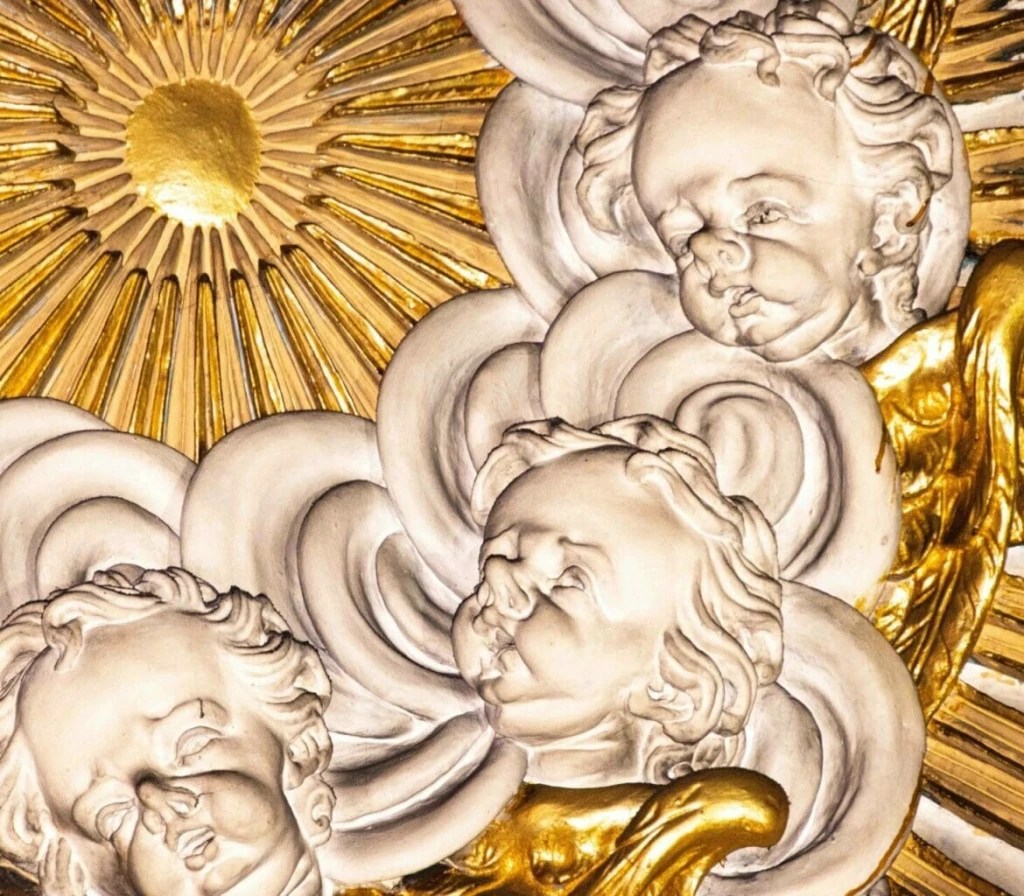
……and look very much like ‘Pig Snout’ – King George I

Did Gibbs see the Eye of Providence at Santa Maria Maggiore?
And did he recreate a version of it in St. Mary le Strand?
Partly to celebrate it – and partly to send up the Hanoverians?
Your Cat might find some of the answers to these questions in September. Andreas Raub will publish the book that he has edited – ‘The Basilica of Santa Maria Maggiore’ – over 400 pages long and with many contributors.
You Cat has requested that the London Library purchase it….
When she has read it she’ll hot-foot it to her desk at the Code…
‘Bye, now!

 The Shakespeare Code
Leave a comment