Despite appearances to the contrary……

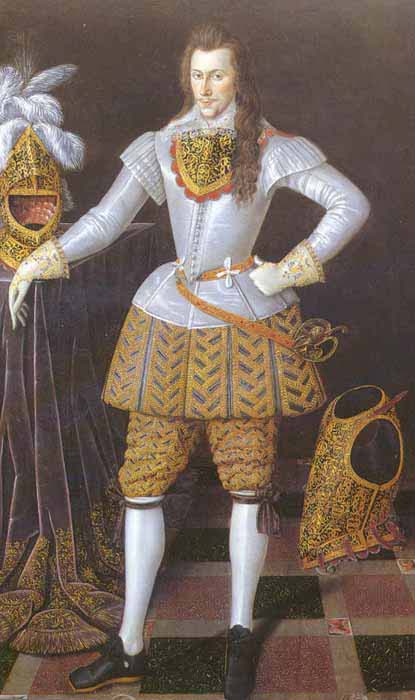
……Henry Wriothesley, the Third Earl of Southampton….
……or ‘Harry Southampton’ as he liked to be known…..
……wasn’t EXCLUSIVELY gay at all!!!
He fell deeply in love with one of Queen Elizabeth’s Ladies-in-Waiting, Elizabeth Vernon…

…..who many in Titchfield believe was the original of Juliet in Romeo and Juliet….

After a stormy, erotic courtship (Elizabeth was pregnant when Harry married her) the couple produced two daughters in the reign of Queen Elizabeth…
…..and then two sons in the reign of King James….
They also enjoyed a loving, intimate relationship…..
When Harry was fighting Ireland in 1599, a pregnant Elizabeth wrote to him:
My dear Lord and only joy of my life…I am severed from you whom I do, and ever will, most infinitely and truly love…I most infinitely long for you, my dear and only joy. I beseech you, love forever most faithfully me, that everlastingly will remain your faithful and obedient wife.
Elizabeth also asked Harry for ‘a stringer of scarlet’ to keep her body warm when she rode and said:
I send you word I grow bigger and bigger every day….
But heterosexuality had come late in the day to Harry…..
As a teenager, he had shown no interest at all in women……
His father, the Second Earl of Southampton, had snatched him away from his mother, Mary, when he was six.
He had accused his wife of adultery with ‘a common person’, made his manservant ‘his wife’, and surrounded his son with an exclusively male entourage of…..
Tall goodly fellows that kept a constant pace….
He died two years later; but had posioned his son’s mind against his mother…..
….and against women in general.
The last thing teenage Harry wanted to do was marry one…
This spelt disaster for Countess Mary….

It would mean….
1. The Southampton family line would die out…..
2. The family would have to pay an enormous £5,000 fine – £2-and-a-half million in today’s money….
Harry, after his father’s death, had become a Ward of Queen Elizabeth’s Treasurer, Lord Burghley……

He had educated Harry at his own home with his own children….
And had kept a strict eye on him when he went to Cambridge…
As Harry approached his majority, Burghley thought his own grand-daughter, Elizabeth de Vere, would make a splendid Protestant match for the stubbornly Catholic lad….

Harry disagreed…..
So Burghley, who had the legal right to insist on the marriage, threatened to fine Harry when he came of age…
Countess Mary and his maternal grandfather, Lord Montague……

…….did everything to persuade him…..
To no avail….
In desperation, Countess Mary called on the services of Harry’s tutor, William Shakespeare…..
(To discover how Shakespeare came to be at Titchfield, please read: Shakespeare the Movie. I.)
Mary commissioned Shakespeare to write seventeen sonnets for Harry’s seventeenth birthday. Their purpose was to convince Harry to marry…
Shakespeare knew that Harry was……
fond on praise….
……so he flattered him by calling him….
beauty’s rose…
…….a play on the Wriothesley name, which the aristocratic branch of the family pronounced…..
Ryosely…..
……suggesting the Southampton rose…..

However, Shakespeare warns Harry that his good looks are doomed to fade….
And that his….
youth’s proud livery, so gazed on now,
Will be a tattered weed of small worth held….
Harry, Shakespeare argues, would do well to impregnate a woman. His son would then remind the world how beautiful his father had once been….
After all, Harry’s own mother, Mary, uses her son as a ‘glass’ in which she…
Calls back the lovely April of her prime….
Shakespeare reprimands Harry for indulging in wasteful masturbation…..
Unthrifty loveliness, why dost thou spend
Upon thyself thy beauty’s leagacy…. [money=semen. See The Shakespeare Code.]
Harry’s masturbation is not only wasteful: it is excessive as well….
Then beauteous niggard, why dost thou abuse
The bounteous largesse [large penis and sex drive] given thee to give?
Profitless usurer, why dost thou use
So great a sum of sums [masturbate excessively] yet canst not live?
Shakespeare warns Harry that, without children, he will end up as friendless and despised as Queen Elizabeth herself.
It is only people like her….
Harsh, featureless and rude….

…..who should…..
barrenly perish…..
But Shakespeare’s heart was not in his commission…
The fact that he dwells on Harry’s ‘self-abuse’ shows Shakespeare had a sexual interest in the young man himself….
And, quite against the Countess’s brief, he suggests another way to gain immortality apart from procreation…..
Allow yourself to be the subject of my verse – that way you will live for ever…..
…..because my verse will live for ever…..
As Time takes away from Harry, Shakespeare’s writing will…..
ingraft [him] new…
And even if Harry does succeed in impregnating a woman, the foetus will be like distilled perfume –
a liquid prisoner pent in walls of glass…..
…..not an image of warmth or attraction….
Marriage and fatherhood had not brought happiness to Shakespeare.
So why should they to Harry?
●
Shakespeare makes his true feelings for Harry known in the ravishing Sonnet 18:

Here Shakespeare claims that Harry’s beauty surpasses that of Nature itself….
He won’t, like other, lesser poets, compare Harry to a summer’s day….
Even a summer’s day has its imperfections: Harry has none….
But Shakespeare is still eager to keep his relationship with Harry platonic…
Even if Harry isn’t…
Shakespeare didn’t want to upset Mother Mary, the source of his livelihood, his commissions and his flashy clothes….

So in Sonnet 20 he claims that ‘Dame Nature’ – who has created Harry…..
the master-mistress of [his] passion…..
….originally intended him to be a girl…..
….but as she created him, she fell in love with him…..
Rather like the sculptor Pygmalion fell in love with Galatea, the statue he is carving….

So Nature…..
….by addition me of thee [Harry] defeated
By adding one thing to my purpose nothing…..
What this ‘one thing’ is Shakespeare makes blindingly clear in the concluding couplet….
But since she prick’d thee out for women’s pleasure,
Mine be thy love, and they love’s use their treasure….
Shakespeare is employing all sorts of ambiguities here….
me of thee defeated…..
….can mean….
she stopped me achieving [possessing] you…
…..or….
she stopped you achieving me….
This implies that their love, if it were allowed to be expressed, would be mutual….
Dame Nature, for her own ends, has given the girl/boy a penis which she intends her/him to use to penetrate her for her ‘pleasure’.
Harry’s penis, Shakespeare insists, has been put there for heterosexual activity alone…..
BUT – this penis remains an ‘artificial’ addition…..
There is a prototype woman lurking beneath the surface of Harry that can both seduce, and be seduced by, Shakespeare….
In Sonnet 53 Shakespeare even confesses that when anyone describes Helen of Troy, he immediately thinks of Harry…..
in Grecian tires……painted new….
…..in other words, Harry in drag….
●
In the meantime, Shakespeare fell in love with The Dark Lady, Emilia Bassano, the young mistress of old Lord Hunsdon…..

She had visited Titchfield to provide music for one of Queen Elizabeth’s Progresses….
…..and had stayed on.
Emilia ‘played hard to get’ with Shakespeare as she did with everyone else. Shakespeare, in what he was later to label in Sonnet 134 as his….
unkind abuse….
…..sent Harry to plead his love case.
Emilia pounced.
A handsome young aristocrat, however gay, was better than an aging playwright who was losing his hair…

And Harry could get his revenge on an unreponsive Shakespeare by….
wilful taste….. [perverse indulgence]
of what his….
self refuseth….. [natural inclinations decline i.e, women].
Harry’s affair with the Dark Lady plunged Shakespeare into despair. He left Titchfield to go on tour with Lord Strange’s Men in the late summer of 1592. But he kept up a sonnet correspondence with Harry and finally admitted to him in Sonnet 42…..
That thou hast her is not all my grief
And yet it may be said I loved her dearly
That she hath thee is of my wailing chief
A loss in love that touches me more nearly….
Shakespeare returned to Titchfield and began a full-blown affair with Harry.
Countess Mary heard of this and questioned Shakepeare about it…..
Shakespeare confessed to her that….
Here, upon my knee, before high heaven and you,
That before you and next unto high heaven
I love your son….
He was later to put these words into the mouth of Helena in his autobiographical Alls Well that Ends Well….
Mary, as we know, had herself fallen in love with a common person when she was a young bride: so she sympathised with another ‘unconventional’ relationship.
Shakespeare’s affair with Harry was to last for a dozen years: but it was never plain sailing. Both were highly sexed, ambitious men….
…..and fidelity was never at the forefront of either of their minds…
Shakespeare, as an actor on tour, making himself…..
a motley to the view……
……was beset with sexual temptations….
When, Harry at one point, accuses Shakespeare of having an affair, Shakespeare excuses himself by saying that it gave his…
heart another youth….[i.e. made him feel young again]….
….and that….
worse essaies prov’d thee my best of love….. [i.e. by being unfaithful, and comparing you with other people, it showed me just how great you are. Sonnet 110]
Shakespeare asks Harry to forgive him and ‘welcome’ him to his ….
….pure and most most loving breast…..
But there is even an ambiguity in ‘most most’ loving breast.
It can be a romantic repitition of ‘most’….
Or it can imply that Harry has had hordes of lovers.
Certainly Shakespeare calls on Harry’s promiscuity to defend his own unfaithfulness in Sonnet 120.
He states….
That you were once unkind [unfaithful] befriends me now….
…and recalls how he then….
passed a hell of time….
…..which was relieved when Harry…
tendered
the humble salve which wounded bosom fits…[i.e. made love to him]
In Sonnet 61 Shakespeare even imagines that, in his absence, Harry is indulging in orgies….
For thee I watch, whilst thou dost wake elsewhere,
From me far off, with others all too near…
Harry might have woken up in his own four-poster bed with aristocratic lovers….
His close companions, the Danvers brothers, remained unmarried all their lives….
And even the Earl of Essex , Harry’s friend and hero…..

…..had a gay side….
He had a private bath-house in the Strand and was exposed by his own doctor (in a fatal moment of drunken indiscretion) as being a passive homosexual….
[Read Martin Green’s brilliant book, Wriothesley’s Roses. And see Martin Green’s endorsement of The Shakespeare Code’]
But the odds are Harry would wake up in low dives.
Like his mother, he had a penchant for lower class men…
Shakespeare claims, early on in their affair, that Harry was
but one hour mine’
…..because, like the Sun who will
permit the basest clouds to rise
With ugly rack on his celestial face…
….so Harry will allow
the region cloud…
…to ‘mask’ him from Shakespeare.
‘Baseness’ always implied lower class people for the Elizabethans.
It also suggested lower class homosexuals….
In Sonnet 48, Shakespeare bemoans the fact that, though he has locked up all his possessions when he goes away on tour, his most precious possession, Harry, he has….
left the prey to every vulgar thief…[common homsexual]
…..because he has not ‘locked up’ Harry ‘in any chest’…..
Or, indeed, any closet…
Harry’s promiscuity makes Shakespeare jealous: it also terrifies him.
Southampton’s enemies could use Harry’s sex-life as a weaspon against him.
The English have never taken umbrage at homosexual activity amongst male aristocrats……
Witness the popularity of the television version of Brideshead Revisited….

Given that aristocrats all went to single sex boarding schools, read the Classical Greek poets and were birched by bachelor schoolmasters, homosexuality was almost a given among the upper orders….
What used to upset everyone was when sex crossed borders of class….
It wasn’t the fact that Oscar Wilde had an affair with Lord Alfred Douglas that angered people……

……it was the fact he had sex with working class ‘Telegram Boys’ in private rooms….
……in expensive restaurants…
…..to which they had no right….
Even in the twentieth century, when Harry’s descendant, Lord Montague of Beaulieu, was in the dock, the Prosecution’s main charge was that he had ‘groomed’ common soldiers and plied them with champagne!
Officers would have been quite a different matter….
Shakespeare in Sonnet 94 warns Harry about the consequences of his promiscuity….
He uses the word ‘hurt’ the way Geoffrey Chaucr does in The Knight’s Tale ‘to arouse others sexually’…..
They that have power to hurt and will do none…
The whole poem is, in fact, in praise of chastity….
It even praises masturbation!
At least it can be a solitary act….
The summer’s flower is to the summer sweet,
Though to itself it only love and die…[die=orgasm. See, again, The Shakespeare Code.]
But the poem goes on to warn Harry about the consequences of sleeping with lower class boys….
But if that flower with base infection meet,
The basest weed outbraves his dignity….
‘Base infection’ here suggests the moral contamination of mixing with plebeians and the resulting venereal disease.
The concluding couplet…..
For sweetest things turn sourest by their deeds
Lilies that fester smell far worse than weeds
….is a startling image both of a diseased penis and a ruined reputation.
In Sonnet 69 Shakespeare admits that everyone admires Harry’s beauty….
but he warns Harry that those same people will…
..look into the beauty of thy mind
And that, in guess they measure by thy deeds,
Then churls, their thoughts (although their eyes were kind)
To thy fair flower add the rank smell of weeds….
And the reason why….
thy odour matcheth not thy show
The soil is this, that thou dost common grow….
The consequence of this is LOSS OF POLITICAL POWER…
If some suspect of ill maskt not thy show
Then thou alone kingdoms of hearts shouldst owe….(Sonnet 70)
●
Shakespeare was the first to admit he often got his predictions wrong….
In Sonnet 107 he admits, in code, that he thought Harry would never get out of the Tower of London alive and that civil war would follow the death of Queen Elizabeth….
See: The Earl of Southampton and Trixie the Cat.
But on the political consequences of Harry’s promiscuity, he was completely correct….
When Harry was tried for High Treason for his part in the Essex rebellion against Elizabeth, a letter was produced against him….
Dated 13th February, 1601 it was from William Reynolds (probably brother of Essex’s secretary, Edward Reynolds) who….
marvelled what had become of Piers Edmonds, the Earl of Essex’s man, born in the Strand near me, who had many preferements by the Earl. His villainy I have often complained of. He was Corporal General of the Horse inIreland under the Earl of Southampton. He ate and drank at his table and lay in his tent. The Earl of Southampton gave him a horse which Edmunds refused a hundred marks for him, the Earl of Southampton would cole and huge [embrace and hug] him in his arms and play wantonly with him.
Edmonds was also known to the Earl of Essex: he was….
so favoured as he often rode in a coach with him, and was wholly of his charges maintained, being a man of base birth in St. Clement’s Parish….
Riding in a coach, for a man, was thought to be effeminate it itself. To ride in a coach with another man was practically a proclamation of homosexuality….
In April, 1594, Lady Anne Bacon had complained to her gay son, Anthony, that his equally gay brother, Francis…
keepeth that Bloody Perez [a notorious Spanish homosexual] as I told him then, yea as a coach companion, and bed companion, a proud, profane costly fellow, whose being about him I verily fear the Lord God doth mislike….
Reynolds had been described as ‘distracted’ by Lord Burghley when, in 1593, he had written to the Queen about Shakespeare’s Venus and Adonis.
But Reynold’s belief that Venus in the poem represented Queen Elizabeth….
….. and his analysis of the poem’s imagery….
much ado of red and white
…..would be endorsed by many modern scholars…..
….if not his belief that the Queen was in love with him!
Also, Martin Green has found details of many payments paid out by Gilly Merrick (Essex’s man) to ‘Capt. P. Edmonde’ between 1599 and 1600…..
Luckily for both Harry and Shakespeare, Elizabeth died in 1603 and King James, who succeeded her, was gay-friendly….
In fact, so gay friendly that everyone thought Harry would become the King’s new favourite.
As Anthony Weldon wrote in 1603:
And now doth the king return to Windsor, where there was an apparition of Southampton being a favourite to His Majesty, by that privacy and dearness presented to the court view, but Salisbury, not liking that any of Essex his faction should come into play, made that apparition as it were in transitu, and so vanished, but putting some jealousy, that he did not much desire to be in the Queen’s company, yet love and regularity must admit of no partnership.
Indeed, it is the view of The Shakespeare Code that the famous painting of Harry in the Tower……

……is a wooing portrait that Harry sent to the King….
…..along with a couple of Shakespeare Sonnets praising Harry’s beauty…..
See, again: The Earl of Southampton and Trixie the Cat.
But James preferrred younger, prettier men……
…..so Harry was out of the loop…..
…..and began to grow bitterly homophobic…..
When his wife Elizabeth produced his first, longed for son in 1605……
…..he dropped Shakespeare the actor.
He didn’t want his son to know just how gay his father had once been….
(For an analysis of Sonnet 126 – Shakespeare’s response to his rejection by Harry – please see:
‘Shakespeare’s Sonnet 126 Decoded.’
…..and….
Shakespeare, Love and Religion. Part Three.)
Read Full Post »












 The Shakespeare Code