Feeds:
Posts
Comments

Archive for 2011

Simon Callow, the great actor, writer, biographer, raconteur and Gladiator for Truth, writes:

I have read your blog. I entirely accept the Titchfield connection with Shakespeare and equally buy your association of Beeston with Falstaff. I much enjoyed Love’s Labour’s Found. Warmest and best.

Warmest and best to you, Simon.  And thanks.

Mr. Callow’s name has been inscribed in The Shakespeare Code’s ROLL OF HONOUR.

Read Full Post »

Maggie Ollerenshaw, celebrated actress, author and wit, renowned for her portrayal of ‘Wavy Mavis’ in Open All Hours, writes to Shakespeare Code Agent, Karen Little, about the Shakespeare blog:

Fascinating! And I’ve only got as far as reading Stewart’s biography.

The biography, (click at the top of the Home Page) will gradually evolve….

Miss Ollerenshaw’s name has been inscribed in The Shakespeare Code’s ROLL OF HONOUR.

Read Full Post »

Greg Doran, Chief Associate Director of the Royal Shakespeare Company  and described by the Sunday Times as ‘one of the great Shakespeareans of his generation’, writes of Love’s Labour’s Found:

The book is exquisite. Thank you.

Mr. Doran’s name has been inscribed in The Shakespeare Code’s ROLL OF HONOUR.

Read Full Post »

Jane Howell, doyenne director of Shakespeare for stage and television (her production of the Henry VI trilogy for the B.B.C. is legendary) writes about Love’s Labour’s Found, the basis for The Shakespeare Code:

It’s got such verve, excitement and gusto in it. It just races along and pulls you with it. It’s light, exciting, fascinating and interesting. You somehow get soaked up into the life of those times. It’s a wonderful piece of work. I hope it gets people stirred up and arguing. It’s brilliant!

The Shakespeare Code will quote extensively from  Love’s Labour’s Found, updating it as the new theories evolve.

Miss Howell’s name has been inscribed in The Shakespeare Code’s ROLL OF HONOUR


Read Full Post »

Nicholas Hytner, radical, scintillating, Director of the Royal National Theatre, writes:

Your theory is fascinating and seductive. It rings of truth. I never understand those who say they are uninterested in Shakespeare’s life; the creation of life for the writer of the playsseems an emotional necessity to me. Yours moves me and convinces me. I hope you have a huge success.

Sir Nicholas’s name has been inscribed in The Shakespeare Code’s ROLL OF HONOUR

Read Full Post »

Melvyn Bragg, brilliant novelist, philosopher, cultural commentator and Chief Guardian of Intellectual Life in Britain, writes:

What great ideas! Wonderfully interesting! Intriguing! Watch out Stratford-upon-Avon!

Lord Bragg’s name has been included in The Shakespeare Code’s ROLL OF HONOUR.

Read Full Post »

Shakespeare’s Curious Knotted Garden.

 At the beginning of Shakespeare’s early comedy, Love’s Labour’s Lost, Don Adriano de Armado, a fantastical Spaniard, writes an outraged letter to the King of Navarre. Costard, the swain, and Jacquenetta the country wench have been copulating in the King’s own Park!

The Place where? It standeth north-north-east and by east from the west corner of thy curious knotted garden

Later the Princess of France, visiting the King on state business, asks:

Was that the King that spurr’d his horse so hard

Against the steep-uprising of the hill?

I have directed Love’s Labour’s Lost twice, once in Clare College gardens as an undergraduate and once as Artistic Director of the Northcott Theatre in Devon.

Both times I had the feeling that Shakespeare was writing about a real place.

But where?

Shakespeare dedicated his poems Venus and Adonis and The Rape of Lucrece to Henry Wriothesley (‘Harry Southampton’ as he liked to be known) the young third Earl of Southampton and Baron of Titchfield. The obvious place to start was his country estate, if it was still there. I phoned the Hampshire Tourist Board:

Yes, the ruins of Titchfield Abbey were still standing, but no, there was no garden. The locals burn an effigy of the third Earl each year because he built a sea-wall which cut off the sea. They also believe that Shakespeare wrote Romeo and Juliet at Titchfield – a lot of nonsense of course.

That was enough for me to pack a picnic hamper and persuade my teenage daughter Amy that a Whitsun outing to Titchfield Abbey was worth it.

Amy Trotter as she is now...

Secretly I feared we would find a super-market car-park. On the train down to the South Coast we skimmed the tourist bumph:

In 1232, Henry III granted the estate of Titchfield to the Premonstratensions, a French, white robed order of monks. Because ships at that time could sail right round the Isle of Wight and right up to Titchfield Harbour, it became an important embarkation point for France. Henry V stayed there in 1415 before setting off with his army for Agincourt and Henry VI married Margaret of Anjou in the Abbey Church in 1445. On his break with Rome, Henry VIII dissolved the monastery in 1537 and gave it to Thomas Wriothesley (1505-1550), later first Earl of Southampton, who converted it into a ‘right stately house’ called The Place. The second Earl, his son, a ‘fanatical papist’, was imprisoned in Tower of London for trying to overthrow Queen Elizabeth. The third Earl (1545-1581), his son, also an ardent Catholic in his youth, was patron to several writers, including William Shakespeare. He also was imprisoned for rebelling against the Queen, but freed in the reign of James VI and I. The line died out with the fourth Earl.

The taxi from Fareham swung past the The Mill Pub – built on the remains of an old cornmill – and into the magnificent ruins of the Abbey.

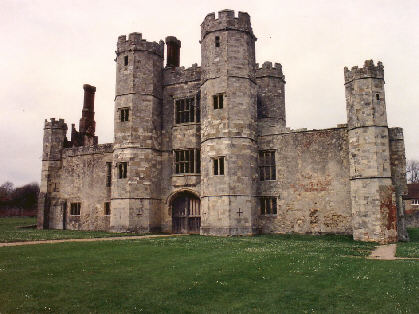
Titchfield Abbey, Hampshire.

True, there was no garden, but I looked down in amazement at an overgrown, sunken patch of ground, grass waist high, that would have once made a perfect knot garden, that geometrical Tudor creation of interwoven flower beds. A beaten path through a garden led to a picnic table that seemed to be waiting for us.

I climbed into a stunted apple tree and, to my daughter’s embarrassment, declaimed some lines from the play:

Like a demi-God, here sit I in the sky,

And wretched fools’ secrets heedfully o’er-eye.

More sacks to the Mill! O heavens I have my wish

Dumaine transformed: four woodcocks in a dish

‘More sacks to the Mill!’

 Could that be the Mill we had just passed in the taxi?

The Mill Pub, Titchfield

I turned to songs of Spring and Winter that end the play. Could all the people mentioned, Tom, who bears logs into the Hall, Dick, the Shepherd who blows his nail, Marian whose nose looks red and raw and Greasy Joan who keels the pot all be people who once lived and worked in this great household?

I noticed a line in the Spring Song: And Maidens bleach their Summer Smocks. The night before  our Titchfield trip, Amy had spilt coffee over her dress. It had spent the night in very non-Tudor bleach. The spirits of the household seemed to be laughing with us.

Not sure if I was in 1590’s or the present, in a garden or a set, in life or in a play, I packed the picnic hamper. As we were leaving, something made me turn round.

There, beyond the garden wall, was the steep up-rising of the hill…

 An extract from Love’s Labour’s Found.

If you are new to this blog,  start with Shakespeare, Love and Religion

 a three part overview of the life and work of Shakespeare, posted earlier.

Read Full Post »
Alan Samson, the distinguished Editor at Weidenfeld and Nicolson, writes about the article The Strange Case of Mr. Apis Lapis:

I enjoyed your speculation about who Mr. Apis Lapis must have been. The article is (as ever) well-written and concerns the intersection of the actual and the possible. I find it ‘playful’ in the best sense, and, as a literary mystery, esoteric. There is something about it that is very attractive indeed.

And from the desk of the world’s premiere literary journal, the Review of English Studies:

The article is full of interesting and thought-provoking material.

If you are new to the blog, start  with Shakespeare, Love and Religion,  a three part chronological overview of the life and work of Shakespeare.

Mr. Samson’s name has been included in The Shakespeare Code’s ROLL OF HONOUR.

Read Full Post »

The eminent Shakespeare Scholar, Martin Green, writes to me about The Shakespeare Code:

Everyone who writes about Shakespeare has the need to fill in, in some reasonable way, the great gaps in our knowledge of Shakespeare’s personal and professional life and reasonable surmises filling in the gaps are entitled to consideration so long as they are presented as surmises. But your interpretations of various passages in Shakespeare’s plays and poems struck me as being not surmises but, for the most part, extraordinarily acute insights…..I am very, very impressed. 

(Martin Green is the author of  The Labyrinth of the Sonnets and Wriothesley’s Roses)

Mr. Green’s name has been inscribed in The Shakespeare Code’s ROLL OF HONOUR.

If you are new to this blog, I would recommend starting with Shakespeare, Love and Religion, three talks I gave at the Grosvenor Chapel in Mayfair, London, W.1. They give a chronological overview of the life and work of Shakespeare.

Read Full Post »

Why Falstaff is Fat.

Why is Falstaff fat? 

Neither the historical Falstaff, nor Oldcastle, as the character was first named, was ever charged with obesity.

The Shakespeare Code’s Chief Agent, Stewart Trotter, has found solid evidence that Shakespeare based the character of the fat knight on a fat Titchfield man.

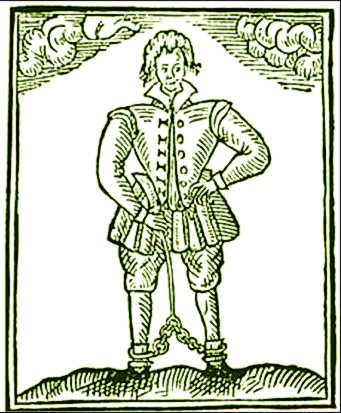
 Thomas Nashe, a pamphleteer and essayist (who was accused of calling William Shakespeare an ‘upstart crow’) dedicated his pamphlet Strange News to a mysterious Master William Apis Lapis…..

Tom Nashe

Scholars have unanimously taken this as a Latin code. Apis is bee, Lapis is stone, so William Apis Lapis is, in reality, William Beeston. We know he was fat, we know he loved sex and we know he loved to eat and drink. But who was he?

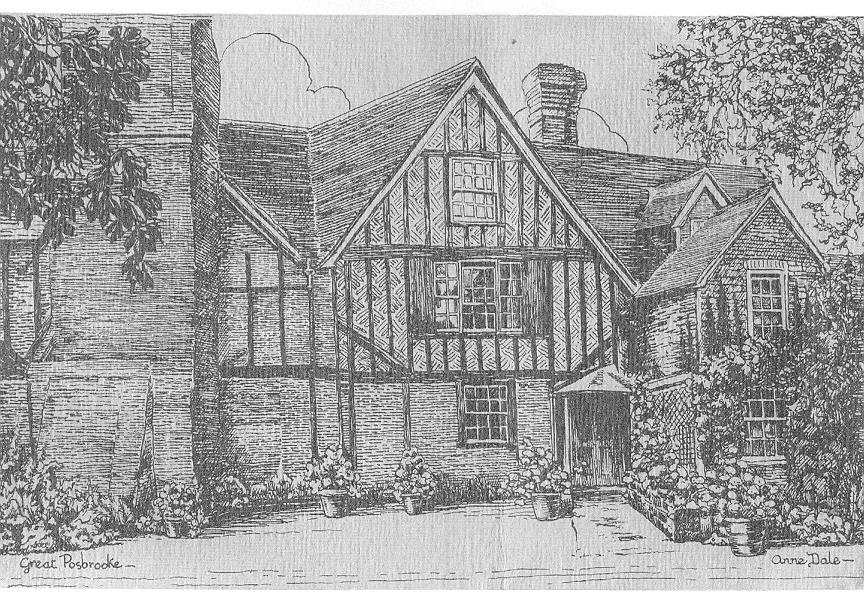
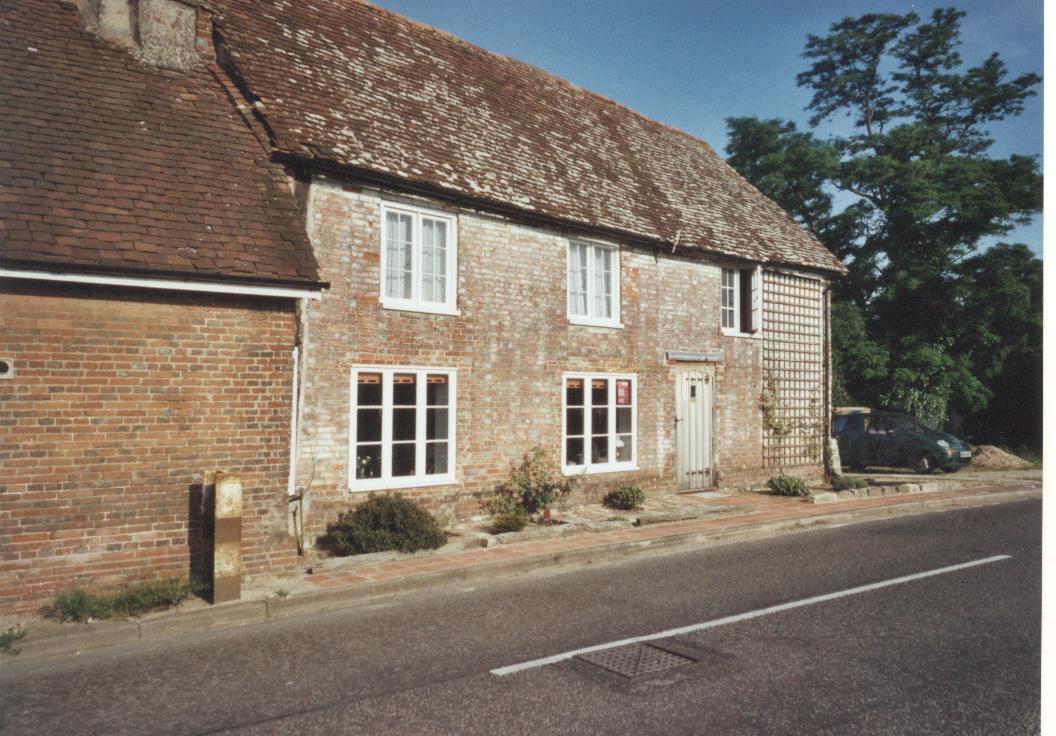
Chief Agent Trotter has found the answer!  William Beeston lived in Titchfield. To be more precise, at Great Posbrook Farm…..

He was an intimate friend of the Southampton family so must have known William Shakespeare.

Beeston, a purveyor of wine and cider, counted among his clients (as well as Nashe) the writers Robert Green and George Peele. At Shakespeare’s request, he hid them away, with maids and alcohol to hand, at Posbrook Farm where they produced ‘Shakespeare’s’ cycle of Henry VI plays.

 No wonder Nashe accused Shakespeare of ‘beautifying’ himself with other bird’s ‘feathers’.

William Beeston had an illegitimate son called Christopher who later became an actor in Shakespeare’s company.

We know that the Titchfield William Beeston was related to Christopher Beeston because of the dates of their wills. Christopher wrote his will on 4th October 1638 (with a codicil on 7th October) and William wrote his on 9th October, 1638.

THERE IS ONLY FIVE DAY’S DIFFERENCE BETWEEN THE WILLS!!!

Christopher, in turn, had a son he called William.  It was this William Beeston who told John Aubrey that Shakespeare had been a schoolmaster in the country.

He meant Titchfield where the school still stands at the gates of Place House.

He also told Aubrey that Shakespeare based his characters on living people. Nashe and Shakepeare between them transformed fat William Beeston of Titchfield, Hampshire, into ‘Plump Jack’ of ‘all the world’.

 And they took Falstaff’s advocacy of wine from the lips of vintner Beeston himself.

Read the whole story in: The Strange Case of Mr. Apis Lapis.

Read Full Post »

« Newer Posts - Older Posts »